wayground logo

Free Printable Worksheets

Font size

S
M
L
XL
Worksheets

Particles Fluids and Pressure KS3

Total questions: 42

Worksheet time: 21mins

Name
Class
Date
1.
What do we call the the amount of force exerted on a certain area?
a)
fluid
b)
pressure
c)
buoyant
2.
This is a measurement of the amount of matter, or 'stuff', in an object or substance.
a)
volume
b)
density
c)
mass
d)
length
3.
In what direction(s) does air exert pressure?
a)
everywhere
b)
no where
c)
there is no pressure
d)
downward
4.

Solids have...

a)

a fixed shape and a fixed volume

b)

a fixed shape but can change volume

c)

No fixed shape but a fixed volume

d)

no fixed shape or volume

5.
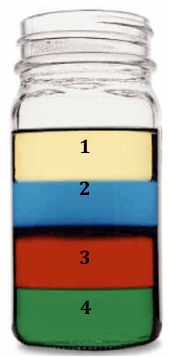
Put the liquids in order from most dense to least dense?
a)
4, 3, 2, 1
b)
1, 2, 3, 4
c)
3, 4, 2, 1, 
d)
4, 3, 1, 2
6.

Which state of matter can be compressed easily?

a)

solid

b)

liquid

c)

gas

d)

all of them

7.

Which TWO things will not increase the pressure of a gas?

a)

adding more particles

b)

cooling particles

c)

heating the particles up

d)

Making a stretchy container

8.

The melting point of gold is 1063 oC. What process happens to gold when liquid gold changes state to solid gold?

a)

Evaporation

b)

Melting

c)

Freezing

d)

Condensation

9.
What am I? I have a fixed mass, a fixed volume, I cannot be squashed and I have a shape that changes to fit the bottom of my container?
a)
solid
b)
liquid
c)
gas
d)
plasma
10.

For what reason do liquids flow so easily?

Because the particles.....

a)

are so tightly compacted to one another.

b)

can slide past one another.

c)

vibrate with one another.

d)

are so far apart from one another.

11.

Why does the liquid inside a thermometer rise?


When the thermometer heats up, the liquid inside ...... because the particles move about ........

a)

expands, less quickly

b)

expands, more quickly

c)

contracts, less quickly

d)

contracts, more quickly

12.

Fluids exert pressure because they

a)

contain force particles

b)

are confined to small area

c)

have constantly moving particles

d)

all of these are correct

13.
Where is pressure the greatest on the dam?
a)
D
b)
C
c)
B
d)
A
14.

Which of the following factors affect the pressure at the bottom of a container of liquid?

a)

depth of the container

b)

width of the container

c)

temperature of liquid

d)

color of liquid

15.
What happens to pressure as you go deeper under water?
a)
it increases
b)
it decreases
c)
it stays the some
d)
no soup for you!
16.
What is the formula for density?
a)
density = mass x volume
b)
density = mass / volume
c)
density = mass + volume
d)
density = mass - volume
17.
Frank has an eraser. It has a mass of 4g, and a volume of 2cm3. What is its density?
a)
8 g/cm3
b)
2 g/cm3
c)
1/2 g/cm3
d)
24 g/cm3
18.
Jack has a rock. The rock has a mass of 14g and a volume of 2cm3. What is the density of the rock?
a)
7 mL
b)
7 g/cm3
c)
28 g/cm3
d)
1/7 g/cm3
19.
What is the volume of Object X?
a)
10.0 cm3
b)
15.0 cm3
c)
20.0 cm3
d)
25.0 cm3
20.
Why do some substances float on water?
a)
they are warmer than water
b)
they are cooler than water
c)
they are more dense than water
d)
they are less dense than water
21.
Helium balloons rise on earth because
a)
helium is less dense than air
b)
helium is more dense than air
c)
helium is cooler than air
d)
helium is warmer than air
22.
What is the measuring unit for mass?
a)
centimeter 
b)
millimeter 
c)
grams 
d)
pounds
23.
What units are used to measure Density?
a)
cm3/g
b)
g
c)
g/cm3
d)
cm3
24.

What is the formula for Mass?

a)

Mass/Volume

b)

Density x Volume

c)

Mass/Density

25.

What is the formula for Volume?

a)

Mass/Volume

b)

Density x Volume

c)

Mass/Density

26.
What is the volume of the fish?
a)
18.0 cm3
b)
6.0 cm
c)
38.0 cm3
27.
Which box has a higher density?  
a)
Box A
b)
Box B
c)
cannot be determined
d)
they are the same
28.
Why do ice cubes float in a  glass of water?
a)
the ice cubes are more dense than the water
b)
the water is more dense than the ice cubes
c)
the water is more dense than the glass
d)
the ice is more dense than the glass
29.

Density is the amount of ________ per unit of volume

a)

gravity

b)

mass

c)

motion

30.
What is Pitch?
a)
How loud or soft a sound is
b)
muscle that holds vocal cords
c)
movement back and forth
d)
how high or low a sound is
31.
What is volume?
a)
How high or low a sounds is
b)
reflected sound that comes back and is repeated
c)
how loud or soft sound is
d)
movement back and forth
32.
The rate in which sound waves occur is?
a)
vibration
b)
echo
c)
frequency
33.
What happens when we hear an echo?
a)
We know there is danger
b)
there must be someone yelling back to us
c)
Sound is reflected off a surface and repeated back
d)
sounds waves are traveling really fast
34.
A wave in which the vibration is in the same direction as that in which the wave is traveling; sound waves
a)
longitudinal wave
b)
ocean wave
c)
transverse wave
d)
mechanical wave
35.
Highest point of a wave
a)
crest
b)
trough
c)
wavelength
d)
frequency
36.

The diagram shows a cartoon of a sound wave produced while a student is speaking.


What happens to the sound wave when the student speaks louder?

a)

The amplitude increases

b)

the wavelength will double

c)

the speed will increase

d)

the amplitude will decrease

37.
High Amplitude =__________________
a)
Louder sounds
b)
Quieter Sounds
38.
Low Amplitude = ______________
a)
Quieter Sounds
b)
Louder sounds
39.
Low frequency = _______ Pitch
a)
Low
b)
High
40.
In General Sound waves travel the slowest in __________
a)
solid
b)
liquid
c)
Gas
d)
Plasma
41.
Material that allows light to pass through allowing you to see "clearly" to the other side
a)
opaque
b)
translucent
c)
transparent
42.

High frequency equals

a)

high energy

b)

low energy

c)

no change in energy

d)

none of the above