
 Worksheets
Origin of life
Total questions: 12
Worksheet time: 19mins
Name
Class
Date
1.
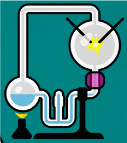
This experiment was conducted by the scientists:
a)
Stanley Miller and Harold Urey
b)
Harold Urey and Albert Einstein
c)
Louis Pasteur and Francesco Redi
d)
James Watson and Francis Crick
2.

Which question were the scientists trying to answer with this experiment?
a)
Where do cells come from?
b)
How did prokaryotes form cell membranes?
c)
How are biomolecules formed?
d)
What gave rise to the Eukaryotic cell?
3.
The apparatus in the experiment was used to mimic what?
a)
Proteins
b)
Present Earth conditions
c)
Early Earth conditions
d)
Nucleic acids (DNA/RNA)
4.
The electrical sparks mimicked?
a)
The Sun's energy
b)
Lightning
c)
Volcanic eruptions
d)
Cosmic radiation
5.
Miller/Urey and other scientists have shown that:
a)
Life on early Earth required material from space
b)
Cells survived in the primitive atmosphere
c)
Amino acids could be produced from inorganic molecules
d)
Simple cells can be produced in a laboratory
6.
Which type of cell came first?
a)
Eukaryotic
b)
Prokaryotic
c)
Plant
d)
Both Eukaryotic and Prokaryotic cells evolved around the same time
7.
The theory of Endosymbiosis explains...
a)
The origin of eukaryotes
b)
How species develop
c)
How bacteria evolved
d)
Why cells rely on one another
8.
RNA World Theory states that ...
a)
Life came from RNA
b)
Life came from life
c)
Life came from non living things
d)
Life came from outer space
9.

The diagram below shows a proposed theory of the origin of eukaryotic cells, called endosymbiosis.
Which of the following explains why cells that contained mitochondria-like organelles had an evolutionary advantage?
a)
They were able to photosynthesize
b)
They had more DNA
c)
They were able to make more use of available energy
d)
They were immune to bacterial invasion.
10.
What gas was necessary for complex (eukaryotic) life to evolve?
a)
Carbon dioxide
b)
Oxygen
c)
Dihydrogen monoxide
d)
Methane
11.
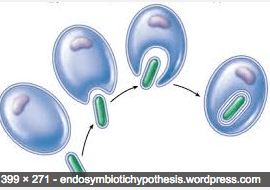
What process is shown within this diagram?
a)
Natural selection
b)
Endosymbiosis
c)
Chemical evolution
d)
Abiogenesis
12.
Endosymbiosis gave rise to
a)
golgi bodies
b)
chloroplasts and mitochondrea
c)
ribosomes and nuclei
d)
the rough and smooth endoplasmic reticulum
100 %

