

wayground logo

Free Printable Worksheets

NEW

Font size

S
M
L
XL
Worksheets

Schiavo Final Exam Earth Science

Total questions: 45

Worksheet time: 2hrs 59mins

Name
Class
Date
1.
Subsurface ocean currents continually circulate from the warm waters near the equator to the colder waters in other parts of the world. What is the main cause of these currents? 
a)
differences in the topography along the ocean floor 
b)
differences in density of ocean water 
c)
the rotation of Earth on its axis 
d)
movement of the jet stream 
2.
What is most responsible for the presence of groundwater in an area? 
a)
the movement of water from a confined aquifer into surface water 
b)
the movement of surface water and precipitation through soil and rock
c)
the movement of water from streams and rivers to watersheds
d)
the movement of surface water through impermeable rock 
3.
Which is the most common contamination source for freshwater resources? 
a)
runoff 
b)
digging wells
c)
melting of glaciers
d)
lightning
4.
Which layer of the soil profile would be affected the most by weathering and erosion?
a)
1
b)
2
c)
3
d)
4
5.
Which of the following isn’t a factor/force involved with erosion?
a)
gravity
b)
wind
c)
tension
d)
water
6.
One complete revolution of the Earth around the sun takes about
a)
one rotation
b)
half a year
c)
one year
d)
one season
7.
The Earth takes about __________________ hours to complete one rotation of its axis.  
a)
12
b)
24
c)
14
d)
28
8.
Name the phase of the moon for letter c
a)
New Moon
b)
Full Moon
c)
Waxing Crescent
d)
Waning Crescent
9.
When a hemisphere is pointed directly towards the Sun, what season will it be?
a)
Fall
b)
Winter
c)
Spring
d)
Summer
10.
Warm air moving north from the Gulf of Mexico is:
a)
continental tropical
b)
continental polar
c)
maritime tropical
d)
maritime polar
11.
____________ air rises because it is ____________dense.
a)
Cool, Less
b)
Warm, Less
c)
Cold, More
d)
Warm, More
12.
Click to read the question
a)
A
b)
B
c)
C
d)
D
13.
Wind is caused mainly by air-pressure differences that result from
a)
uneven heating of Earth's atmosphere
b)
absorption of ultraviolet radiation by Earth's land masses
c)
radiation of heat from Earth's land masses to water bodies
d)
rotation of Earth on its axis
14.
T8 - What two factors are primarily used to describe climate?
a)
temperature and density
b)
temperature and precipitation
c)
precipitation and density
d)
winds and humidity
15.
T8 - As altitude _____________ temperature ___________. 
a)
decreases, decreases
b)
increases, increases
c)
increases, decreases
d)
decreases, increases
16.

The rising of cold water from deeper layers to replace warmer surface water is called ____.

a)

the Coriolis effect

b)

a surface current

c)

upwelling

d)

reflection

17.
Ocean tides are primarily caused by 
a)
Earth's revolution around the sun
b)
The changing phases of the moon
c)
Gravitational attraction between the moon and the Earth
d)
Seasonal changes in the location of the sunrise
18.

The percentage of the total volume of rock or sediment that consists of pore spaces is called ____.

a)

permeability

b)

an aquifer

c)

the zone of saturation

d)

porosity

19.
Wind, water, and ice breaking down rock is called
a)
Erosion
b)
Deposition
c)
Compaction
d)
Weathering
20.

what is a soil profile?

a)

a picture of soil

b)

a cross section of soil exposed by digging

c)

analyzing what the soil is made of

d)

a growing zone for plants

21.

Acid rain and oxidation are examples of

a)

mechanical weathering

b)

chemical weathering

c)

erosion

d)

creep

22.

unloading, frost action, animals burrowing into the ground, plants by their roots, and ice wedging are examples of

a)

mechanical weathering

b)

chemical weathering

c)

erosion

d)

landforms

23.
The San Andreas fault formed due to a ___ boundary.
a)
transform
b)
convergent
c)
divergent
d)
subduction
24.

Which type of plate boundary would cause mountains to form?

a)

Transform

b)

Convergent

c)

Divergent

d)

Reform

25.
line of volcanic activity that surrounds the Pacific Ocean basin is the 
a)
Ring of Fire
b)
Aleutian Islands
c)
Hawaiian Islands
d)
Caribbean Islands
26.
The Great Rift Valley in Africa and the Mid-Ocean Ridge were all created by this boundary
a)
Divergent
b)
Convergent
c)
Reform
d)
Transform
27.
What does biodiversity mean?
a)
Only one species in an area.
b)
The different amount of species in an area
c)
All abiotic life
d)
Nitrogen fixation
28.
Which human activity would most likely deplete nonrenewable resources?
a)
use of natural enemies to eliminate insect pests
b)
development of wildlife refuges 
c)
governmental restriction of industrial pollution 
d)
increased use of fossil fuels
29.
Acid rain can damage
a)
Drinking water sources
b)
Aquatic life
c)
Architecture/buildings
d)
All options are correct
30.
Which of the following is likely to be affected by a growing human population?
a)
amount of land for agriculture
b)
amount of clean water
c)
amount of air pollution
d)
all of the above
31.
The largest number of individuals in a species that an environment can support long term
a)
carrying capacity
b)
emigration
c)
immigration
d)
population density
32.
 The photo shows an area with a heavy growth of kudzu, an introduced vine species commonly found in North Carolina. 
Based on the evidence shown in the photo, what is the effect of kudzu on the habitat shown?
a)
The kudzu is overcrowding the native plant species.
b)
The kudzu is providing habitat for many other species of plants.
c)
 The kudzu is a slow-growing vine that has beneficial effects for native plants.
d)
  The kudzu was introduced with a good understanding of North Carolina ecology. 
33.
 Which energy source has the lowest long–term environmental impact? 
a)
 wind
b)
 nuclear
c)
 clean coal
d)
 corn ethanol 
34.
 According to Kepler’s Third Law, which is the shape of every planet’s orbit around the Sun? 
a)
 circular
b)
elliptical
c)
  oval
d)
 spherical 
35.
How can urbanization affect a local area? 
a)
It can increase the number of invasive species in an area
b)
It can decrease the risk of water pollution in an area
c)
It can increase the risk of flooding in an area
d)
It can decrease the need for natural resources in an area
36.
Which change would best aid a farmer in making the transition from conventional farming techniques to more sustainable farming techniques?
a)
reduce the ratio of essential elements in the fertilizer
b)
irrigate crops using well water
c)
rotate the types of crops grown
d)
plant only genetically modified crops 
37.
Which natural phenomenon occurs as a result of Earth rotating on its axis?
a)
movement of tectonic plates
b)
deep ocean currents
c)
seasonal changes
d)
day and night 
38.
How could the introduction of a nonnative species of plant affect an ecosystem in North Carolina?
a)
It could pollinate the native plant species, producing a disease-resistant  species
b)
It could reduce the competition for space and light with native plant species
c)
It could take over the habitats of the native plant species
d)
It could cause some insect species to destroy native plant species
39.
Why is it important to conserve the biodiversity of Earth?
a)
to decrease the amount of global predator populations
b)
to decrease the stability of major global ocean currents
c)
to increase the stability of ecosystems during environmental changes
d)
to increase the amount of nonrenewable resources located in the lithosphere 
40.
Maritime air masses form ____.
a)
over water
b)
only in winter
c)
over land
d)
only in summer
41.
A front is
a)
where warm air is cooling at earth's surface
b)
a line where hot and cold air are separating
c)
a line where two different air masses meet
d)
where cold air is rising and forming rain clouds
42.
Which most likely produces clear, cool weather?
a)
zero air pressure
b)
stable air pressure
c)
a low pressure system
d)
a high pressure system
43.
_____________ air is more dense and tends to sink
a)
cold
b)
warm
c)
moist
d)
dry
44.

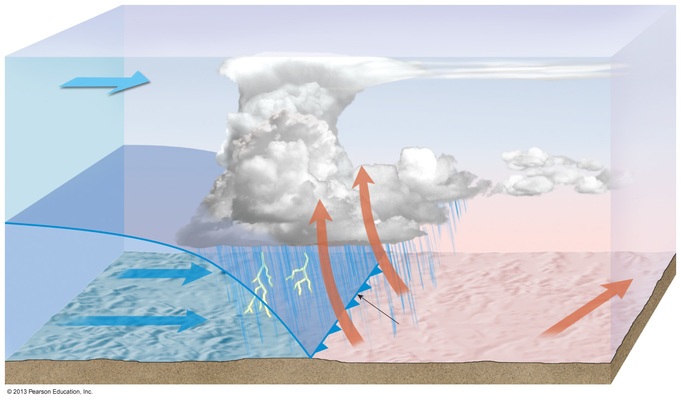
What type of storm front is this? (click on the photo and look at the symbols along the line to show which way the front is moving)

a)

warm front

b)

cold front

c)

stationary front

d)

occluded front

45.

What are examples of non-renewable resources?

a)

Oil, coal and solar energy.

b)

Gas, coal and water.

c)

Oil, gas and wind.

d)

Oil, gas and coal.
