Wayground logo

Free Printable Worksheets

Font size

S
M
L
XL
Worksheets

Plate Tectonics/Weather and Climate

Total questions: 54

Worksheet time: 1hrs 12mins

Name
Class
Date
1.

Earth's plates meet at ____________.

a)

plate tectonics

b)

plate boundaries

c)

continental drift

d)

oceans

2.

Breaks in the crust called __________ form where plates meet.

a)

mountains

b)

rift valleys

c)

faults

d)

trenches

3.

Plates slide past each other at _________________ boundaries.

a)

divergent

b)

convergent

c)

transform

d)

universal

4.

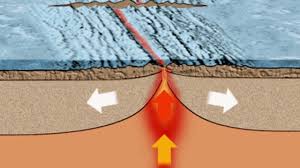
A __________ forms where plates diverge on land.

a)

rift valley

b)

mid-ocean ridge

c)

mountain

d)

trench

5.

________________ currents drive Earth's plate movement.

a)

ocean

b)

atmosphere

c)

wind

d)

convection

6.

What is the motion of Earth's plates like?

a)

fast and in stages

b)

slow and in stages

c)

fast and constant

d)

slow and constant

7.

The San Andreas fault is an example of which type of boundary?

a)

transform

b)

divergent

c)

convergent

d)

universal

8.

Which feature forms at convergent boundaries?

a)

trench

b)

rift valley

c)

mountain range

d)

mid-ocean ridge

9.
A ______ is a section of the lithosphere that slowly moves over the asthenosphere, carrying large slabs of continental and oceanic crust.
a)
wedge
b)
plate
c)
chunk
d)
fault
10.
A break in Earth's crust along which rocks move is called a ________.
a)
plate
b)
rift
c)
fault
d)
breach
11.
_________ are vibrations that travel through Earth carrying the energy released during an earthquake.
a)
Seismic Waves
b)
Rumbles
c)
Plate Tectonics
d)
Convection Currents
12.
The process by which molten material adds new oceanic crust to the ocean floor is called ___________.
a)
Divergent boundary
b)
Sea-floor spreading
c)
Convergent boundary
d)
Renovating 
13.
What is an undersea mountain chain where new ocean floor is produced?
a)
Rift valley
b)
Deep-ocean trench
c)
Mid-ocean ridge
d)
Transform bounda
14.
What is the process by which oceanic crust sinks beneath a deep-ocean trench and back into the mantle at a convergent plate boundary?
a)
Subduction
b)
Induction
c)
Abduction 
d)
Reduction
15.
_____________ is a plate boundary where two plates move away from each other.
a)
Convergent boundary
b)
Transform boundary
c)
Divergent boundary
d)
Insurgent boundary
16.
_____________ is when two plates move toward each other.
a)
Convergent boundary
b)
Allegiant boundary
c)
Transform boundary
d)
Sliding boundary
17.

What is the correct order (starting from the surface) of Earth’s layers?

a)

crust, outer core, inner core, mantle

b)

mantle, outer core, inner core, crust

c)

crust, mantle, outer core, inner core

d)

outer core, inner core, crust, mantle

18.

In sea-floor spreading, molten material rises from the mantle and erupts

a)

along the edges of all the continents.

b)

along mid-ocean ridges.

c)

in deep-ocean trenches.

d)

at the north and south poles.

19.

The process by which the ocean floor sinks beneath a deep-ocean trench and back into the mantle is known as _______

a)

convection.

b)

continental drift.

c)

subduction.

d)

conduction.

20.

Scientists think that convection currents flow in Earth’s

a)

continents.

b)

mantle.

c)

lithosphere.

d)

inner core.

21.

The San Andreas Fault in California is known as an active earthquake area. What type of

boundary is it?

a)

Converging

b)

Diverging

c)

Transform

d)

Sea Floor Spreading

22.
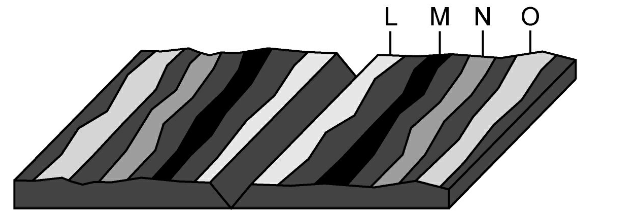
Where would the oldest rock be found?
a)
L
b)
M
c)
N
d)
O
23.
How is it possible for new crust to be formed without increasing the surface area of the Earth?
a)
Crust is destroyed at the same time it is created
b)
New crust is underwater where it sinks
c)
New crust breaks more easily than old crust
24.
This layer of Earth is the thickest part
a)
crust
b)
outer core
c)
mantle
d)
inner core
25.
What are the two types of crust
a)
continental and oceanic
b)
ocean and upper
c)
lower and upper
d)
pizza and subway
26.
The Himalayas in Asia are an example of what type of plate boundary?
a)
divergent
b)
continent-to-continent convergent
c)
ocean-to-continent convergent
d)
transform
27.

Precipitation is

a)

rain, sleet, snow or hail.

b)

only rain.

c)

only snow or hail.

28.

Land closer to the equator is

a)

colder.

b)

warmer.

c)

dry.

29.

Which statement represents weather data?

a)

Less than 30mm of rainfall annually

b)

50% humidity at 4pm

c)

Monsoon rains during summers

30.

As the temperature decreases the pressure in decrease.

a)

True

b)

False

31.

rain is collected and measured by a

a)

rain stick

b)

rain bucket

c)

rain quadrant

d)

rain gauge

32.

All of the following impact climate EXCEPT

a)

latitude

b)

ocean currents

c)

prevailing wind

d)

tectonic plates

e)

atmospheric pressure

33.
Which of the following is a greenhouse gas?
a)
carbon monoxide
b)
oxygen
c)
nitrogen
d)
carbon dioxide
34.
All of the following are causes of Global Warming except
a)
Rotation of the Earth
b)
Deforestation
c)
Increases in Greenhouse Gases
d)
Burning Fossil Fuels
35.
All of the following are effects of Global Warming EXCEPT
a)
increase in hurricanes
b)
lower sea levels
c)
increase in disease
d)
melting polar ice caps
36.
What does monsoon mean?
a)
Extreme weather
b)
prolonged drought
c)
storm surge
d)
seasonal wind
37.

What is the dry side of the mountain called?

a)

climagraph

b)

peninsula

c)

arid

d)

rain shadow

38.

How many "seasons" are there in Monsoon Asia?

a)

1

b)

2

c)

3

d)

4

39.

The 2 seasons of the Monsoon are...

a)

Wet and Dry

b)

Hot and Cold

c)

Fuzzy and Rough

d)

Moist and Hot

40.

Which of the following are greenhouse gases?

a)

Carbon dioxide

b)

Methane

c)

Nitrogen Oxide

d)

All answers are correct

41.
Which of the following is NOT an effect of Global Warming?
a)
Polar ice caps will melt.
b)
Coastal regions will be covered with rising sea levels.
c)
Some areas will experience serious droughts
d)
The Earth's rotation will slow down and eventually stop
42.
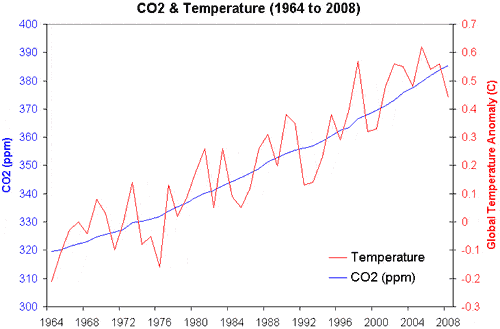
The graph below shows CO2 emissions and temperatures from 1909 to 1949.  What conclusion is best supported by the graph?
a)
There is no relationship between carbon dioxide concentrations and temperatures
b)
As carbon dioxide concentrations increase, temperatures increase
c)
As carbon dioxide concentrations increase, temperatures decrease
d)
As carbon dioxide concentrations decrease, temperatures increase
43.

Greenhouse gases can

a)

Clean your greenhouse

b)

Trap the heat escaping from earth.

c)

Inflate your greenhouse

d)

Cool the Earth

44.

Methane is

a)

Made by rice in paddy fields

b)

Not a greenhouse gas

c)

Not given off by cows.

d)

Not causing global warming.

45.

Fossil fuels are

a)

Coal, oil and gas.

b)

Burning rocks

c)

Burning fossils

d)

Non flammable

46.

CFC's are greenhouse gases and stands for

a)

Carbon fluoro carbons

b)

Chlorofluorochloros

c)

Carbonfluorochloros

d)

Chlorofluorocarbons

47.
How can global warming cause sea levels to rise? Choose the best answer.
a)
by causing it to rain more often
b)
by melting glaciers and ice caps
c)
by increasing the number of undersea volcanic eruptions
d)
by creating bigger and more powerful hurricanes
48.
Why does cutting down trees increase global warming?
a)
trees soak up carbon dioxide
b)
trees provide shade which counteracts global warming
c)
trees absorbs the sun's energy without radiating back into the atmosphere
d)
trees drain greenhouse gases like methane from soil
49.
Without the Greenhouse Effect the Earth would be too
a)
warm 
b)
cold
c)
dead
d)
funny
50.
What is this difference between global warming and the greenhouse effect?
a)
Global warming refers to a change in the Earth's climate that is causing it to heat up; the greenhouse effect is a natural process that happens constantly, due to sunlight and the atmosphere.
b)
Global warming and the greenhouse effect are the same thing.
c)
The greenhouse effect comes within global warming.
d)
Global warming comes within the greenhouse effect
51.
As global warming continues, the intensity of what type of storm that hits coastlines is predicted to increase?
a)
Tornadoes
b)
Hurricanes 
c)
Tsunamis
d)
Earthquakes
52.
The main human activity that releases greenhouse gases is
a)
using bottled water
b)
burning fossil fuels
c)
texting on cellphones
d)
eating meat
53.
It was hot all week last week.  Is this a sign of climate change?
a)
Yes
b)
No
54.
Worldwide, temperatures have been increasing for more than 100 years.  Is this evidence of global warming?
a)
yes
b)
no