
Font size
 Worksheets
Electrochemistry
Total questions: 16
Worksheet time: 22mins
Electrochemistry is
Study of electron in atom
Study of electricity in molecules
The relationship between chemical reactions and electricity
the study of electrons moving from one a tom to another

An oxidizing agent will
increase in mass
lose electrons
be reduced
increase in oxidation number

Pb + 2Ag+ → Pb+2 + 2Ag
The chemical species being reduced is
Ag
Pb
Pb+2
Ag+
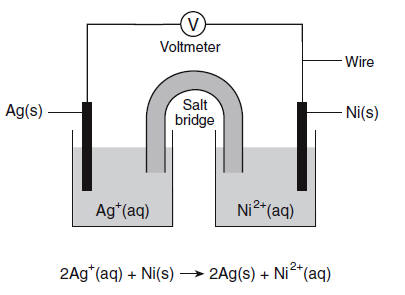
In a galvanic cell with the following cell notation:
∣Ni(s)∣Ni+2(aq)∥Co+2(aq)∣Co(s)∣
Which of the following is true?
Ni is being reduced
Co+2 is being oxidized
Energy will be added to operate this cell.
This cell operated spontaneously
In electrochemical cell Anode is of which charge
–ve
+ve
No charge
Both charge
In electrochemical cell, reduction takes place at
Right
Left
Top
Bottom

When aqueous copper(II) chloride solution is electrolysed using copper electrodes, the half-equation for the reaction that occurs at the anode is
Cu2+ + 2e -------> Cu
Cu --------> Cu2+ + 2e
2Cl- --------> Cl2 + 2e
4OH- --------> 2H2O + O2 + 4e
What are the cations present in zinc sulphate solution?
Zn2+
Zn2+, SO42
Zn2+ , H+
OH- , SO42-
Which metal is the negative electrode?
Zn/Zn2+ // Cu2+/Cu
zinc
copper

Galvanic cells convert
mechanical energy in to electrical energy
potential energy in to electrical energy
electrical energy in to chemical energy
chemical energy in to electrical energy

In electrolysis, particles which move towards cathode are called
anions
cations
photons
positrons
Which of the species strong oxidizing agent?
Cl2(g) + 2e → 2Cl-(aq) Eocell = + 1.36 V
Cu2+(aq) + 2e → Cu(s) Eocell = + 0.34 V
Ni2+(aq) + 2e → Ni(s) Eocell = – 0.25 V
Ca2+(aq) + 2e → Ca(s) Eocell = – 2.87 V
Cl2(g)
Cu2+(aq)
Ni2+(aq)
Ca2+(aq)
Which is correct to write cell notation
Anode: Zn
Cathode: Ni
Zn2+ (aq,1M) / Zn (s) // Ni (s) / Ni2+ (aq,1M)
Zn (s) /Zn2+ (aq,1M) // Ni2+ (aq,1M) / Ni (s)
Zn2+ (s,1M) / Zn (aq) // Ni (aq) / Ni2+ (s,1M)
Zn (aq) /Zn2+ (s,1M) // Ni2+ (s,1M) / Ni (aq)
Calculate standard cell potential for this equation:
Zn2+(aq) + 2e → Zn(s) Eº = – 0.76 V
Cd2+(aq) + 2e → Cd(s) Eº = – 0.40 V
Eocell = -0.36 V
Eocell = -1.16 V
Eocell = +1.16 V
Eocell = +0.36 V

