Wayground logo

Free Printable Worksheets

Font size

S
M
L
XL
Worksheets

Middle School Social Studies/ Science Final Exam

Total questions: 46

Worksheet time: 34mins

Name
Class
Date
1.
Where are electrons of an atom found?
a)
Nucleus
b)
Electron Cloud
c)
Some are in the nucleus and some in the electron cloud.
d)
They are moving everywhere.
2.
Which of the following is a positively charged subatomic particle found in the nucleus of an atom?
a)
Electron
b)
Proton
c)
Neutron
d)
Quark
3.

An atom has an atomic number of 15 and a mass number of 31. How many protons are there in the atom?

a)

15

b)

31

c)

16

d)

47

4.
What carries no charge 
a)
Neutrons
b)
Electrons
c)
Protons
5.
What is the Atomic Mass?
a)
6.941
b)
7
c)
3
d)
6
6.
How many Protons are in one atom of Lithium?
a)
3
b)
6
c)
7
d)
6.941
7.
How many Protons are in one atom of Lithium?
a)
3
b)
6
c)
7
d)
6.941
8.
Which is the smallest?
a)
electron
b)
proton
c)
atom
d)
neutron 
9.
What is in the nucleus of an atom?
a)
Neutrons and protons 
b)
Protons
c)
Protons and Electrons
d)
Electrons and Nuetrons
10.
An atom has an atomic number of 19 and a mass number of 29. How many neutrons are in the atom?
a)
30
b)
19
c)
10
d)
38
11.
What are the three states of matter?
a)
solid, volume, mass
b)
density, volume, mass
c)
solid, liquid, gas
d)
density, gas, volume
12.
Something that takes up space and has mass.
a)
volume
b)
matter
c)
mass
d)
density
13.
A state of matter that has a definite volume and shape.
a)
solid
b)
liquid
c)
gas
d)
matter
14.
The amount of space something takes up
a)
density
b)
volume
c)
mass
d)
matter
15.
Mixtures are separated through ___________changes.
a)
mixture
b)
compound
c)
physical
16.
TRUE OR FALSE: You can look at matter and observe the chemical properties.
a)
TRUE
b)
FALSE
17.
What is the definition of chemical change?
a)
any change that results in the formation of new chemical substances. 
b)
changing of only the appearance of the object
c)
matter cannot be created or destroyed, only change form
d)
changes affecting the form of a chemical substance, but not its chemical composition.
18.
Is wood burning a physical or chemical change?
a)
Physical 
b)
Chemical
19.
Is Gatorade powder dissolving in water physical or chemical change?
a)
Physical 
b)
Chemical
20.

Which of the following most

directly led to the widespread public support that Roosevelt enjoyed in

his first term?

a)

his use of the "Brain Trust" to form public policy

b)

the support of the business community

c)

the sudden economic turn around under the New Deal

d)

his confidence and ability to connect with his audience on radio

21.

The trend shown between 1933 and 1937 would contribute to

a)

support for more extensive government

intervention in the national economy.

b)

conservative claims that the New Deal

had exceeded the powers given to the government in the Constitution.

c)

a splitting up of the

Democratic Party coalition.

d)

America’s decision to enter

World War II

22.

Hoover took all of the following steps to address the economic crisis the during his administration

EXCEPT:

a)

He encouraged business leaders to participate in voluntary measures to maintain wages and prices.

b)

He ordered the closing of banks across the country to stop bank failures.

c)

Signed the Smoot-Hawley Act

d)

He supported some public works construction projects

23.

All of the following were outspoken critics of the New Deal EXCEPT:?

a)

Charles Lindbergh

b)

The National Association of Manufacturers

c)

Former Democratic Presidential nominee Al Smith

d)

Henry Morganthau

24.

Dr. Francis Townsend’s popular proposal was eventually adopted by the Roosevelt

administration and became what lasting New Deal program?

a)

Security and Exchange Commission

b)

FDIC

c)

Social Security

d)

National Labor Relations Board

25.

The Democrats believed they could win the 1932 election because the economy was worsening under the Republican president in office.

a)

True

b)

False

26.

Franklin D. Roosevelt was a distant cousin of former president Theodore Roosevelt.

a)

True

b)

False

27.

The nation’s economy began to improve during the time between Roosevelt’s election and inauguration.

a)

True

b)

False

28.

Fireside chats were meetings in which Roosevelt’s top advisers gathered around a fire and discussed possible solutions to the nation’s economic problems.

a)

True

b)

False

29.

Subsidies are grants of money, often from the government, for an action intended to benefit the public.

a)

True

b)

False

30.
Which of the following was one cause Great Depression?
a)
WWI
b)
The invention of the radio
c)
Stock Market Crash
d)
Hoovervilles
31.
Which is NOT  cause of The Great Depression?
a)
Overproduction
b)
Speculation
c)
Shaky Banking
d)
Unrestricted International Trade
32.
What was the human impact of The Great Depression?
a)
People were homeless and hungry
b)
People generally owned their own home 
c)
People were optimistic about their current circumstances. 
d)
There was so much economic prosperity that Photographers took historical images of all the boisterousness. 
33.
Why was the New Deal established?
a)
lt started a new company for Harlem Renaissance artists.
b)
 To try to bring the Great Depression to an end'
c)
To make employees understand what happened during this period of history.
d)
To impeach POTUS Hoover
34.
When banks failed during the Great Depression and many Americans lost their money,
a)
(a)  the government gave all homeless people free houses.
b)
only people who had invested in the stock market could pay for food
c)
(a)  people in France and Britain sent donations of food and money
d)
(a)  people bought fewer goods and factory workers lost their jobs
35.
What effect did the Dust Bowl storms have on the Great Depression?
a)
Many farmers were forced to leave the Great Plains.
b)
Unemployment decreased gradually.
c)
Many homes long the Mississippi River were flooded.
d)
Hoover was re-elected as president.
36.
In the 1930's, people would line up at ____________ to get food.  These were normally run by charities.
a)
churches
b)
businesses
c)
soup kitchens
d)
work
37.
Who was president at the time of the Stock Market Crash of 1929?
a)
Abraham Lincoln
b)
Franklin D. Roosevelt
c)
Theodore Roosevelt
d)
Herbert Hoover
38.
After the Stock Market Crash, many people lost their life savings because _______________.
a)
banks closed
b)
banks gave away their money
c)
they couldn't remember where they put it
d)
someone stole it
39.
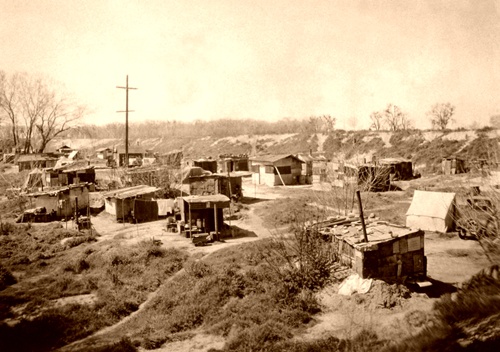
What were the villages full of shacks located in cities filled with unemployed Americans called?
a)
Hoovervilles
b)
Okies
c)
Bonus Army Bases
d)
Rooseveltowns
40.
Which economic factor contributed most directly to the start of the Great Depression?
a)
low worker productivity
b)
high income taxes
c)
decreasing tariff rates
d)
buying stocks on margin
41.
Which of the following was NOT an effect of the Great Depression?
a)
homelessness
b)
bank failures
c)
high tariffs
d)
struggling farmers
42.
Which economic factor contributed most directly to the start of the Great Depression?
a)
low worker productivity
b)
high income taxes
c)
decreasing tariff rates
d)
buying stocks on margin
43.

Which term is used to describe an organized system for buying and selling shares in corporations?

a)

A. market boom

b)

B. stock option

c)

C. market house

d)

D. stock exchange

44.

Which term is used to describe an organized system for buying and selling shares in corporations?

a)

A. market boom

b)

B. stock option

c)

C. market house

d)

D. stock exchange

45.

What was a cause of the Great Depression?

a)

A. government relief programs

b)

B. the New Deal

c)

C. subsidies

d)

D. borrowed money

46.

In 1932 which group marched on Washington demanding a promised payment?

a)

A. U.S. Army troops

b)

B. World War I veterans

c)

C. Reconstruction Finance Corporation

d)

D. federal government workers