
 Worksheets
Simple chemical reactions
Total questions: 32
Worksheet time: 34mins
Name
Class
Date
1.
the starting materials in a chemical reaction
a)
Products
b)
Reactants
c)
Starters
d)
Enders
2.
a substance that is formed as the result of a chemical reaction
a)
Product
b)
Reactant
c)
Starters
d)
Enders
3.
Which of the following examples shows that a chemical reaction has occurred?
a)
A rock breaks into smaller pieces when it is struck with a hammer.
b)
Rust forms on a hammer that has been left outside to long.
c)
A cup of water turns pink when a few drops of red food coloring are added.
d)
A solid is formed when heat is removed from a sample of water.
4.
A student places a piece of a potato into a container of hydrogen peroxide. One observation the student makes is that bubbles form around the potato. The presence of bubbles might indicate the formation of a new substance because bubbles -
a)
could show that a gas is forming
b)
always rise to the top of a liquid.
c)
are almost always perfectly spherical.
d)
usually burst after a few minutes.
5.
A clear liquid from a flask is poured into another clear liquid in a beaker. Which of the following results of this procedure would indicate a new substance was formed?
a)
The level of the substance in the beaker is higher after the other liquid is added.
b)
A yellow solid forms and then settles to the bottom of the beaker.
c)
Small white crystals are left behind in the flask that held the first liquid.
6.
Which of the following is an example that includes evidence of a chemical reaction?
a)
A sample of zinc is placed in water and it settles to the bottom
b)
A solid block of ice is heated and it completely melts into a liquid.
c)
Sugar that is burned gives off an odor and turns brown and then black.
d)
A tomato is placed into a blender and chopped up into smaller pieces.
7.
Evidence of a chemical reactions is anything that shows -
a)
a new substance has formed
b)
a solid dissolved in a liquid
c)
interaction between 2 gases
d)
a change in the state of matter
8.
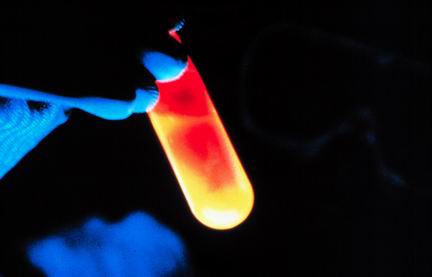
Which of the following is NOT evidence that that a chemical reaction has occurred?
a)
produces light/heat
b)
production of a gas
c)
formation of a precipitate
d)
melting
9.
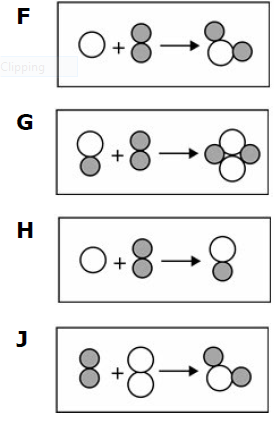
Which of the following models best demonstrates a balanced chemical equation?
a)
F
b)
G
c)
H
d)
J
10.
How do you test for carbon dioxide gas?
a)
Turns limewater milky
b)
Relights a glowing splint
c)
Makes a squeaky pop with a splint
d)
Bleaches damp litmus paper
11.
How do you test for oxygen gas?
a)
Makes a squeaky pop with a lit splint
b)
Relights a glowing splint
c)
Bleaches damp litmus paper
d)
Turns limewater milky
12.
How do you test for Chlorine gas?
a)
Bleaches damp litmus paper
b)
Makes a squeaky pop with a lit splint
c)
Relights a glowing splint
d)
Turns limewater milky
13.
How do you test for Chlorine gas?
a)
Bleaches damp litmus paper
b)
Makes a squeaky pop with a lit splint
c)
Relights a glowing splint
d)
Turns limewater milky
14.
The missing numbers in sequence in this reaction to balance the equation for burning hydrogen in air are:
___ H2 (g) + _____O2 (g) → _____ H2O (g)
a)
4 3 2
b)
2 1 2
c)
1 1 1
d)
1 2 1
15.
How many atoms are in S8?
a)
1
b)
8
c)
16
d)
2
e)
I don't know
16.
How many atoms of carbon are in CO2?
a)
1
b)
2
c)
3
d)
4
e)
I don't know
17.
How many atoms of carbon are in C3H8?
a)
1
b)
3
c)
8
d)
11
e)
I don't know
18.
How many atoms of carbon are in 2C2H6?
a)
1
b)
2
c)
4
d)
6
e)
12
19.
How many atoms of carbon are in 3C3H8?
a)
3
b)
8
c)
9
d)
14
e)
24
20.
How many atoms of carbon are in 3Al2(CO3)3?
a)
1
b)
3
c)
6
d)
7
e)
9
21.
How many atoms of carbon are in 3Mg(C2H3O2)2?
a)
2
b)
4
c)
6
d)
7
e)
12
22.
Balance this equation:
MgCl2 --> Mg4+ Cl2
MgCl2 --> Mg4+ Cl2
a)
It's already balanced.
b)
4MgCl2 --> Mg4+ 4Cl2
c)
4MgCl2 --> Mg4+ 5Cl2
23.
Balance this equation:
2Li + Cl2 -> LiCl
2Li + Cl2 -> LiCl
a)
2Li + Cl2 -> 4LiCl2
b)
2Li + Cl2 -> LiCl2
c)
2Li + Cl2 -> 2LiCl
24.
In chemical reactions, what does the principle of conservation of mass mean?
a)
Matter is not created or destroyed.
b)
The total mass of the reactants is greater than the total mass of the products.
c)
The total mass of the reactants is less than the total mass of the products.
d)
Matter is not changed.
25.
How many Hydrogen (H) atoms are in NH3O5
a)
3
b)
4
c)
5
d)
1
26.
How many phosphorus atoms are in PO4?
a)
1
b)
2
c)
3
d)
4
27.
Which number should go in the blank?
_ H2 + O2 -> 2 H2O
_ H2 + O2 -> 2 H2O
a)
1
b)
2
c)
3
d)
0
28.
Is the following equation balanced or unbalanced ?
Al + O2 --> Al2O3
Al + O2 --> Al2O3
a)
Balanced
b)
Unbalanced
29.
Is the following equation balanced or unbalanced ?
N2 +3 H2 --> 2NH3
N2 +3 H2 --> 2NH3
a)
Balanced
b)
Unbalanced
30.
How many hydrogens are in 4H2O?
a)
6
b)
8
c)
2
d)
4
31.
How many atoms of aluminum are on each side of the following equation: 4Al + 3O2 --> 2Al2 O3
a)
2
b)
6
c)
1
d)
4
32.
Balance this equation:
__ Al + __ HCl → __ H2 + __ AlCl3
__ Al + __ HCl → __ H2 + __ AlCl3
a)
2, 6, 3, 2
b)
it is already balanced
c)
4, 12, 3, 4
d)
2, 1, 4, 5
100 %

