wayground logo

Free Printable Worksheets

Font size

S
M
L
XL
Worksheets

6th gr NYS Science final exam

Total questions: 75

Worksheet time: 2hrs 41mins

Name
Class
Date
1.
The central or inner most part of the earth, made of 2 layers.  
a)
Mantle 
b)
Crust
c)
Core
2.
What two layers make up the core?  
a)
Mesosphere and 
Asthenosphere 
b)
Inner and Outer core
c)
Lithosphere and Outer Core
d)
Inner core and Mesosphere
3.
Thin layer that has two layer called oceanic and continental.  
a)
Crust
b)
Core
c)
Mantle
d)
Atmosphere
4.

1. Rock sediments that travel down a mountain, sand being blown across the beach, and mud sliding down a hill are all examples of

a)

pressing and cementing

b)

erosion

c)

part of the rock cycle

d)

fossil formation

5.

The remains of living things that died long ago are often found in what type of rock?

a)

igneous rocks

b)

sedimentary rock

c)

metamorphic rock

d)

all rocks

6.

The cooled and hardened magma from volcanoes form what rocks?

a)

igneous

b)

sedimentary

c)

metamorphic

d)

fossils

7.

Hot, molten rock inside the earth is called ...

a)

lava

b)

magma

c)

igneous rock

d)

minerals

8.

Once magma reaches the earth's surface, it is called __________.

a)

a vent

b)

minerals

c)

igneous rocks

d)

lava

9.

Rocks that are buried deep in the earth can be changed into an entirely new rock when it goes through what?

a)

weathering and erosion

b)

pressing and cementing

c)

heat and pressure

d)

cooling and hardening

10.
A ______ is a section of the lithosphere that slowly moves over the asthenosphere, carrying large slabs of continental and oceanic crust.
a)
wedge
b)
plate
c)
chunk
d)
fault
11.
A break in Earth's crust along which rocks move is called a ________.
a)
plate
b)
rift
c)
fault
d)
breach
12.
_________ are vibrations that travel through Earth carrying the energy released during an earthquake.
a)
Seismic Waves
b)
Rumbles
c)
Plate Tectonics
d)
Convection Currents
13.
The movement of fluid, caused by differences in temperature, that transfers heat from one part of the fluid to another is _____________.
a)
Convection current
b)
Seismic waves
c)
Sea-floor spreading
d)
Conduction current
14.
_____________ is a plate boundary where two plates move away from each other.
a)
Convergent boundary
b)
Transform boundary
c)
Divergent boundary
d)
Insurgent boundary
15.
___________ is the theory that pieces of Earth's lithosphere are in constant motion, driven by convection currents in the mantle.
a)
Seismic waves
b)
Convection current
c)
Divergent boundary
d)
Plate tectonics
16.
Which seismic wave moves at right angles?  
a)
P Waves
b)
S Waves
c)
Surface Waves
17.
Which letter represents the movement created by the P Wave?  
a)
A
b)
B
c)
C
18.
What is the lag time?  
a)
30 sec
b)
86 sec
c)
56 sec
d)
140 sec
19.
What is directly above the focus?  
a)
Epicenter
b)
Fault
c)
Seismograph Station
20.
Which seismogram represents a city that is far from the epicenter of an earthquake?  
a)
New York, NY
b)
Nome, Alaska
c)
Guadalajara, Mexico
21.
A weak spot in the crust where molten material, or magma comes to the surface
a)
lava
b)
volcano
c)
earthquake
d)
tsunami
22.
A sleeping volcano
a)
Composite volcano
b)
Active volcano
c)
Extinct volcano
d)
Dormant volcano
23.
A live volcano
a)
Dormant volcano
b)
Active volcano
c)
Extinct volcano
d)
Shield volcano
24.
A dead volcano, one that is unlikely to erupt again
a)
Dormant volcano
b)
Extinct volcano
c)
Shield volcano
d)
Caldera
25.
Energy from water or steam that has been heated by magma
a)
Geothermal energy
b)
Thermal energy
c)
Kinetic energy
d)
Potential energy
26.
When rocks are broken down into smaller pieces
a)
erosion
b)
weathering
c)
sediment
27.
When water, ice and wind move particles of rock and soil from one place to another
a)
sediment
b)
weathering
c)
erosion
28.
A mass of ice that covers a large area and moves slowly
a)
gravity
b)
glacier
c)
sediment
29.
How does freezing water cause the weathering of rocks?  The freezing water—
a)
keeps the rocks in place
b)
makes the rocks last longer
c)
expands cracks and breaks rocks
d)
causes rocks to fall in landslides
30.
These rocks were made smooth by wind blowing smaller rock particles across their surface.  This is an example of:
a)
ice wedging
b)
chemical weathering
c)
acid rain
d)
abrasion
31.
What is mechanical weathering?
a)
Process through which rocks are physically broken into smaller pieces.
b)
Rocks are broken down through chemical changes.
c)
Rocks are worn away from acid in plant roots.
d)
Rocks broken down by machinery.
32.
What is the major cause of weathering and erosion to form canyons?
a)
wind
b)
ice
c)
glaciers
d)
moving water
33.
Which landforms can be created by deposition?
a)
plateaus and mesas
b)
canyons and valleys
c)
prairies, plains
d)
sand dunes and deltas
34.

A cliff formed near the ocean. Which statement best describes how this cliff formed?

a)

Warm air melted the rock.

b)

Sun rays evaporated the rock.

c)

Ocean waves washed away rock.

d)

Plant roots pushed away the rock.

35.
Which pie chart correctly shows the percentages of elements in the air?
a)
a
b)
b
c)
c
d)
d
36.
Which statement most accurately describes the temperature trend in the Troposphere? Temperatures...
a)
rise with increasing altitude above the Earth
b)
rise then fall with increasing altitude above the Earth
c)
decrease with increasing altitude above the Earth
d)
remain constant with increasing altitude above the Earth
37.
Where weather occurs.
a)
stratosphere
b)
thermosphere
c)
troposphere
d)
mesosphere
38.
The hottest layer.
a)
troposphere
b)
thermosphere
c)
exosphere
d)
mesosphere
39.
What is the function of the ozone layer?
a)
to allow UV rays to get to Earth
b)
to block UV rays from getting to Earth
c)
To keep oxygen in
d)
to allow meteors to get to Earth
40.

What causes global convection currents

a)

Forests

b)

greenhouse gases

c)

more land forms

d)

uneven heating of the Earth's surface

41.

What city will experience decreasing temperatures in the next day?

a)

Denver

b)

El Paso

c)

Memphis

d)

Los Angeles

42.

Where do warm ocean currents come from?

a)

warm ocean currents come from the southern hemisphere

b)

warm ocean currents come from the equator

c)

Warm ocean currents come from the poles

d)

Warm ocean currents come from the beach

43.

Where do cold ocean currents come from?

a)

cold ocean currents come from the southern hemisphere

b)

cold ocean currents come from the equator

c)

cold ocean currents come from the poles

d)

cold ocean currents come from the beach

44.

What does this symbol represent?

a)

Cold Front

b)

Warm Front

c)

Stationary Front

d)

Occluded Front

45.

What does this symbol represent?

a)

Cold Front

b)

Warm Front

c)

Stationary Front

d)

Occluded Front

46.

high Pressures are associated with what type of weather

a)

fair weather

b)

cold weather

c)

warm weather

d)

rainy weather

47.

The sun's rays are least direct near the equator.

a)

True

b)

False - near the poles

c)

False - at high altitudes

d)

False - far from the ocean

48.

Global warming is known as the gradual increase in _________________ of the atmosphere.

a)

precipitation

b)

sun spots

c)

temperature

d)

ocean currents

49.

The most abundant greenhouse gas in the atmosphere is ___________________.

a)

oxygen

b)

nitrogen

c)

carbon dioxide

d)

argon

50.

Possible human solutions for limiting global warming and climate change are...

a)

being more energy-efficient

b)

using renewable sources of energy

c)

removing carbon from fossil fuel emissions

d)

all of the above

51.
Which of the following does NOT have an affect on a region's climate?
a)
Large bodies of water
b)
Latitude
c)
Mountains
d)
Longitude
52.
All objects are attracted to each other by the force of 
a)
weight 
b)
inertia
c)
mass
d)
gravity
53.
One complete revolution of Earth around the sun takes how long?
a)
1 day
b)
365.25 days
c)
24 hours
d)
29.5 days
54.
In the Northern hemisphere, the summer solstice occurs in 
a)
March
b)
June
c)
September
d)
December
55.
Earth has seasons because
a)
it has an axis
b)
the sun gets closer and farther from the sun
c)
axis is tilted as it moves around the sun
d)
the sun gets hotter
56.
A pattern or grouping of stars that represent objects or people are called
a)
star chart
b)
constellation
c)
seasons
d)
mythology
57.
The phase of the moon you see depends on
a)
where you are on Earth's surface
b)
how much of the sunlit side of the moon faces Earth
c)
if the moon is making its own light
d)
whether or not an eclipse is occurring.
58.
How long does the moon's rotation and revolution take?
a)
28 minutes
b)
29.5 seconds
c)
29.5 days
d)
24 hours
59.

Which of the following is an accurate model of how the Sun, Earth, and Moon move?

a)

Sun and moon orbit Earth

b)

Earth and moon orbit Sun

c)

Earth orbits the Sun and the moon orbits Earth

d)

Earth and sun orbit moon

60.
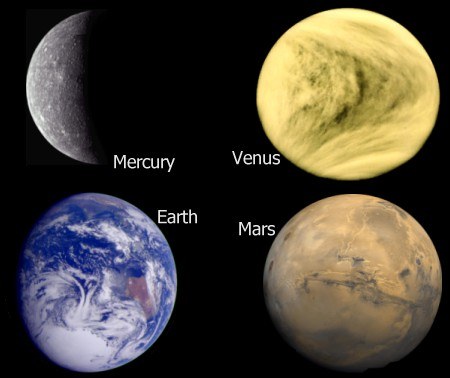
Earth and the other planets closest to the Sun are made mostly of _______
a)
gas
b)
metal
c)
water
d)
rock
61.
A ball of ice and dust with a tail of gas and dust pointing away from the sun.
a)
Asteroid
b)
Comet
c)
Moon
d)
Meteor
62.
One full orbit of an object around another object is called a ________.
a)
axis
b)
rotation
c)
revolution
d)
satellite
63.
Select the order from smallest to largest.
a)
Sun, Milky Way, solar system, universe
b)
Sun, Milky Way, universe, solar system
c)
Sun, solar system, Milky Way, universe
d)
Sun, solar system, universe, Milky Way
64.

This table shows the rotation period and revolution period for 6 planets, and Earth’s moon, all relative to Earth’s periods. Which 2 planets have shorter days than Earth?

a)

Jupiter and Saturn

b)

Venus and Mercury

c)

Mars and Jupiter

d)

Saturn and Moon

65.

How long ago was our solar system formed?

a)

10 million years ago

b)

4.6 million years ago

c)

4.6 billion years ago

d)

2 billion years ago

66.

What are the three major types of galaxies?

a)

Spiral

b)

Elliptical

c)

Glasticas

d)

Irregular

67.

an immense cloud of dust & gas where stars are born

a)

black hole

b)

nebula

c)

prominence

d)

supernova

68.
What is the life cycle of a medium sized star?
a)
Nebula, red giant, nova, white dwarf, black hole
b)
Red giant, nova, white dwarf, dead star
c)
Nebula, red giant, nova, white dwarf, dead star
d)
Nebula, white dwarf, dead star
69.
All of the galaxies together is _______.
a)
nebula
b)
solar system
c)
Milky Way
d)
universe
70.
What happens when a massive star's life ends?
a)
dead star
b)
black hole or neutron star
c)
supernova
d)
white dwarf
71.
The color of the star tells us its 
a)
composition
b)
Temperature
c)
Luminosity 
d)
Mass
72.
Our galaxy is called the
a)
Earth Nebula
b)
The Hubble Galaxy
c)
The Milky Way
d)
The Snickers
73.
The Milky Way Galaxy is a 
a)
spiral
b)
lenticular
c)
elliptical 
d)
irregular
74.
The life cycles of stars are determined by their:
a)
mass (size)
b)
color
c)
distance from Earth
d)
luminosity
75.
The largest type of star is 
a)
nebula
b)
red giant
c)
red supergiant
d)
supernova