
 Worksheets
Periodic Table Recap
Total questions: 18
Worksheet time: 14mins
Name
Class
Date
1.

Each column in the periodic table is called a _________ .
a)
period
b)
group
c)
cluster
d)
unit
2.

What element is will have the most similar physical and chemical properties to the element Sulfur (S)?
a)
Carbon (C)
b)
Phosphorous (P)
c)
Oxygen (O)
d)
Neon (Ne
3.

What element is will have the most similar physical and chemical properties to the element Lithium (Li)?
a)
Sodium (Na)
b)
Magnesium (Mg)
c)
Beryllium (Be)
d)
Calcium (Ca)
4.

What element is will have the most similar physical and chemical properties to the element Bromine (Br)?
a)
Fluorine (F)
b)
Carbon (C)
c)
Krypton (Kr)
d)
Selenium (Se)
5.

Elements that are arranged in __________ have the most similar physical and chemical properties to each other.
a)
periods
b)
groups
6.

Periods on the periodic table are __________.
a)
Horizontal Rows
b)
Vertical Columns
7.
The Modern Periodic Table of Elements is arranged by
a)
atomic mass
b)
atomic number
c)
valence electrons
d)
number of isotopes
8.
What does the atomic number of an element tell you?
a)
only the number of electrons
b)
only the number of protons
c)
only the number of neutrons
d)
the number of both electrons and protons in an atom.
9.
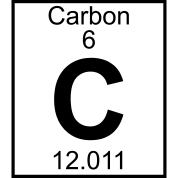
What does the 6 represent?
a)
atomic mass
b)
atomic number
c)
element name
d)
chemical symbol
10.
Select the correct definition of neutron.
a)
A subatomic particle that has a positive charge and that is found in the nucleus of an atom
b)
not able to conduct heat or electricity, little to no metallic luster
c)
A subatomic particle that has a negative charge
d)
A small particle in the nucleus of the atom, with no electrical charge
11.
A subatomic particle that has a negative charge
a)
nobles gases
b)
protons
c)
electrons
d)
neutrons
12.
Which of the following is not a compound?
a)
HCl
b)
Cl
c)
NaCl
d)
CO2
13.
Which of the following represents an element?
a)
H2O
b)
H2
c)
NaCl
d)
CaCO3
14.
What cannot be broken down into other substances?
a)
Compound
b)
Mixture
c)
Solids
d)
Element
15.
How many elements are represented in the compound?
Na2CO3
Na2CO3
a)
1
b)
2
c)
3
d)
4
16.
Is sugar (C12H22O11) an element or a compound?
a)
Element
b)
Compound
17.
Water (H2O) freezing is an example of:
a)
A chemical change
b)
A physical change
18.
A chemical change always results in the formation of a:
a)
explosion
b)
big mess
c)
new substance
d)
new state of matter
100 %

