wayground logo

Free Printable Worksheets

Font size

S
M
L
XL
Worksheets

EVOLUTION

Total questions: 45

Worksheet time: 41mins

Name
Class
Date
1.

What do you call a characteristic that allows an organism to survive in an environment?

a)

variation

b)

adaptation

c)

selection

d)

overproduction

2.
Survival of the Fittest and Evolution were proposed by what scientist?
a)
Charles Darwin
b)
Albert Einstein
c)
Steven Hawking
d)
Isaac Newton
3.
What is the advantage of having different shaped beaks?
a)
To look different from other species.
b)
To be able to eat the food readily available in the environment.
c)
To protect itself against predators.
d)
To protect itself against prey.
4.
Why are advantageous traits more likely to be passed onto offspring?
a)
Because they are more likely to survive and reproduce.
b)
Because they come from dominant alleles.
c)
Because they come from recessive alleles.
d)
Because the trait is an acquired phenotype.
5.
Mutations are a change in what?
a)
DNA
b)
tRNA
c)
genotype
d)
phenotype
6.
Where humans have bred organisms together based on traits we like.
a)
Evolution
b)
Natural Selection
c)
Extinction 
d)
Artificial Selection
7.
Genetic differences between organisms of the same species
a)
Variation
b)
Adaptation
c)
Behavior
d)
Environment
8.
Two organisms that are closely related would have
a)
very similar DNA sequence
b)
exactly the same DNA sequences
c)
no proteins in common
d)
completely different DNA sequence
9.
True or False?
Generations of a species that are farther apart from each other look the most different.
a)
True
b)
False
10.

The law of superposition (strata) states

a)

the oldest rock layer is on the top, the younger rock layer is on the bottom

b)

rock layers are always in sequence from oldest to youngest

c)

the youngest rock layer is on the bottom and the oldest is on the top

d)

the oldest layer is on the bottom and the youngest is on the top when it is undisturbed

11.
Scientist find dinosaur fossils in the bottom of a cliff and mammals fossils in the middle layer, what can be inferred?
a)
dinosaurs ate plants
b)
dinosaurs were eaten by the mammals
c)
they lived at the same time
d)
dinosaurs lived before the mammals
12.
What would indicate that a series of fossils represent evolution?
a)
the fossils were identical
b)
the fossils were found in the same layers of rock
c)
the fossils show similarities
d)
the fossils were completely different
13.
Natural selection is
a)
survival of the fittest
b)
humans change
c)
two species are the same
d)
more animals survive
14.
This makes an organism more suited to its enviornment
a)
species
b)
lifespan
c)
adaptation
d)
mutation
15.
What is one reason that strawberries are surviving in the winter season?
a)
they have larger leaves
b)
they have genetic variations allowing them to be resistant to cold
c)
they reproduce more
d)
the color is dark
16.
The tree of life is a metaphor for what idea?
a)
we came from a common ancestor
b)
we need water and sunlight to survive
c)
we have multiple species
d)
we are old
17.
Who was Charles Darwin?
a)
A naturalist who came up with the theory of evolution
b)
A scientist who studied plants
c)
A geologist who looked at rocks and fossils
d)
A paleontologist who studied dinosaurs
18.
These are natural differences within a species.
a)
Evolution
b)
Genetic variation
c)
Biological diversity
d)
Populations
19.
The death of every member of a species.
a)
Competition
b)
Population
c)
Extinction
d)
Evidence
20.
The availability of facts indicating whether a hypothesis is valid (true).
a)
Fossil
b)
Evidence
c)
Extinction
d)
Competition
21.
Individuals that are well adapted to their environment will survive and produce
a)
better traits
b)
stronger genes
c)
more offspring
d)
fewer mutations
22.

Darwin wrote that organisms with traits that are best suited to the environment will ________________

a)

increase in number

b)

become extinct

c)

make disappear other organisms

d)

Destroy the world

23.

Another word for adapt is ____________.

a)

change

b)

create

c)

Destroy

d)

Fight

24.
Which of the following is NOT an example of natural selection? 
a)
People selectively breeding hamsters.
b)
Insect populations developing resistance to certain pesticides.
c)
Bacteria becoming resistant to antibiotics.
d)
Male birds of certain species developing colorful feathers to attract female mates.
25.
What characteristic did Darwin observe about the finches on the Galapagos Islands?
a)
Their feathers 
b)
Genotypes 
c)
Their beaks
d)
Their body sizes
26.
 The diagram represents the relationship between beak structure and food in several species of finches found on the Galapagos Islands. The different beak structures observed in the diagram are evidence of
a)

 finch species with different beak structures coming to the Galapagos Islands from the coast of Ecuador

b)
 finches changing their beak characteristics so that they could feed efficiently
c)

 different species of finches adapting to different environments over many generations
d)
 finches mating with birds of other species and acquiring some of their traits
27.
Natural selection is best described as
a)
a change in an organism in response to a need of that organism
b)
a process of nearly constant improvement that leads to an organism that is nearly perfect
c)
differences in survival rates as a result of different inherited characteristics
d)
inheritance of characteristics acquired during the life of an organism
28.
These cause variations.
a)
mutations
b)
adaptations
c)
a desire to change
d)
injuries
29.
The discovery of DNA and genes proved that
a)
Darwin was wrong
b)
mutations create variations and come from genes
c)
we are all the same species
d)
bats and butterflies have a very close common ancestor
30.
Which organisms are most likely to survive?
a)
the best adapted
b)
the fastest
c)
the strongest
d)
the most domesticated (tamed)
31.
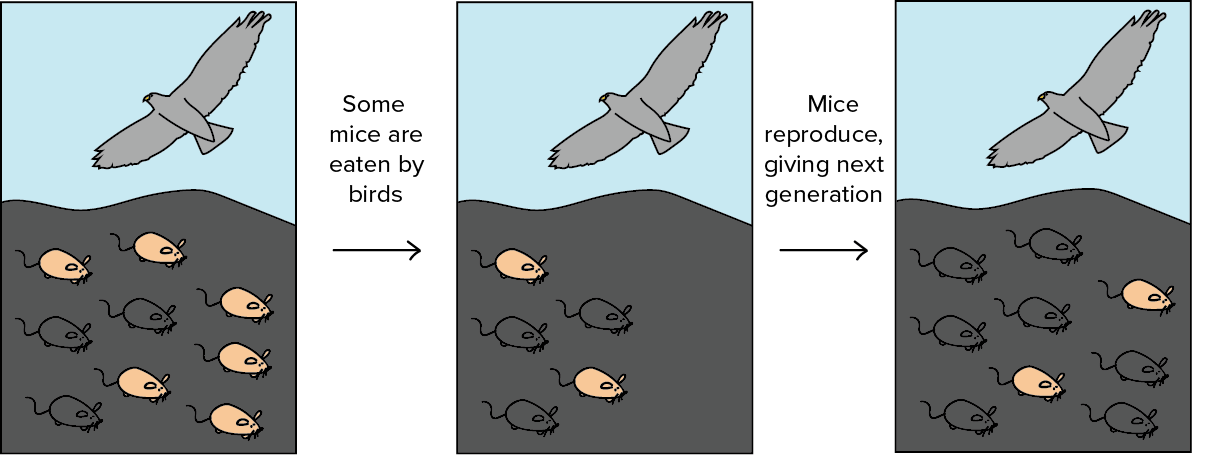
Why is the mouse population changing over time?
a)
The light mice can reproduce more successfully than the dark mice
b)
The hawks eat more dark mice than light mice because the dark mice taste better
c)
The hawks eat more light mice than dark mice because they can see the light mice more easily
d)
The hawks eat more dark mice than light mice because they can see the dark mice more easily
32.
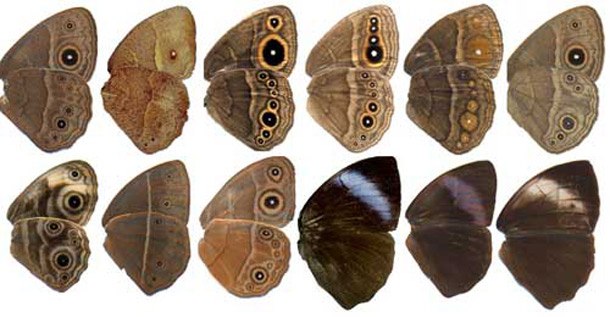
These moths are all the same species. The differences between their wings is an example of ________________
a)
Natural Selection
b)
Variation
c)
Homeostasis
d)
Extinction
33.

Based on the organism skulls, which organisms share the most recent common ancestor?

​Select the two correct answers.

a)
b)
c)
d)
e)
34.

When the industrial revolution started, the trees have been covered in soot from coal factories. Which moth will be more successful in this environment?

a)

White Moth

b)

Dark Moth

c)

Both are Equally Successful in this Environment

d)

Neither will be successful

35.

Why could the same species of moth be two different colors?

a)

Their color was based on their DNA. Sometimes a mutation would cause the moth to be born with a different color.

b)

Their color was caused by the environment. The soot from the factories would fuse with the moth's skin.

c)

Bacteria inside the moth's stomach would sometimes give the moth stomach the ability of the moth to have "active camouflouge." This allowed the moths to change their color at will.

36.

If scientists find fossils of a type of mosquito on the bottom layer and find fossils of beetles towards the top layer, what can scientists infer?

a)

Mosquitos ate the beetles

b)

Mosquitos are older fossils than beetles

c)

Beetles are older fossils than mosquitos

d)

Both mosquitos and Beetles must have lived at the same time.

37.

Scientists believe horses evolved over a period of 50 million years. How did they change?

a)

They became much larger

b)

Their toes eventually were replaced by a hoof

c)

Their environment changed from a forest to a grassland environment

d)

all the other answers!

38.

How do scientists use embryology to support the theory of evolution?

a)

Embryos of many species have a lot of similar characteristics when they are first forming showing different creatures must have a common ancestor

b)

Embryos of many species have very little in common until they start developing for long periods of time

c)

Features like gills and tails prove that all animals are really just fish

39.
What is the process of which humans breed organisms for certain traits?
a)
artificial selection
b)
descent without modification
c)
inheritance of acquired characteristics
d)
natural selection
40.
Which of the following is a factor in natural selection?
a)
Individuals of species compete with one another to survive.
b)
All species are genetically diverse.
c)
Individuals better able to adapt to changes leave more offspring.
d)
All are correct 
41.
The fossil record provides evidence that 
a)
Fossils cannot be dated.
b)
All species were formed during Earth’s formation and have changed little since then.
c)
The fossilized species have no connection to today’s species.
d)
Older species gave rise to more-recent species.
42.
Starting in 1954, commercial fishers in the northwest Pacific were paid by weight, rather than by the individual fish, for pink salmon. The fishers increased the use of a type of net that selectively catches larger fish.  Which of the following effects did this change in fishing technique most likely have on the salmon population over the next 20 years?
a)
The average body size of the salmon population decreased significantly.
b)
The average body size of the salmon population increased significantly.
c)
The average body size of the males in the salmon population increased, and the females stayed the same.
43.
Comparing human hemoglobin of chimpanzees, horses, kangaroos, and chickens, reveal that humans have the fewest amino acid differences with 
a)
Kangaroos
b)
Horses
c)
chickens
d)
chimpanzees
44.
Why are advantageous traits more likely to be passed onto offspring?
a)
Because they are more likely to survive and reproduce.
b)
Because they come from dominant alleles.
c)
Because they come from recessive alleles.
d)
Because the trait is an acquired phenotype.
45.

Mutations are important because they bring about

a)

death of the organism in which they develop

b)

genetic variation needed for a population to evolve

c)

benefits for the individual, not for the population

d)

changes in genotype, but not phenotype