wayground logo

Free Printable Worksheets

Font size

S
M
L
XL
Worksheets

KS3 Forces

Total questions: 35

Worksheet time: 23mins

Name
Class
Date
1.

Forces are measured in....

a)

Kilograms

b)

Newtons

c)

Centimetres

d)

kg/N

2.

Forces are measured using a ….

a)

calculator

b)

Balance

c)

Ruler

d)

Newton meter

3.

Friction is good because....

a)

It allows things to start

b)

It acts as brakes

c)

Both of the above

4.
How does friction affect speed?
a)
more friction decreases speed
b)
more friction increases speed
c)
less friction decreases speed
5.
What surface would have the most friction?
a)
Glass
b)
Marble
c)
Pool table
d)
Sandpaper
6.
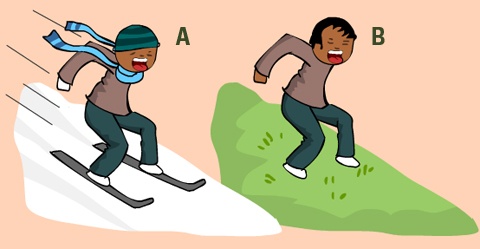
Why is it harder for the boy in Image B to get down the hill?
a)
Motion
b)
Friction
c)
Work
d)
Displacement
7.

without friction, an object in motion would never stop

a)

true

b)

false

8.
What force holds the planets in motion around the sun?
a)
Magnetic
b)
Electrical
c)
Gravitational
d)
Air Resistance
9.
An _______ force must act on an object for it to CHANGE it's motion
a)
balanced
b)
unbalanced
c)
gravitational
d)
electrical
10.

What is defined as a push or pull?

a)

force

b)

motion

c)

vector

d)

speed

11.

If the net force is equal to zero, the forces acting on the object are

a)

balanced

b)

unbalanced

12.
Balanced forces do not change the objects speed or 
a)
direction
b)
distance 
c)
time
d)
mass
13.
What is the net force?
a)
5000 N right
b)
4000 N right
c)
40 N left
d)
4000 N left
14.
If these boys are pulling with the same amount of force.  What will happen?
a)
The boy in blue will win.
b)
They will not move at all.
c)
The boy in red will win.
d)
Both will fall down.
15.

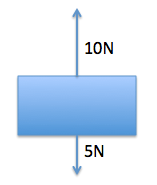
What is the net force on the block? (The overall force)

a)

5 Newtons up

b)

5 Newtons down

c)

15 Newtons up

d)

15 Newtons down

16.

If there were no forces acting on a moving object it would

a)

stay in motion

b)

come to a stop

c)

lose speed

d)

gain speed

17.
What will cause an object to move?
a)
Applied forces
b)
Balanced forces
c)
Unbalanced forces
18.
Balanced or Unbalanced?
a)
Balanced 
b)
Unbalanced
19.

To calculate weight...

a)

Weight = gravity ÷ mass

b)

Weight = distance x time

c)

Weight = volume x distance

d)

Weight = mass x gravity

20.
How could you make an object increase its speed?
a)
use less force
b)
use more force
c)
use no force
21.
Forces that happen between objects that touch are called _____________.
a)
magnetism
b)
gravity
c)
slippery
d)
contact forces
22.

What force is acting upwards on the book?

a)

Gravity

b)

Friction

c)

Thrust

d)

Reaction force

23.

A force is...

a)

a push

b)

a pull

c)

a twist

d)

a push or pull

e)

a push, pull or twist

24.
In a tug of war the left team pulls with a force of 200N. The right team pulls with a force of 150N.What is the resultant force?
a)
50N to the left.
b)
350N to the left.
c)
350N to the right.
d)
50N to the right.
25.

A type of friction that occurs when air pushes against a moving object to slow it down is...

a)

surface area

b)

air resistance

c)

static electricity

d)

gravity

26.

Which answer shows three non-contact forces?

a)

magnetism, gravity, friction

b)

gravity, friction, upthrust

c)

gravity, static electricity, magnetism

d)

upthrust, static electricity, friction

27.

The symbol unit of force is...

a)

N

b)

n

c)

Newton

d)

m

28.

What are the units for weight and mass?

a)

weight – newtons;

mass – kilograms

b)

weight – kilograms;

mass – newtons

c)

weight - kilograms

mass - kilograms

d)

weight – newtons;

mass - newtons

29.

What do most force meters have inside them?

a)

a light bulb

b)

a spring

c)

wires

d)

a battery

30.
Which key term best describes the 'Elastic limit'
a)
a) The point at which the spring breaks.
b)
b) The point at which the elastic snaps.
c)
c) The point at which a material will not return to its original length after being extended.
d)
d) The point at which a material will not stretch any further.
31.
Hooke's Law is a rule that applies to which of the following?
a)
a) Hooks
b)
b) Melting points
c)
c) Gases
d)
d) Springs
32.
Which statement most accurately represents Hooke's Law?
a)
a) Extension of a spring is proportional to the force applied.
b)
b) Extension of a spring is proportional to the number of coils.
c)
c) Extension of a spring is inversely proportional to the force applied.
d)
d) Thickness of a spring wire is proportional to the force applied.
33.
What is the correct procedure to identify an unknown force by using the extension of a spring?
a)
a) Bounce the unknown weight on a spring and measure the length of the biggest bounce.
b)
b) Bounce the unknown weight on a spring and add the lengths of the bounces together.
c)
c) Measure the extension of a spring by adding increasing weights. Draw a trend line on a graph and compare to the extension to the unknown weight.
d)
d) Measure the extension of a spring by adding pulling increasingly hard. Draw a trend line on a graph and compare how hard you pulled to the unknown weight.
34.

Which key term best describes past the 'Elastic limit'?

a)

Plastic

b)

Over elastic

c)

Super elastic

d)

Springy

35.
What is the limit of proportionality/elastic limit.
a)
When the spring stops obeying Hooke's law.
b)
When the spring starts obeying Hooke's law.
c)
The amount a spring will stretch.