wayground logo

Free Printable Worksheets

NEW

Font size

S
M
L
XL
Worksheets

Electricity

Total questions: 45

Worksheet time: 48mins

Name
Class
Date
1.
What is a closed path for electrons to flow through?
a)
static electricity
b)
circuit
c)
amperes
2.
Identify the conductor below.
a)
cloth rag
b)
plastic bottle
c)
gold ring
3.
Identify the insulator below.
a)
aluminum foil
b)
paperclip
c)
rubber eraser
4.
Thicker wires have _______ resistance than thinner wires.
a)
more
b)
less
c)
the same
5.
Electric current is measured in ______.
a)
Watts
b)
Volts
c)
Amperes
6.
As the resistance in a circuit increases, the electric current __________.
a)
increases
b)
decreases
c)
stays the same
7.
Which formulas represents Ohm's law?
a)
V=IR
b)
R=IV
c)
I=RV
8.
How many volts are in a circuit with a battery that has a resistance of 10 Ohms and a current of 2 Amps? 
a)
.5 Volts
b)
5 Volts
c)
20 Volts
9.
Electricity is the flow of _________.
a)
protons
b)
neutrons
c)
electrons
10.
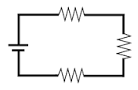
What type of circuit is pictured?
a)
series
b)
Parallel
11.
What type of circuit is pictured?
a)
series
b)
parallel
12.

Opposite charges _______________.

a)

attract

b)

repel

c)

nothing changes

13.

Like charges _______________.

a)

attract

b)

repel

c)

nothing changes

14.

The flow of electric charge in a circuit is called _______.

a)

Heat

b)

Sound

c)

Electric Current

d)

Magnetic

15.

If the light is on, the circuit is _________________.

a)

closed

b)

open

16.
A/an _________________ is an object that will allow electricity to flow through it.
a)
insulator
b)
conductor
17.
A/an _________________ is a material that will not allow electricity to flow through it.
a)
insulator
b)
conductor
18.

How could you make this circuit work?

a)

Close the switch

b)

Take out the bulbs

c)

Add another battery

d)

Add another bulb

19.

Mahra finds that all of the electric cords in her school are covered with plastic. Why is it important to cover the electric cords with plastic?

a)

Plastic is an insulator.

b)

Plastic is a conductor.

c)

Plastic is strong.

d)

Plastic will melt.

20.
Static electricity is:
a)
electricity flowing in a wire
b)
the buildup of electric charges on an object
c)
when protons move between objects
21.
Two objects with LIKE static charges will
a)
attract each other
b)
even out in the end
c)
repel each other
d)
cause a spark
22.
Which is an example of static dischage?
a)
a motor
b)
lightning
c)
thunder
d)
insulators
23.
Which of these is NOT a way to create a static charge?
a)
Friction
b)
Induction
c)
Electroaction
d)
Conduction
24.
Is it possible to CREATE electrons?
a)
Yes, that's what static electricity is.
b)
No, you can move them, but they are never created or distroyed.
c)
Sometimes, it depends on the voltage.
d)
Sometimes, it depends on the element.
25.
If two objects with static charge are attracted, what do you know about them?
a)
They are both positively charged.
b)
They are both negatively charged.
c)
One is positively charged and one is negatively charged, but you won't be able to tell which is which.
d)
One is positively charged and one is negatively charged, and you can tell which is which by looking at them.
26.
Rubbing a balloon on hair is an example of static charge build up created by....
a)
conduction
b)
friction
c)
induction
d)
hairduction
27.

What is a device that supplies the power to an electric circuit (for example: a battery)?

a)

electron

b)

atom

c)

power source

d)

fuse

28.

What type of electric circuit only has ONE path for the electricity to flow?

a)

series

b)

parallel

c)

open

d)

none of the above

29.
How do you calculate voltage?
a)
Current X Resistance
b)
Resistance ÷ Current
c)
Current ÷ Resistance
d)
Measure it with a ruler
30.
How do you calculate current
a)
Resistance X Voltage
b)
Voltage X Resistance
c)
Resistance ÷ Voltage
d)
Voltage ÷ Resistance
31.
What voltage is needed to cause a 2A current flow through a 10Ω resistor?
a)
5V
b)
0.2V
c)
20V
d)
200V
32.
What resistance is needed to cause a 50A current flow because of a 500V battery?
a)
10Ώ
b)
c)
2500Ώ
d)
550Ώ
33.
This is an example of a ______ circuit
a)
Series
b)
Parallel
c)
Open
d)
Dihexihedral
34.
What type of circuit is this?
a)
Parallel Circuit
b)
Series Circuit 
c)
Open Circuit 
d)
Transverse Circuit
35.
Current that reverses direction in a regular pattern is called ____. 
a)
direct current 
b)
circuit current
c)
magnetic current
d)
alternating current 
36.
How does resistance affect current?
a)
less resistance - less current
b)
more resistance - less current
c)
more resistance - more current
d)
resistance does not affect current
37.
Which is an example of static dischage?
a)
a motor
b)
lightning
c)
thunder
d)
insulators
38.

Which is NOT a conductor

a)
b)
c)
d)
39.

Which is NOT an insulator

a)
b)
c)
d)
40.
What is Resistance?
a)
The flow of electrons
b)
Electric potential difference
c)
A battery
d)
The ability to reduce the flow of electrons
41.
What is one problem with using a series circuit? 
a)
It has a lot of series. 
b)
If one goes down, they all go down! 
c)
It doesn't work properly.
d)
There are no problems. 
42.
What is one benefits of using a parallel circuit?  
a)
It gets confusing.
b)
There are no problems.
c)
If one goes down, it does not affect the others. 
d)
Porque es para llelio. 
43.
In a parallel circuit if one of the light bulbs burns out the rest _________.
a)
stop the flow of electricity
b)
 can still light up
c)
 will go out
d)
of the light bulbs burn out also
44.
AC stands for ___.
a)
Alternating Current
b)
Attraction Connections
45.
Current from a battery is 
a)
AC
b)
DC
c)
BC
d)
AC/DC