Wayground logo

Free Printable Worksheets

Font size

S
M
L
XL
Worksheets

Human Body Systems

Total questions: 46

Worksheet time: 30mins

Name
Class
Date
1.

What is the main function of the endocrine system?

a)

For growth and development of the body

b)

It is a protective barrier against infection and disease

c)

To send and receive electrical messages

d)

To create movement

2.

Which body system's is used for communicating and directing the body with electrical signals?

a)

Endocrine

b)

Nervous

c)

Circulatory

d)

Cardiovascular

3.

The cardiovascular system consists of what organ?

a)

Heart

b)

Kidneys

c)

Skin

d)

Cell

4.

Which system provides oxygen and removes carbon dioxide?

a)

digestive

b)

muscular

c)

respiratory

d)

nervous

5.

Which system carries nutrients, water, and oxygen to body cells?

a)

muscular

b)

circulatory

c)

skeletal

d)

respiratory

6.
How do the muscular and skeletal systems work together to help the body?
a)
they provide blood to the body
b)
They provide nutrients to the body.
c)
They provide structure and movement for the body.
d)
They provide oxygen and carbon dioxide to the body.
7.
Which best compares the respiratory system to the circulatory system?
a)
The respiratory system transports oxygen to cells, while the circulatory system provides oxygen for cells.
b)
The respiratory system provides oxygen for cells, while the circulatory system transports oxygen to cells.
c)
The respiratory system breaks down food for cell energy, while the circulatory system rids the body of waste.
d)
The respiratory system rids the body of waste, while the circulatory system breaks down food for cell energy.
8.
Which two human body systems are most responsible for getting oxygen to cells?
a)
digestive and skeletal
b)
skeletal and circulatory
c)
circulatory and respiratory
d)
respiratory and digestive
9.
How does the muscular system depend on the nervous system?
a)
The nervous system transports blood to the muscles.
b)
The nervous system provides support for the muscles.
c)
The nervous system supplies food and oxygen to the muscles.
d)
The nervous system sends signals to the muscles to cause movement.
10.
How does the muscular system depend on the nervous system?
a)
The nervous system transports blood to the muscles.
b)
The nervous system provides support for the muscles.
c)
The nervous system supplies food and oxygen to the muscles.
d)
The nervous system sends signals to the muscles to cause movement.
11.
How does the urinary system work with the circulatory system?
a)
Urinary system excretes waste from the body
b)
Urinary system filters waste from the blood
c)
Circulatory carries electrical messages to the kidneys
d)
Circulatory system produces oxygen for the kidneys
12.
Which system has the spinal cord, brain, and nerves as the main organs?
a)
skeletal
b)
muscular
c)
nervous
d)
respiratory
13.
The following structures belong to which system? trachea, alveoli, and lungs
a)
digestive
b)
excretory
c)
respiratory
d)
circulatory
14.
The following structures belong to which system? bones, joints, ligaments
a)
circulatory
b)
integumentary
c)
skeletal
d)
muscular
15.

How do the skeletal and muscular systems work together to provide movement?

a)

By allowing oxygen to get to cells

b)

By sending chemical messengers to the muscles

c)

By using the nutrients from food to create energy

d)

By having muscles pull on bones in pairs

16.
What 3 systems are involved with moving your body?
a)
endocrine, immune, integumentary
b)
excretory, digestive, immune
c)
muscular, circulatory, reproductive
d)
nervous, skeletal, muscular
17.
What system is pictured here? 
a)
Skeletal 
b)
Circulatory 
c)
Digestive
d)
Integumentary 
18.
A coffee filter can be best compared to which organ in the body?
a)
Stomach
b)
Kidney 
c)
Mouth 
d)
Muscle 
19.

What is the order of organization in the body from smallest to largest?

a)

Cell, tissue, organ system, organ, organism

b)

Cell, organ, organ system, tissue, organism

c)

Cell, tissue, organ, organ system, organism

d)

Organism, organ system, organ, tissue, cell

20.
 Like all other body systems, the immune system helps the body maintain homeostasis.  Which statement best describes how the immune system does this?  
a)
it protects other organs and tissues from infection and disease
b)
it breaks down food to provide cells with nutrients
c)
it gathers information through the senses and controls all other body systems
d)
 it transports oxygen and carbon dioxide
21.
The picture below illustrates one internal part of the body’s immune system. What process is illustrated in the picture?  
a)
a skin cell destroying germs.
b)
inflammation near an opened wound
c)
a white blood cell destroying pathogens
d)
mucus in the lungs destroying pathogens
22.
What do scientists call bacteria and viruses that can make people sick?  
a)
diseases
b)
vaccines
c)
antibodies
d)
pathogens
23.
Jorge has a cold but feels well enough to study with his friends Lisa and Jin. Lisa and Jin become sick. Which term describes Jorge’s condition when he was studying with his friends?  
a)
noninfectious
b)
contagious
c)
immune
d)
deadly
24.
 Liz notices that shortly after cutting her arm accidentally the area around the cut is turning red and feeling hot.  Which immune system defense is Liz experiencing?  
a)
inflammation
b)
white blood cell clotting
c)
skin
d)
fever
25.
Diseases are passed from human to human by these four types of germs: 
a)
Viruses, influenza, HIV, and vaccines
b)
Viruses, bacteria, fungi, and parasites
c)
Viruses, cancers, mutagens, and DNA
d)
Viruses, blood, pollutants, and symptoms
26.
Which answer best describes how infectious diseases get transmitted (passed on)?  
a)
people can sneeze or cough and pass disease on through the air
b)
drinking water can be contaminated with diseases
c)
objects such as doorknobs and towels can be contaminated by disease
d)
all of the above answers are ways that diseases are transmitted
27.
The human body has both internal and external defense against disease.  Which of these includes only internal defenses?  
a)
hair and inflammation
b)
white blood cells and sweat
c)
inflammation and white blood cells
d)
skin and mucus
28.
Erick wants to avoid exposure to infectious disease as much as possible.  Which strategy can best help him do this?  
a)
eat a balanced diet
b)
wash his hands regularly
c)
wear sunscreen outside
d)
exercise several days a week
29.
Scientists are testing the effectiveness of 3 different viral medicines (or vaccines) in protecting against the common cold.  They sign up 1,200 human volunteers and split them into three groups.  So each group of 400 people is given one of the vaccines.  The groups are studied for five years and the scientists record how many colds they get each year.  What is the dependent variable in this investigation?  
a)
different viral medications
b)
the type of common cold virus
c)
the number of years
d)
the number of colds each year
30.
The cells produced via meiosis are called:
a)
sex cells
b)
somatic cells
c)
body cells
d)
skin cells
31.
The chromosomes that pair up during meiosis, are called __________ chromosomes.  
a)
homozygous 
b)
asexual
c)
homologous
d)
genes
32.
How many daughter cells are produced from meiosis ?
a)
10
b)
6
c)
4
d)
2
33.
Name the growth phase of the cell cycle for both Mitosis and Meiosis.
a)
metaphase
b)
telophase
c)
interphase
d)
anaophase
34.
How many cells are produced during telophase I ?
a)
4
b)
8
c)
2
d)
0
35.
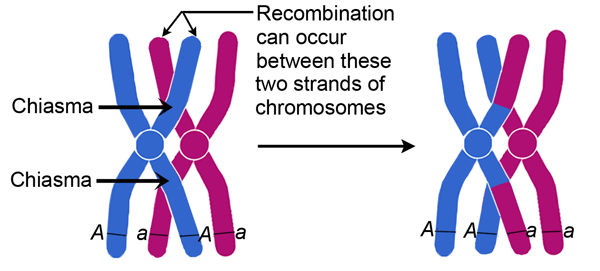
This image shows chromosomes during Prophase 1. Which of the following correctly describes the process shown?
a)
segregation of sister chromatids
b)
condensation and segregation of alleles
c)
mutationin which the DNA content of the gene is altered
d)
crossing - over in which alleles are exchanged
36.
When an area of a chromatid is exchanged with the matching area on a chromatid of its homologous chromosome, _________________ occurs
a)
crossing over
b)
mutagenesis
c)
hybridization
d)
fertilization
37.

At the end of mitosis you have _____ cells

a)

identical

b)

different

c)

identical twins

d)

variety

38.
products of meiosis are genetically
a)
different
b)
identical
39.
How are your chromosomes inherited?
a)
most of your chromosomes from your mother
b)
most of your chromosomes from your father
c)
a random number of chromosomes from each parent
d)
half your chromosomes from your mother and half from your father.
40.

A human body (somatic) cell usually has how many chromosomes?

a)

6

b)

22

c)

4

d)

46

41.
The process of crossing over occurs in what phase of meiosis?
a)
anaphase 1
b)
prophase 1
c)
prophase 2
d)
telophase 1
42.
The process of crossing over occurs in what phase of meiosis?
a)
anaphase 1
b)
prophase 1
c)
prophase 2
d)
telophase 1
43.

The chromosomes that pair up during meiosis, are called __________ chromosomes.

a)

heterozygous

b)

asexual

c)

homologous pairs

d)

genes

44.
What process, and which type of resulting cells are represented?
a)
mitosis, gametes
b)
mitosis, body cells
c)
meiosis, gametes
d)
meiosis, body cells
45.
What phase is represented?
a)
metaphase 1
b)
metaphase 2
c)
anaphase 1
d)
anaphase 2
46.
What phase is represented?
a)
metaphase 1
b)
metaphase 2
c)
anaphase 1
d)
anaphase 2