
 Worksheets
The Earth and the Solar System
Total questions: 15
Worksheet time: 15mins
Name
Class
Date
1.
Which planet in our solar system is closest to the Sun?
a)
Earth
b)
Jupiter
c)
Mercury
d)
Saturn
2.
Which of the following is an accurate model of how the Sun, Earth, and Moon move?
a)
Sun and moon orbit Earth
b)
Earth and moon orbit Sun
c)
Earth orbits the Sun and the moon orbits Earth
d)
Earth and sun orbit moon
3.
What planet is eighth in the Solar System?
a)
Uranus
b)
Jupiter
c)
Neptune
d)
Mars
4.
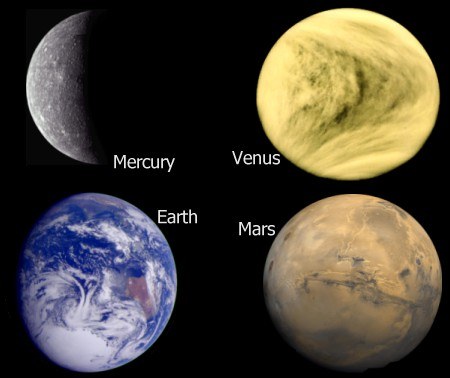
Earth and the other planets closest to the Sun are made mostly of _______
a)
gas
b)
metal
c)
water
d)
rock
5.
Which is the largest object in our solar system?
a)
Sun
b)
Jupiter
c)
Earth
d)
Pluto
6.
A ball of ice and dust with a tail of gas and dust pointing away from the sun.
a)
Asteroid
b)
Comet
c)
Moon
d)
Meteor
7.
Which is the second closest planet to the sun?
a)
Earth
b)
Saturn
c)
Venus
d)
Mercury
8.
Which planet is third from the sun?
a)
Mars
b)
Pluto
c)
Venus
d)
Earth
9.

Which planet is NOT one of the
"Gas Giants"?
a)
Uranus
b)
Venus
c)
Neptune
d)
Saturn
10.

What is the largest planet in
our solar system?
a)
Neptune
b)
Jupiter
c)
Uranus
d)
Mars
11.

One full orbit of an object around another object is called a ________.
a)
axis
b)
rotation
c)
revolution
d)
satellite
12.
Select the order from smallest to largest.
a)
Sun, Milky Way, solar system, universe
b)
Sun, Milky Way, universe, solar system
c)
Sun, solar system, Milky Way, universe
d)
Sun, solar system, universe, Milky Way
13.
Day and night is caused by the _____________ of earth on its axis.
a)
revolution
b)
orbit
c)
rotation
14.
Which outer planets have rings?
a)
Just Saturn
b)
Saturn and Jupiter
c)
Jupiter, Neptune, and Saturn
d)
all 4 of the outer planets
15.

a small rocky body orbiting the sun, ranging from the size of a small house to dust particles
a)
nebula
b)
terrestrial planets
c)
collision
d)
asteroids
100 %

