
 Worksheets
Scalar & Vector
Total questions: 33
Worksheet time: 49mins
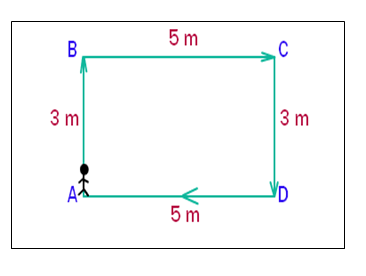

Michael walks in the following order: from Point A, to Point B, and finally to Point C. Which is true?
Distance and displacement are EQUAL
Distance is less than displacement
Displacement is less than distance.
Juan walks in the following order: from Point A, to Point B, to Point C, and stops at Point D. Which is true?
Distance and displacement are EQUAL
Distance is less than displacement
Displacement is less than distance.
Which one of the following is scalar quantity
Force
Length
Velocity
Acceleration
Which of the following is a scalar quantity
Acceleration
Velocity
temperature
momentum
Which one of the following is a scalar quantity
work
displacement
acceleration
momentum
Which one of the following is vector quantity
work
energy
force
mass
Which one of the following is vector quantity
power
energy
temperature
acceleration
Which one of the following is vector quantity
area
length
velocity
energy
Which statement describes a vector?
It has magnitude but no direction
It has direction but no magnitude
It has both direction and magnitude
It has constant magnitude but no
direction
How should you add two vectors?
Add them head to tail
Add them tail to tail
Add them with the addition key
Add the length of each
A physical quantity that has magnitude only is
scalar quantity
vector quantity
derived quantity
A physical quantity that has both magnitude and direction is known as
derived quantity
scalar quantity
vector quantity
Which of the following physical quantities is a scalar quantity?
Displacement
Momentum
Force
Work
With this one, try drawing the diagram yourself to help you if you need it:
A football is kicked at 12 m s-1 at an angle of 35° to the horizontal. The horizontal component of its velocity, in m s-1, is given by
12cos 35°
12sin35°
cos35°12
sin35°12

Two forces F1 and F2 act on an object as in the diagram above.
If F1 and F2 are drawn to scale, the resultant force can be found by measuring the length of the resultant line FR.
Which of the following diagrams shows the correct position of the line FR?


Vertical 7.2
Vertical 18.9
Vertical 9.6
Vertical 15.2


Two forces act on an object to the right at the same time. What is the net force on the object?
9 N to the right
9 N to the left
3 N to the left
18 N to the left
Two forces act on an object to the right at the same time. What force is required to bring the object into equilibrium?
9 N to the right
9 N to the left
3 N to the left
18 N to the left


