
 Worksheets
buoyancy
Total questions: 23
Worksheet time: 27mins
The amount of matter in an object is ____.
mass
volume
density
buoyancy
The unit used to measure mass is
cubic centimeters (cm3 )
milliliters (mL)
g/cm3
grams (g)
How much space an object take up is its _______________.
volume
mass
density
buoyancy
The amount of mass in a given volume is _________.
Mass
Volume
Density
Buoyancy
An upward force that a displaced fluid exerts on an object_____.
Mass
Volume
Density
Buoyant Force
When atoms start to move slower, get closer together and become more dense, what has happened to the temperature?
The temperature has gone up.
The temperature has gone down.
There was no change in the temperature.
If an object that weighs 100 pounds is thrown in water and displaces 80 pounds of water, what will it do?
If will float
It will sink
It will be buoyed up.
If an object has a volume of 10 mL and a mass of 20 g, what is its density?
.5 g/mL
200 g/mL
2 g/mL
Which tool can we use to find the mass of an object?
Balance
Beaker
Graduated Cylinder
Ruler
Which equation below is used to find density?
Length times width times height
Mass divided by volume
Radius squared times Pi times height.
The kinetic theory of matter states
All objects are made of matter.
The atoms in matter will stop moving if you get them cold enough.
The atoms in matter are always in motion.
Which of the following is not a fluid?
Solids
Liquids
gasses
How many millilters would 15 cubic centimeters be?
5
10
15
20
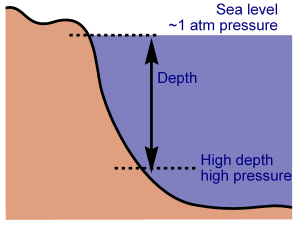
When you increase your depth under water, the water pressure on your body
increases
decreases
stays the same


The upward force exerted by a fluid is called the...
buoyancy force
density force
fluidity force
normal force
_______ pushes an ice cube to the top of a glass of water.
Buoyant force
a sinking object
Density
Compressed air
A block of metal is thrown into a lake. What happens to the buoyant force as it sinks deeper in the water?
Increases
Decreases
remains the same
increases and then decreases
The magnitude of the buoyant force is equal to the weight of fluid displaced by the object _____.
for every object submerged partially or completely in a fluid
only for an object that floats
only for an object that sinks
for no object submerged in a fluid
A 5 N stone is dropped in a lake and it sinks. Which of the relationships below is true for the buoyant force on the stone?
𝐹B= 0
𝐹B=5𝑁
𝐹B<5𝑁
𝐹B>5𝑁

