
 Worksheets
Introduction to electrolysis
Total questions: 21
Worksheet time: 11mins
Name
Class
Date
1.
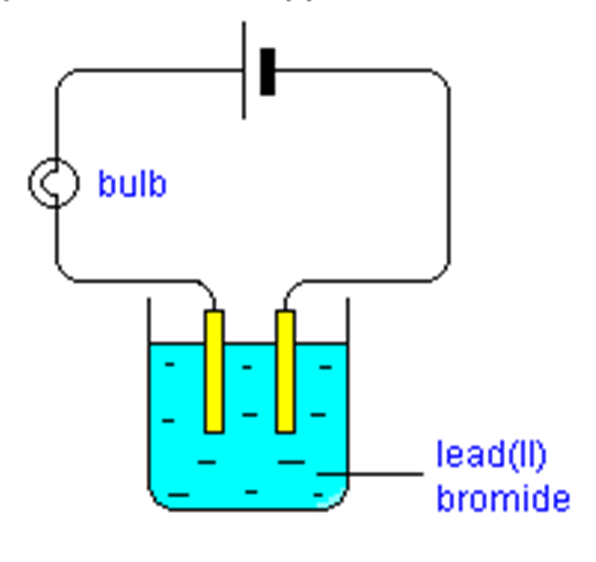
The diagram shows the electrolysis of lead(II) bromide using inert electrodes. Why does the bulb only light up when the lead(II) bromide is melted?
a)
Bromine atoms in lead(II) bromide are converted to ions when it is melted
b)
Electrons flow through the lead(II) bromide when it is melted
c)
The ions in lead(II) bromide are free to move when it is melted
d)
There are no ions in solid lead(II) bromide
2.
The electrode connected to the positive terminal of a battery is __________.
a)
cathode
b)
anode
3.
The negatively charged ions migrate toward the ________.
a)
anode
b)
cathode
4.
What is electrolysis?
a)
breaking down of a compound using a current
b)
making a compound using a current
5.
Which statement correctly describes the 2 electrodes?
a)
The anode is negative and the cathode is positive
b)
The anode and cathode are both positive
c)
The anode is positive and the cathode is negative
d)
The anode and cathode are both negative.
6.
What is the name given to the solution that is being electrolysed?
a)
Salt solution
b)
Electric solution
c)
Mineral solution
d)
Electrolyte
7.
Explain why the electrolyte has to be a liquid.
a)
So the ions can move
b)
So the electrons can move
c)
So that it doesn't get too hot
d)
So the fish are ok
8.
What happens at the positive electrode?
a)
Positive non-metal ions are attracted
b)
Positive metal ions are attracted
c)
Negative non-metal ions are attracted
d)
Negative metal ions are attracted
9.
Positive ions (cations) will move towards the cathode (-) where they will discharge by....
a)
Breaking apart
b)
Losing electrons
c)
Clumping together.
d)
Gaining electrons
10.
What does the Cathode (-) do to ions?
a)
Give electrons to the Positive ions to turn them back into atoms
b)
Take electrons from the positive ions?
c)
Turn ions back into atoms by removing electrons
d)
Turn atoms into ions by adding electrons
11.
What is the equation to show what happens to Cl ions at the anode.
a)
Cl- --> Cl + e-
b)
2Cl- --> Cl2 + 2e-
c)
Cl2 + 2e- 2Cl-
d)
Cl2 + 2e- --> 2Cl-
12.
Anions get discharged by ________ electrons at the ___________
a)
gaining, cathode
b)
losing, anode
c)
gaining, anode
d)
losing, cathode
13.
Positive ions (cations) move towards the cathode (-) where they will discharge by....
a)
Breaking apart
b)
Losing electrons
c)
Clumping together.
d)
Gaining electrons
14.
What ions are present in molten aluminium oxide?
a)
Al3+, O2-, H+, OH-
b)
Al3+, O2-
c)
Al3+, OH-
15.
Which electrode is inert electrode.
a)
Copper
b)
Iron
c)
Carbon
d)
Zinc
16.
Oxidation is loss of electron. Where does oxidation take place during electrolysis.
a)
At anode
b)
In the solution
c)
At the circuit
d)
At cathode
17.
Which of the following substances conducts electricity in both the solid and liquid states?
a)
Paraffin wax
b)
Potassium
c)
Potassium chloride
d)
Sulfur
e)
Venus
18.
Molten lead(II) bromide is able to conduct electricity due to the presence of
a)
free atoms
b)
molten lead
c)
mobile ions
d)
bromine gas
19.
reduction is ...
a)
loss of electrons
b)
gain of electrons
20.
Electrodes are commonly made of ...
a)
graphite
b)
copper
c)
zinc
d)
sodium
21.
Ionic compounds can carry charge when dissolved or molten.
a)
true
b)
false
100 %

