
 Worksheets
Collision Theory and Reaction Rates
Total questions: 20
Worksheet time: 26mins
What factors affect reaction rate?
size of atoms
temperature
concentration
surface area
catalysts
A log is burning in a campfire. If the concentration of oxygen reaching the log is increased, what will happen to the reaction rate?
reaction rate decreases
reaction rate increases
reaction rate remains the same
What is necessary for a chemical reaction to occur?
Correct orientation of particles when they collide
particle collisions
an increase or decrease in temperature
particle collisions with sufficient energy
a catalyst
A reactants temperature is increased. What happens?
more collisions occur
the same number of collisions occur
greater collision energy
less collision energy
the same collision energy
the rate at which a chemical reaction takes place
activation energy
collision theory
reaction rate
chemical reactions
As a reaction proceeds, the concentration of reactants will _______ and the concentration of products will ________.
increase, decrease
increase, increase
decrease, decrease
decrease, increase
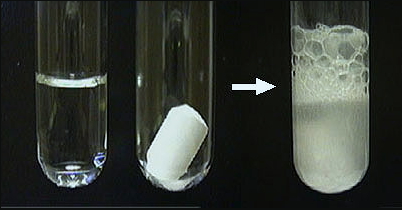
How could we make this reaction happen more quickly?
Decrease the concentration of the acid
crush the chalk to increase the surface area
Put the test tube in an ice bath
Which has more surface area?
Large chunks of chalk
Cube of sugar
Powdered sugar
Small chunks of sugar
Why does a higher concentration increase the rate of reaction?
it increases the amount of reactants
it lowers the activation energy
it increases the energy of particle collisions
it increases the frequency of particle collisions


What the Activation energy?
The maximum energy a reaction can release
The minimum amount of energy that reacting particles must have when colliding to form products
The energy added by a catalyst
The energy possessed by the products
A high activation energy means the rate of the reaction will be...
fast
slow
medium
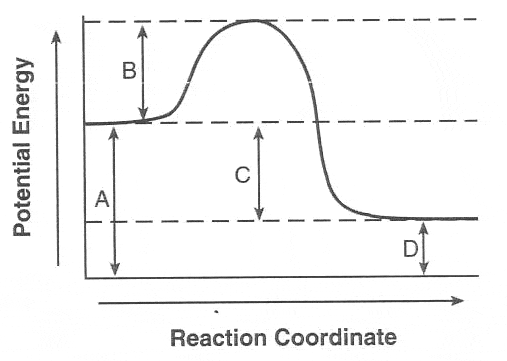

Calculate the rate of reaction between 20 and 30 seconds.
(a)
Given the following reaction: P4O10 + Mg(OH)2 ---> Mg3(PO4)2 + H2O
If the rate of consumption of Mg(OH)2 is 1.2 x 10⁻⁴ mol L-1s-1, what is the rate of formation
of Mg3(PO4)2 ?
3.6 x 10⁻⁵ mol L-1s-1
4.0 x 10⁻⁵ mol L-1s-1
6.0 x 10⁻⁵ mol L-1s-1
6.5 x 10⁻⁵ mol L-1s-1

