
 Worksheets
Animal Kingdom- Phylum Porifera TO Arthropoda
Total questions: 24
Worksheet time: 24mins
Which of these is a picture of a choanocyte?


The large opening at the top of the sponge is called the
Osculum
Porocyte
Spicule
Spongocoel
Which of the following is NOT what a sponge skeleton can be made of?
Spongin
Spicule
Cnidocyst
Silica

Sponges feed by filtering _____________ out of the water column as it passes through the spongocoel.
small fish
oxygen
macro algae
plankton
What are stinging organelles with a coiled thread found in the tentacles which are used to capture prey or defend against predators?
cnidocytes
nematocytes
choanocyte
pinacocytes
What are the two modes of asexual reproduction observed in a sponge?
binary fission
budding
regeneration
sexual reproduction
The first organisms to evolve tissues that helped with the movement of the organism?
Sponges
Cnidarians
Poriferians
Algae

This picture of a sea anemone would represent which form of a Cnidarian?
Larval
Polyp
Medusa
Free-swimming
Cnidarians were the first animals to develop _____________ cells so they could react to their environment.
epidermis
gastrodermis
nerve
collar
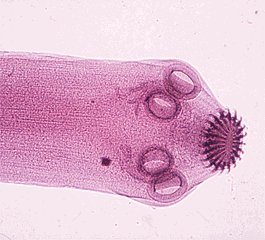
Why are Platyhelminthes flat?
the type of respiratory system they contain
because they have no respiratory system and they respire by diffusion across skin
the placement of their mouth 2/3 of the way down their ventral surface
They are acoelomates with bilateral symmetry
Which of the following best describes the body cavity of a flatworm?
acoelomate
pseudocoelomate
true coelomate
diploblastic
Which of the following is not an arthropod characteristic?
Jointed appendages
Nonsegmented body
molting
exoskeleton

Which annelid has developed the ability to suck blood from other organisms?
Earthworms
Bristle worms
Leeches
Roundworms

Another word for "Molting" is called
Metamorphosis
Tagmatization
Scaling
Ecdysis
Crustaceans have
Cephalothorax and abdomen
two pairs of antennae
five or more pairs of legs
all of these answers are true
Filarial worms (also called thread worms) that live in the lymphatic system where they block vessels causing fluid to build up and enlarge various appendages, a condition called elephantiasis.
Wuchereria
Trichinella
Necator
Ascaris
Enterobius
The nematode ______________________ is a fluid-filled cavity that contains the visceral organs and forms a hydrostatic skeleton.
mesoderm
acoelom
pseudocoelom
coelom
What is an animal that has both male and female organs?
Acoelomate
Intersex
Hermaphrodite

