wayground logo

Free Printable Worksheets

Font size

S
M
L
XL
Worksheets

coordinated science revision

Total questions: 75

Worksheet time: 2hrs 23mins

Name
Class
Date
1.

__________ is an energy resource that WILL run out in the next several hundred years.

a)

Renewable Energy Resource

b)

Non-renewable Energy Resource

2.

if you push a cart with a force of 60 N for 2 m... how much work have you done

a)

120 J

b)

30 J

c)

120 N

d)

30 N

3.

units for work are

a)

newtons

b)

joules

c)

meters

d)

seconds

4.

Two factors that determine work are

a)

force

b)

acceleration

c)

mass

d)

distance

e)

velocity

5.
Which energy source does NOT use turbines?
a)
wind
b)
hydropower
c)
solar
d)
nuclear
6.
You do 90 joules of work in 30 seconds. How much power have you generated?
a)
30 watts
b)
3 watts
c)
120 watts
d)
270 watts
7.

At which point of the roller coaster is potential energy the greatest?

a)

W

b)

X

c)

Y

d)

Z

8.

When you eat fruits and vegetables, chemical bonds are releasing stored energy, this is...

a)

a. thermal energy

b)

b. sound energy

c)

c. electrical energy

d)

d. chemical energy

9.

A student is holding the end of a pendulum. The student releases the pendulum. What energy transfers are taking place?

a)

potential energy is transferred to kinetic energy

b)

chemical energy to thermal energy

c)

mechanical energy to chemical energy

d)

kinetic energy is tranferred to potential energy

10.
Which direction will the heat flow while this person holds a hot cup of tea?
a)
from the cup to her hand
b)
from her hand to the cup
c)
no heat is transferred
11.
Transfer of thermal energy through "space"
a)
conduction
b)
convection
c)
radiation
12.

A cheetah can run briefly with a speed of 31.0 m/s. Suppose a cheetah with a mass of 47.0 kg runs at this speed. What is the cheetah’s kinetic energy?

a)

1457 Joules

b)

22,584 Joules

c)

15 Joules

d)

45,167Joules

13.
The SI unit in which kinetic energy is measured is 
a)
Newton
b)
Kilogram
c)
Joules
d)
Metres per second
14.

What is the kinetic energy of a ball with a mass of 5kg rolling at 10m/s

a)

50 J

b)

500 J

c)

250 J

d)

25 J

15.
A 5000N block is lifted 10 m. How much work was done?
a)
50000 J
b)
5000 J
c)
500 J
d)
50 J
16.
Which of the following is NOT a function of the digestive system?
a)
Breaking down food into molecules the body can use
b)
Absorb molecules into the blood and carry them throughout the body
c)
Food allows blood cells to flow through arteries and veins
d)
Eliminate waste
17.
Consider the food chain:
grass >>> insect >>> frog >>> snake
Which is the 3rd level consumer?
a)
grass
b)
insect
c)
frog
d)
snake
18.
What two types of particles exist within an atomic nucleus?
a)
protons and neutrons
b)
Neutrons and electrons
c)
Protons and neutrinos
d)
Positrons and neutrons
19.
Carbon has an atomic number of 6. What can you conclude about carbon from this fact?
a)
It has six protons
b)
It has six neutrons 
c)
It's in group 6
d)
It's in period 6
20.
To become positively charged, an atom must:
a)
Gain a proton
b)
Lose a proton
c)
Gain an electron
d)
Lose an electron
21.
How many neutrons does the isotope of lithium have?
a)
8
b)
3
c)
4
d)
5
22.
Ions are: 
a)
atoms with a positive or negative charge
b)
atoms with no charge
c)
atoms with ONLY a positive charge
d)
atoms with ONLY a negative charge
23.
Which of the following is a REACTANT of photosynthesis?
a)
Oxygen
b)
Carbon dioxide
c)
Sugar
d)
Heat
24.
Is photosynthesis an exothermic or endothermic reaction?
a)
Endothermic
b)
Exothermic
c)
Neither
d)
It is not a chemical reaction
25.
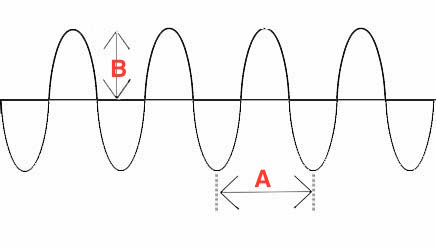
What property of this wave is represented by the letter "A"
a)
amplitude
b)
crest
c)
trough
d)
wavelength
26.
The number of wavelengths that pass a point each per second is:
a)
frequency
b)
period
c)
longitudinal 
d)
transverse wave 
27.
When a wave bends as it passes through at an angle from one medium to another.(example: pencil in a glass of water-)
a)
medium
b)
refraction
c)
reflection
d)
interference
28.
_____ is a lens that is thicker in the middle and makes an object appear bigger.
a)
prism
b)
convex lens
c)
concave lens
d)
mirror
29.
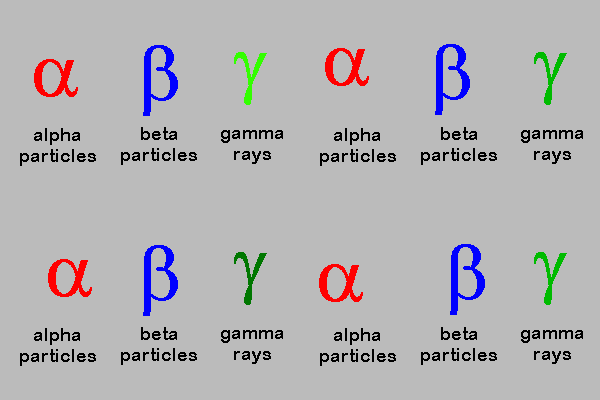
In order of most to least penetrating radiation we have
a)
Alpha , Beta,  Gamma
b)
Beta , Gamma , Alpha
c)
Gamma, Beta, Alpha
d)
Gamma, Alpha, Beta
30.
What type of radiation can be stopped by a 5 mm piece of aluminium?
a)
Alpha radiation
b)
Beta radiation
c)
gamma radiation
31.
What do atoms contain?
a)
elements, neutrons, and bonds
b)
protons, neutrons, and electrons
c)
protons, molecules, and elements
d)
electrons, protons, and bonds
32.
What's a herbivore
a)
Eats meat
b)
Eats plants
c)
eats meat and plants
d)
decomposes
33.
What kinetic energy?
a)
Energy of Motion
b)
Potential Energy
c)
Food Energy
34.

Elements on the Periodic Table are ordered according to their

a)

element name

b)

element symbol

c)

number of atoms

d)

atomic number

35.

Rows in the Periodic Table are called

a)

Periods

b)

Groups/Families

c)

Cousins

d)

Metals

36.

A force of 20 N does 10 J of work when it moves an object through a distance d in the direction of the force.

What is distance d?

a)

0.5m

b)

2.0m

c)

10m

d)

200m

37.

What is the site of gas exchange in lungs called?

a)

Trachae

b)

Bronchi

c)

Alveoli

d)

Esophagus

38.

Which acid is produced by the stomach?

a)

Pepsin

b)

Hydrochloric Acid

c)

Gastric Juice

d)

Amino Acid

39.

The diagram shows a typical plant cell. What are the structures X, Y and Z?

a)

X- Traps light, Y- Contains genetic material, Z- Controls entry and exit of materials

b)

X-Traps light, Y-Site of chemical reactions, Z- Provides Support

c)

X-Contains genetic material, Y-Site of chemical reactions, Z- Controls entry and exit of materials

d)

D- Contains genetic material, Y- Controls entry and exit of materials, Z- Provides support

40.

The statements explain the activity of a human enzyme as the temperature increases from 20 °C

to 50 °C. The statements are in the wrong order.

1 The enzyme is working at its optimum rate.

2 The kinetic energy of the enzyme molecules begins to increase.

3 The enzyme begins to change shape.

4 The enzyme is completely denatured.

What is the correct order of the statements?

a)

1 → 3 → 2 → 4

b)

1 → 4 → 3 → 2

c)

2 → 1 → 3 → 4

d)

3 → 2 → 4 → 1

41.

Which statement about atoms and molecules is correct?

a)

Atoms loose or gain electrons to become molecules

b)

Atoms of the same element contain the same number of molecules

c)

Molecules are the simplest unit of an atom

d)

Molecules contain atoms that are covalently bonded

42.

Which diagram represents a mixture of two elements?

a)

A

b)

B

c)

C

d)

D

43.

Which statement about atoms and ions is not correct?

a)

A chlorine atom loses one electron to obtain a noble gas electronic structure.

b)

A magnesium atom has two valency electrons.

c)

A sodium ion, Na+, has eight electrons in its outer shell.

d)

Oxygen atoms and oxide ions each have two occupied electron shells.

44.

Which equation represents the reaction at the cathode during the electrolysis of aqueous copper(II) chloride?

a)

2Cl → Cl 2 + 2e

b)

Cu2+ + 2e → Cu

c)

2H+ + 2e → H2

d)

4OH → O2 + 2H2O + 4e

45.

Diagrams 1, 2 and 3 each show either a distance-time graph or a speed-time graph.


Which of the diagrams represent the motion of an object moving with a non-zero constant acceleration?

a)

1 and 3

b)

1 only

c)

2 only

d)

3 only

46.

The diagram represents a wave.


What is the wavelength of the wave?

a)

3cm

b)

4cm

c)

6cm

d)

8cm

47.
a)
A
b)
B
c)
C
d)
D
48.
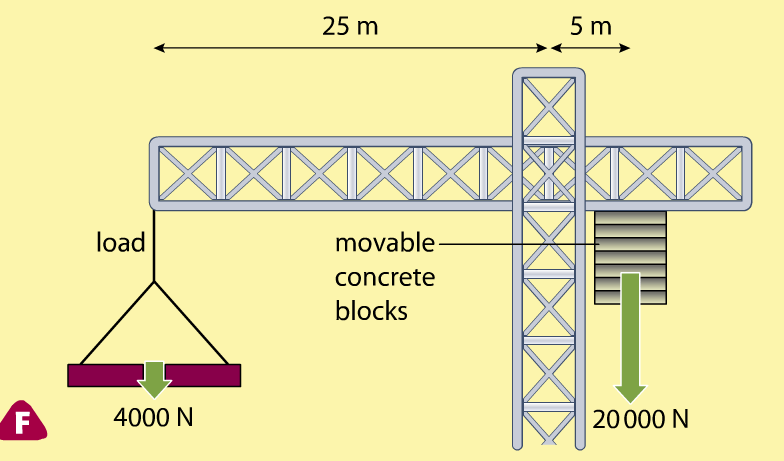
What is the anticlockwise moment acting on this crane?
a)
80,000Nm
b)
100,000Nm
c)
120,000Nm
d)
140,000Nm
49.

What is the correct equation linking voltage current and resistance

a)

V = IR

b)

R = VI

c)

I = VR

50.

Which row describes the electrolysis of molten potassium bromide?

a)

A

b)

B

c)

C

d)

D

51.
Name this part.
a)
Right atrium
b)
Left ventricle
c)
Right ventricle
d)
Left atrium
52.
What type of transport is occurring in Part C of the diagram shown?
a)
Active Transport
b)
Osmosis
c)
Facilitated Diffusion
d)
Diffusion
53.
What are the products of photosynthesis?
a)
carbohydrates + oxygen
b)
carbohydrates + water
c)
carbon dioxide + oxygen
d)
carbon dioxide + water
54.
A person moves their hand away from a hot object.Which characteristic of living organisms is this?
a)
growth
b)
nutrition
c)
reproduction
d)
sensitivity
55.

The apparatus shown is used to investigate the speed of reaction between hydrochloric acid and calcium carbonate.


The time to collect 50 cm3 of gas is measured. Using concentrated acid and lumps of calcium carbonate, the time is 150 s.


In a second experiment, the time is 90 s. Which change was made in the second experiment?

a)

larger lumps of calcium carbonate

b)

less concentrated acid

c)

lower temperature

d)

powdered calcium carbonate

56.

What is the correct equation linking charge current and time

a)

Q = It

b)

I = Qt

c)

t = QI

57.
What type of circuit is pictured?
a)
series
b)
Parallel
58.
How many volts are in a circuit with a battery that has a resistance of 10 Ohms and a current of 2 Amps? 
a)
.5 Volts
b)
5 Volts
c)
20 Volts
59.

If the current through a resistor is 2A and the voltage across it is 12V, what is the resistance

a)

12Ω

b)

c)

24Ω

d)

0.167Ω

60.

Which direction is the electron flow in a circuit?

a)

Negative to positive

b)

Positive to negative

61.

Which direction is conventional current

a)

positive to negative

b)

negative to positive

62.

Which direction is used for magnetic field

a)

North to south

b)

South to north

c)

negative to positive

d)

positive to negative

63.

A coil of wire with a current flowing through it

a)

Generator

b)

Motor

c)

Solenoid

d)

Magnet

64.
Bases
a)
formed from joining positive and negative ions
b)
increase OH ions
c)
forms a salt and water
d)
increases H2O ions
65.
Which of the following is a chemical property of a base
a)
a slippery feel
b)
conducts an electric current
c)
turns red litmus paper blue
d)
forms hydronium ions in water
66.
Which of the following is a salt: ammonia or sodium chloride?
a)
ammonia 
b)
sodium chloride
67.
The difference between a strong and weak acid is: 
a)
Strong acids stay intact in water weak acids don't 
b)
Strong acids are slippery weak acids aren't
c)
Strong acids break apart in water. Weak acids stay intact
d)
Weak acids break apart in water most of the time, strong acids do all of the time. 
68.
How does an egg cell move through the fallopian tube?
a)
Via diffusion
b)
Ciliated epithelial cells move it along
c)
Via gas exchange
d)
It drifts through the liquid in the fallopian tube
69.
What happens to the egg if no pregnancy occurs?
a)
It is re-used
b)
Is comes out with the next period
c)
It disintegrates
d)
It is reabsorbed by the ovary
70.
Which organisms in a prairie ecosystem are producers?
a)
prairie dogs, rabbits, and mice
b)
hawks, owls, and snakes
c)
grass and bushes
d)
All of the organisms are producers.
71.
Which is NOT an abiotic factor?
a)
grass
b)
rocks
c)
oxygen
d)
water
72.
When fertilizers run off farmland into streams and ponds, the nitrogen content of the water increases. This can lead to rapid growth of algae in a process called eutrophication. How can this process affect other organisms in the water?
a)
Oxygen is used up as algae is decomposed, reducing the amount available to other organisms.
b)
The water becomes better able to support aerobic organisms.
c)
The algae provide food for fishes and other organisms, leading to decreased algae populations.
d)
The extra nitrogen provides additional food for the other organisms, increasing their population.
73.

A characteristic that a living thing gets from its parents

a)

inherited trait

b)

learned behavior

c)

physical behavior

d)

acquired trait

74.

To receive a characteristic or trait genetically form one's parent or grandparent.

a)

Inherit

b)

Nurture

c)

Acquire

75.
What cells have NO nucleus?
a)
Leaf cells
b)
Animal cells
c)
Red blood cells
d)
egg cells