
NEW
Font size
S
M
L
XL
 Worksheets
Summer School Physical Science - CH 18 - Section I
Total questions: 15
Worksheet time: 8mins
Name
Class
Date
1.
The central core of an atom is called the ________.
a)
hub
b)
nucleus
c)
grand junction
d)
plum bob
2.
The region around the nucleus occupied by the electrons is called the negative zone.
a)
True
b)
False
3.
The symbol for chlorine is ___________.
a)
C
b)
Ch
c)
Cl
d)
Au
4.
According to present atomic theory, the location of an electron in an atom is best represented by a probability cloud.
a)
True
b)
False
5.
Particles of matter that make up protons and neutrons are __________.
a)
electrons
b)
atoms
c)
isotopes
d)
quarks
6.
A chemical symbol represents the __________ an element.
a)
name
b)
spirit
c)
structure
d)
type
7.
A particle that moves around the nucleus is a(n) __________.
a)
proton
b)
neutron
c)
ion
d)
electron
8.
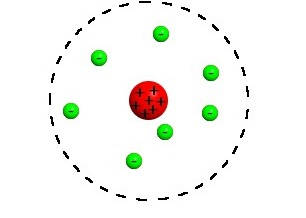
This model this model was the first to show a nucleus, consisting of protons and neutron. Electrons surround the nucleus but are not shown in distinct energy levels.
a)
The "Rutherford Model" of the atom
b)
The "Plum Pudding Model" of the atom
c)
The "Quantum Mechanical Modell" of the atom
d)
Democritus's model of the atom
9.

This was the first model of the atom ever proposed. It was simple and described atoms as tiny spheres that could not be broken down into smaller pieces.
a)
Democritus's model of the atom
b)
The "Plum Pudding Model" of the atom
c)
The "Rutherford Model" of the atom
d)
The "Quantum Mechanical Model" of the atom
10.

This is the most complete and current model of the atom. It consists of 61 elementary particles. Electrons are located in complex orbitals.
a)
The "Quantum Mechanical Model" of the atom
b)
The "Rutherford Model" of the atom
c)
The "Plum Pudding Model" of the atom
d)
The "Bohr Model" of the atom
11.

This model added on to previous models by showing electrons existed at certain "energy levels". However it does not accurately show what those levels look like.
a)
The "Bohr Model" of the atom
b)
The "Rutherford Model" of the atom
c)
The "Plumb Pudding Model" of the atom
d)
The "Quantum Mechanical Model" of the atom
12.

This model was developed after J.J. Thompson discovered electrons, a particle smaller than an atom. Is shows electrons floating freely in a positive space.
a)
The "Plum Pudding Model" of the atom
b)
The "Rutherford Model" of the atom
c)
Democritus's model of the atom
d)
The "Quantum Mechanical Model" of the atom
13.

Ernest Rutherford discovered that atoms were mostly _________________.
a)
negatively charged
b)
positively charged
c)
electrons
d)
empty space.
14.

What does the nucleus of an atom contain?
a)
Electrons & Neutrons
b)
Protons & Neutrons
c)
Neutrinos & Positrons
15.
What can you conclude from the fact that scientists continue to update the atomic model?
a)
New information about atoms continues to be discovered
b)
Old information about atoms is completely useless
c)
Scientists did not have any information about atoms until a few years ago
d)
Scientists still have no idea what atoms look like
Reset

