
 Worksheets
Particle model pre and post test
Total questions: 20
Worksheet time: 10mins
Name
Class
Date
1.
Which states allow easy flow of particles
a)
Gas and Solid
b)
Gas and Liquid
c)
Solid and Liquid
d)
Gas only
2.
which of the following would be most stolid?
a)
Ice
b)
Jelly
c)
Honey
d)
Tomato Sauce
3.
How do materials change from one state of matter to another?
a)
They gain or lose energy
b)
They break appart
c)
The particles get stickyer
d)
They are magnetised to themselves
4.
Which of the following is a property of a liquid
a)
Can't be compressed
b)
Can be compressed
c)
Particles are far appart
d)
Particles hold the object's shape
5.
Can Solids be compressed?
a)
No
b)
Yes
c)
Sometimes (it depends what it's made of)
d)
Generally no
6.
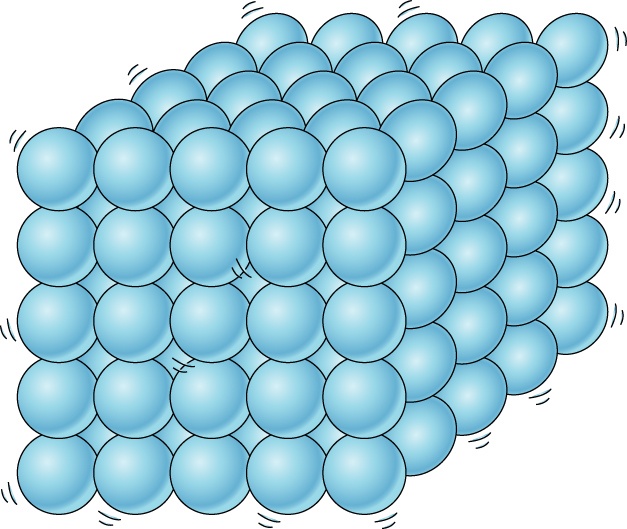
Which description best matches this particle model?
a)
Closely packed and can't move a lot.
b)
Particles are close together but can move a little.
c)
Particles have lots of energy and can move around.
7.
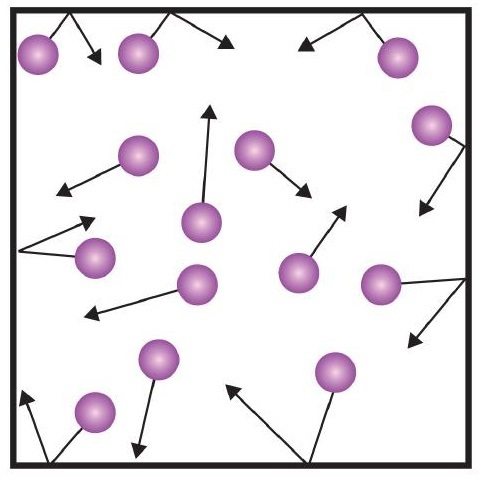
Which description best matches this particle model?
a)
Closely packed and can't move a lot.
b)
Particles are close together but can move a little.
c)
Particles have lots of energy and can move around.
8.
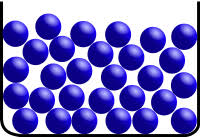
Which description best matches this particle model?
a)
Closely packed and can't move a lot.
b)
Particles are close together but can move a little.
c)
Particles have lots of energy and can move around.
9.
This state of matter keeps its shape and volume.
a)
gas
b)
solid
c)
liquid
10.
In this state of matter, there is a strong attraction between molecules and they cannot break away from each other.
a)
solid
b)
liquid
c)
gas
11.
When water beads on the outside of a cold glass of water.
a)
vaperization
b)
condensation
c)
melting
d)
freezing
12.
When boiling water creates steam.
a)
condensation
b)
melting
c)
freezing
d)
evaporation
13.
When dripping water turns into icicles.
a)
melting
b)
freezing
c)
vaporization
d)
condensation
14.
When a scoop of ice cream drips down the side of the cone.
a)
freezing
b)
vaporization
c)
melting
d)
condensation
15.
The measure of the amount of space and object takes up.
a)
temperature
b)
matter
c)
mass
d)
volume
16.
the measure of the amount of matter an object has.
a)
mass
b)
matter
c)
volume
d)
temperature
17.
The following are examples of liquids except
a)
water
b)
oxygen
c)
soda
d)
koolaid
18.
__________ is any thing that takes up space.
a)
Mass
b)
Matter
c)
Volume
d)
Length
19.
What term describes a solid changing to a gas?
a)
Deposition
b)
Sublimation
c)
Evaporation
d)
Freezing
20.
When a gas changes directly to a solid, the process is known as what?
a)
Sublimation
b)
Condensation
c)
Deposition
d)
Evaporation
100 %

