
 Worksheets
Economics
Total questions: 23
Worksheet time: 30mins
Name
Class
Date
1.
Economics is...
a)
studying goods, services, and how people can get them.
b)
studying trees, bushes, and other plants.
c)
studying animals and wildlife.
d)
studying food, and how food is made.
2.

Which of these is a good?
a)
Librarian
b)
Teacher
c)
Computer
d)
Mechanic
3.

Which of these provides a service?
a)
Pumpkins
b)
Mailman
c)
Turtles
d)
Cars
4.
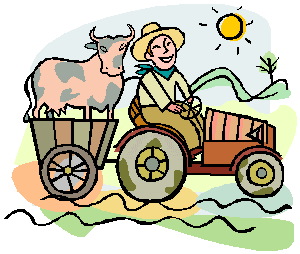
The people who grow or create goods are called...
a)
producers
b)
consumers
c)
banker
d)
traders
5.

The people who buy goods and services are called...
a)
producers
b)
consumers
c)
banker
d)
traders
6.

Which of the following is a need?
a)
Crayons
b)
Video Games
c)
Basketballs
d)
Houses
7.

If video games are not a need, what are they?
a)
a wish
b)
a dream
c)
a want
d)
a necessity
8.

All people have the same wants and needs.
a)
True
b)
False
9.
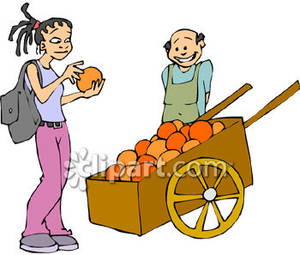
How do most people obtain goods or services today in America?
a)
Money
b)
Trading
c)
Bartering
10.
What is the fundamental problem of every society?
a)
labor costs
b)
scarcity
c)
economic interdependence
d)
market fluctuation
11.

The table shows the production possibilities for a country. Based on the table, which of the following production combinations is a possibility?
a)
28 pizzas and 5 pairs of shoes
b)
3 pairs of shoes and 23 pizzas
c)
2 pairs of shoes and 20 pizzas
d)
4 pairs of shoes and 15 pizzas
12.
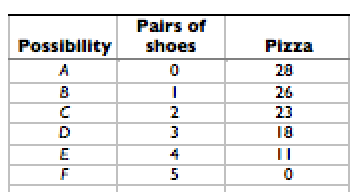
Based on the table, if the country is currently producing at point B and decides to produce at point C, the opportunity cost for the additional pair of shoes is ____ pizzas.
a)
26
b)
23
c)
3
d)
2
13.
What is the production possibilities curve?
a)
a graph that shows how much an economy can produce between 2 goods
b)
how much money something is
c)
the opportunity one has to give up in order to gain something else
d)
land, labor, capital, entrepreneurs
14.
What is opportunity cost?
a)
a graph that shows how much an economy can produce between 2 goods
b)
how much money something is
c)
the opportunity one has to give up in order to gain something else
d)
land, labor, capital, entrepreneurs
15.
Land, Labor, Capital, and Entrepreneurship
a)
Diversification
b)
Deductions
c)
Portfolio
d)
Factors of Production
16.
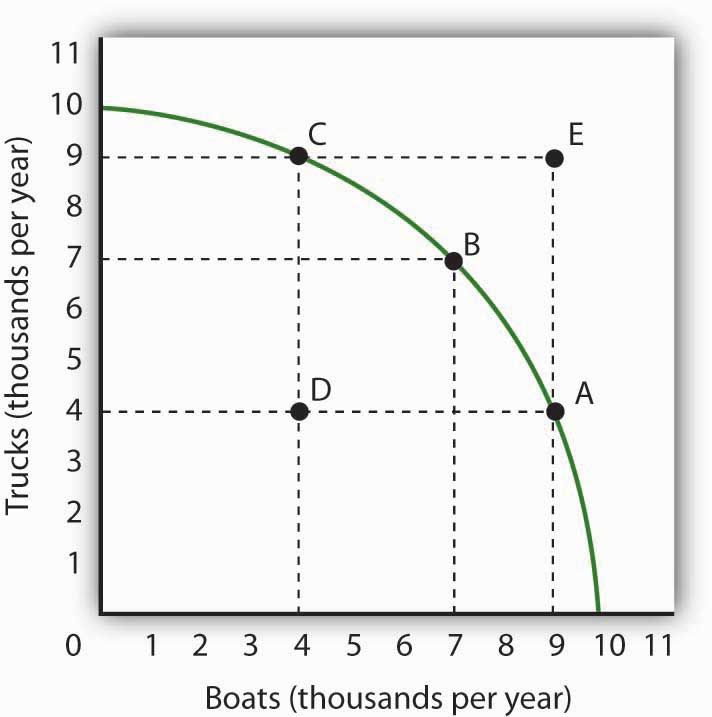
The opportunity cost of increasing production from 7 to 9 trucks is
a)
Scarcity
b)
2 boats
c)
2 trucks
d)
3 boats
17.

The opportunity cost of increasing production from 4 to 7 boats is
a)
1 boat
b)
2 boats
c)
2 trucks
d)
3 trucks
18.

Movement down the PPF curve indicates that the opportunity cost of more capital goods is producing more consumer goods
a)
True
b)
False
19.
What do points inside the PPF indicate?
a)
The combination of goods that employ goods efficiently
b)
The combination of goods that employ resources fully
c)
The combination of goods that do not employ resources fully
20.
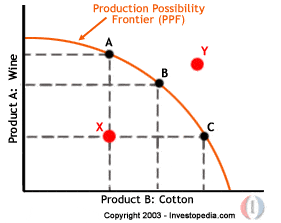
What does point Y represent on the PPC?
a)
Efficiency
b)
Unattainable / impossible
c)
Inefficency
d)
Nothing
21.

What does point B represent?
a)
Production at greater than the country's minimum potential
b)
Production is less than the country's minimum potential
c)
Productive inefficiency
d)
Productive efficiency
22.
Which point represents "resources are not being used efficiently, or resources are being wasted or idle"?
a)
Point A
b)
Point Y
c)
Point X
d)
All of the above
23.
Labor, human capital, entrepreneurship, natural resources, and capital are all examples of which of the following?
a)
Outputs
b)
Substitutes in Production
c)
Absolute Advantage
d)
Factors of Production
100 %
![QUIZ 3 : TOPIC 10 [Standard Costing & Variance Analysis]](https://cf.quizizz.com/image/image-loader.svg)
