
 Worksheets
Unit 3_Free Energy_Thermodynamics
Total questions: 20
Worksheet time: 19mins
1. The temperature increases when calcium chloride dissolves in water.
2. Steam condenses to liquid water
3. Water boils
4. Dry ice sublimates
The thermodynamic quantity that expresses the degree of disorder in a system is _
entropy
internal energy
heat flow
enthalpy
bond energy
A reaction that is not spontaneous at low temperature can become spontaneous at high temperature if ΔH is __________ and ΔS is __________.
+, +
-, -
+, -
-, +
+, 0
For a reaction to be spontaneous under standard conditions at all temperatures, the signs of ΔHΟ and ΔSΟ must be __________ and __________, respectively.
+, +
+, -
-, +
-, -
+, 0
Which of the following situations demonstrates high entropy?
water freezing
water vaporizing
steam condensing to water
What is reduction?
It is the gain of electrons.
It is the loss of electrons.
It is the creation of electrons.
It is the destruction of electrons.
What is a galvanic (voltaic) cell?
It is a cell that destroys electrons on one side and creates electrons on the other side.
It is a cell that contains only one metal bar and one aqueous ion solution.
It is a type of battery that drives a redox reaction when electricity is applied.
It is a type of battery that generates an electrical current from redox reactions.
What is an anode?
It is the electrode where oxidation takes place.
It is the electrode where reduction takes place.
It is an aqueous solution containing an electrode.
It is the salt bridge that connects half-cells.
What is a cathode?
It is the electrode where oxidation takes place.
It is the electrode where reduction takes place.
It is an aqueous solution containing an electrode.
It is the salt bridge that connects half-cells.
Electrons always flow from
cathode to anode
anode to cathode
Oxidation occurs at the
anode
cathode
What occurs to the mass of copper electrode in the following reaction?
Zn/Zn2+ // Cu2+/Cu
increases
decreases
remains the same
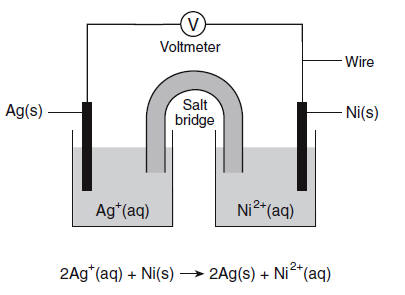
What reaction occurs at the anode?
Ag+/Ag = 0.80V
Ni2+/Ni = -0.25V
Ag+ + e- →Ag
Ag → Ag+ + e-
Ni2+ + 2e- → Ni
Ni → Ni2+ + 2e-
Nernst equation FOR (i) Mg(s) | Mg2+(0.001M) || Al3+(0.0001 M) | Al(s)
ECELL=E0CELL-0.0591/6 log[Mg2+]3/[Al3+]2
ECELL=E0CELL-0.0591/6 log[Al3+]2/[Mg2+]3
ECELL=E0CELL+0.0591/3 log[Mg2+]3/[Al3+]2
ECELL=E0CELL-0.0591/3 log[Mg2+] /[Al3+]
Nernst equation for an electrode is based on the variation of electrode potential of an electrode with
Temperature
Concentration of electrolyte
Both a & b
Density of the electrodes
Which of the following would most likely lead to a spontaneous reaction.
A high negative enthalpy.
A low negative enthalpy.
A high positive enthalpy.
A low positive enthalpy.

