
 Worksheets
Common Assessment - Unit 1 - Fundamental Science Skills
Total questions: 40
Worksheet time: 2hrs 44mins
What step does every scientific experiment begin with?
hypothesis
observation/question
procedures
conclusion

A ___ is a diagram, physical replica, mathematical representation, analogy, and/or computer simulation that can be used to predict or explain phenomena.
variable
model
bias
theory
A ___ tries to provide the most logical explanation about why things happen the way they do. This is not a guess, but a collection of all sorts of different phenomena explained under one umbrella idea that can be tested in a variety of ways.
scientific theory
scientific law
hypothesis
experiment
A statement about what happens in nature that seems to be true all the time
Experiment
Scientific Law
scientific theory
Standard
How close a measurement is to the accepted value is called..
Accuracy
Precision
Significant
Estimate

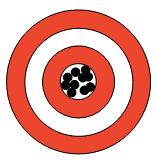
What level of accuracy/precision does this dartboard show?
High Accuracy & High Precision
High Accuracy & Low Precision
Low Accuracy & High Precision
Low Accuracy & Low Precision

length?
3.2 cm
3.12 cm
3 cm
3.219 cm
How many significant figures (sig figs) are there?
100.00
1
3
4
5
How many significant figures (sig figs) are there?
100000000
1
9
10
How many significant figures (sig figs) are there?
4004
1
2
3
4
If the exponent is a positive number...
If the exponent is a negative number...
6.47 x 10¹¹
The metric system unit for measuring length is the __________.
meter
kilogram
liter
Newton
second
The metric system unit for mass is the ___________.
meter
kilogram
liter
second
Newton
The metric system unit for volume is the __________.
meter
kilogram
liter
second
Newton
The united states measures things uses the non-standard imperial system, which includes units such as (select ALL that apply):
degrees Fahrenheit (for temperature)
inches (for length)
pounds (for weight/mass)
degrees Celsius (for temperature)
grams (for mass)
323 meters = 0.323 kilometers
What math do you do to convert from meters to kilometers?
Divide by 1000.
Multiply by 1000.
Multiply by 1000, then add an extra zero.
Divide by 1000, then add an extra zero.
90.9 feet per second is the same as
62 miles per hour.
What do you need to do to change the units from "feet per second" to "miles per hour"?
Convert feet to hours, and miles to seconds.
Convert feet to meters, and keep seconds as seconds.
Convert feet to miles, and seconds to hours.
Convert miles to feet, and hours to seconds.
Convert 500,000 millimeters/month to kilometers/year.
.6 kilometers/year
.06 kilometers/year
6 kilometers/year
60 kilometers/year
What is its speed in m/s?
(1 km = 1000 m)
You are watching cars driving past you for a minute and see 20 cars. If this rate continues, how many cars will pass in a day?
280 cars/day
104 cars/day
28,800 cars/day
28,800 days/car
What is its speed in m/s?
(1 km = 1000 m)

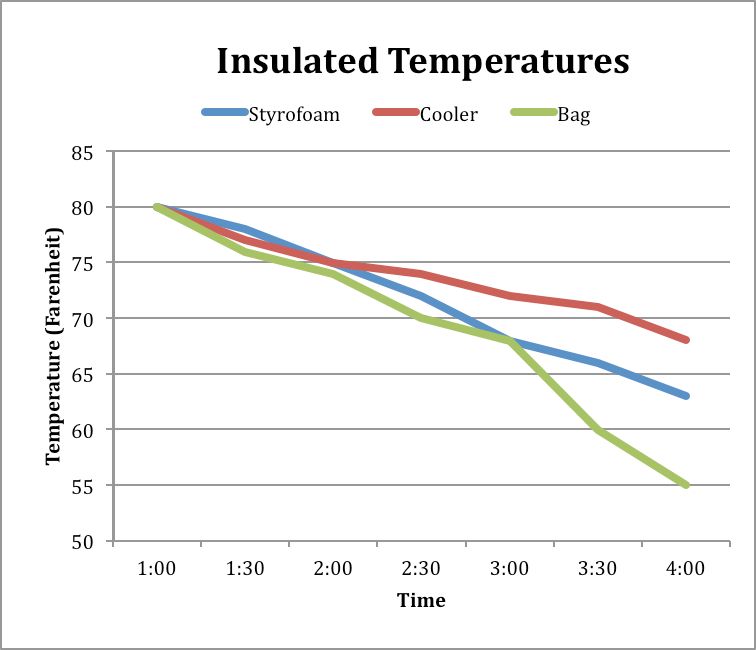
What data does this graph represent?
Change in temperature of a liquid over time in 3 different containers
How temperature can change the molecules in a material
The phase changes of a material
What type of container people use the most to store hot liquids.

What conclusions can you draw from this graph?
The deer population went down over time.
The deer population went up over time.
The dear population went up quickly, then down, but then stayed the same.
There are less dear because of hunters

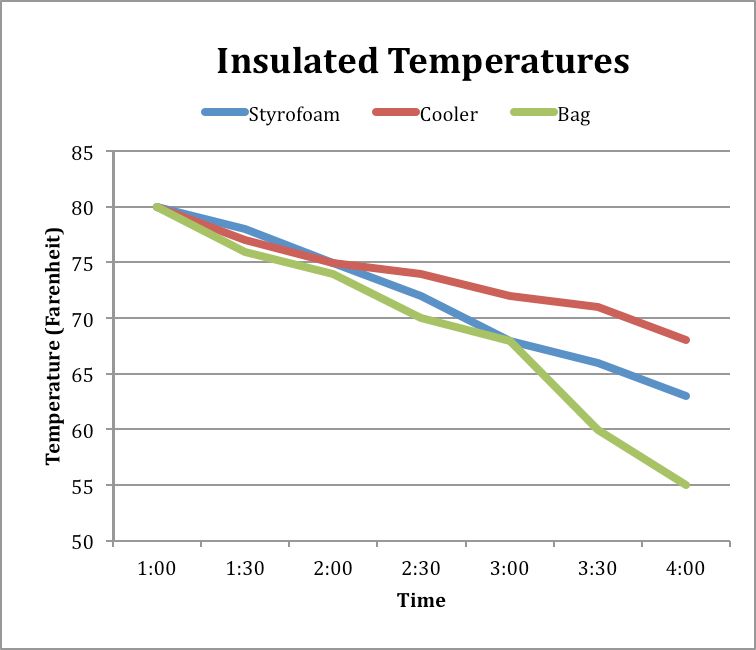
What was the temperature of the liquid in the Styrofoam container at 4:00?
55 degrees
68 degrees
73 degrees
63 degrees

