Wayground logo

Free Printable Worksheets

Font size

S
M
L
XL
Worksheets

electrolysis

Total questions: 14

Worksheet time: 4mins

Name
Class
Date
1.
What is electrolysis?
a)
breaking down of a compound using a current
b)
making a compound using a current
2.
What is the name of the positive electrode?
a)
cathode
b)
anode
3.
What is the name of the negative electrode?
a)
cathode
b)
anode
4.

The negatively charged ions (anions) are attracted to the ________.

a)

anode

b)

cathode

5.

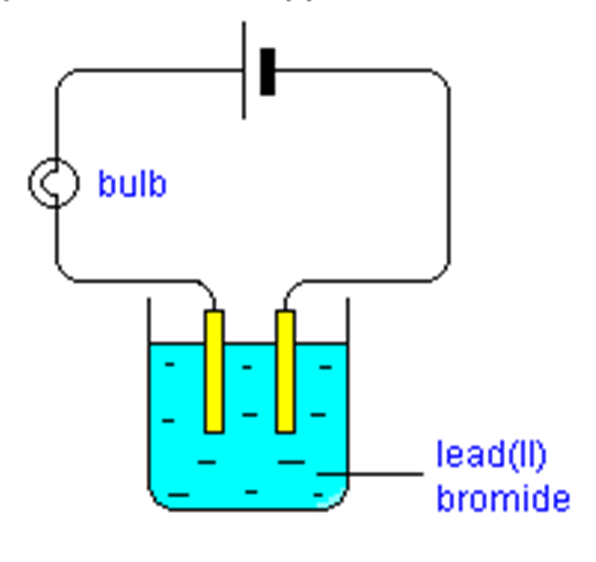
The diagram shows the electrolysis of lead(II) bromide using inert electrodes. Why does the bulb only light up when the lead(II) bromide is melted?

a)

Bromine atoms in lead(II) bromide are converted to ions when it is melted

b)

Electrons flow through the lead(II) bromide when it is melted

c)

The ions in lead(II) bromide are mobile charge carriers in the molten state.

d)

There are no ions in solid lead(II) bromide

6.

Anions get discharged by ________ electrons at the ___________

a)

gaining, cathode

b)

losing, anode

c)

gaining, anode

d)

losing, cathode

7.

Positive ions (cations) move towards the cathode (-) where they will discharge by....

a)

Breaking apart

b)

Losing electrons

c)

Clumping together.

d)

Gaining electrons

8.

What ions are present in molten aluminium oxide?

a)

Al3+, O2-, H+, OH-

b)

Al3+, O2-

c)

Al3+, OH-

9.
What is the name given to the solution that is being electrolysed?
a)
Salt solution
b)
Electric solution
c)
Mineral solution
d)
Electrolyte
10.
Explain why the electrolyte has to be a liquid.
a)
So the ions can move
b)
So the electrons can move
c)
So that it doesn't get too hot
d)
So the fish are ok
11.
What happens at the positive electrode?
a)
Positive non-metal ions are attracted
b)
Positive metal ions are attracted
c)
Negative non-metal ions are attracted
d)
Negative metal ions are attracted
12.

___________ electrode is an inert electrode.

a)

Copper

b)

Iron

c)

Carbon

d)

Zinc

13.
What particle carries the charge in the wire?
a)
electron
b)
proton
c)
ion
d)
atom
14.
What particle carries the charge in the electrolyte?
a)
electron
b)
proton
c)
ion
d)
atom