wayground logo

Free Printable Worksheets

Font size

S
M
L
XL
Worksheets

DL AP: Water and Carbon CH 3 & 4

Total questions: 35

Worksheet time: 28mins

Name
Class
Date
1.
Subatomic particles with an atom include
a)
Oxygen and Hydrogen
b)
Protons, Isotopes and Neutrons
c)
Electrons
d)
Protons, Neutrons and Electrons
2.

The bond between the oxygen atom and the hydrogen atom is a _________ bond

a)

Hydrogen

b)

Ionic

c)

Polar Covalent

d)

Neutral

3.
The bond between water molecules is a _____ bond
a)
Hydrogen
b)
Proton
c)
Covalent
d)
Neutron
4.

When liquid water freezes into a ice it becomes ______

a)

More dense

b)

Less dense

c)

Smaller

d)

Translucent

5.
True or False. Water has a realitively high specific heat, which means it can absorb a lot of energy in the form of heat before it temperature rises. 
a)
True 
b)
False
6.
The water molecule is a polar covalent molecule, which means
a)
One end has a positive charge and the other end has a negative charge
b)
It has a north pole and a south pole
c)
It has a bipolar personality 
d)
It is neutral 
7.
Carbon in the atmosphere is in the form of
a)
Coal
b)
Limestone
c)
Carbonic Acid
d)
Carbon dioxide
8.
The element present in all organic molecules is
a)
Nitrogen
b)
Phosphorus
c)
Hydrogen
d)
Carbon
9.
How many electron pairs does carbon share in order to complete its valence shell?
a)
1
b)
3
c)
4
d)
8
10.
Thalidomide and L-dopa, shown below, are examples of pharmaceutical drugs that occur as enantiomers, or molecules that
a)
are cis-trans isomers
b)
are mirror images of one another
c)
are mirror images of one another and have the same biological activity
d)
have identical three-dimensional shapes
11.
Which of the structures shown is an impossible covalently bonded molecule?
a)
A
b)
B
c)
C
d)
D
12.
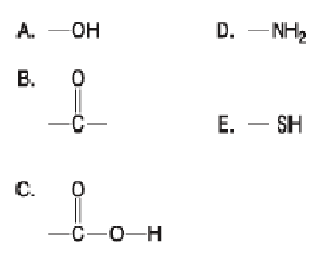
Which of the groups shown above is a carbonyl functional group?
a)
A
b)
B
c)
C
d)
D
13.
Which molecule shown above has a carbonyl functional group in the form of a ketone?
a)
A
b)
B
c)
C
d)
D
14.
Which molecule shown above has a carbonyl functional group in the form of an aldehyde?
a)
A
b)
B
c)
C
d)
D
15.
Organic chemistry is currently defined as
a)
The study of compounds made only by living cells
b)
The study of hydrocarbons
c)
The study of carbon compounds
d)
The study of vital forces
16.
Which property is most closely associated with the hydroxyl functional group?
a)
Polar
b)
Nonpolar
c)
Basic
d)
Acidic 
17.
Which is NOT a way functional groups may affect a molecule?
a)
Serve as a recognizable tag on biological molecules
b)
Affect the molecule's shape
c)
Be directly involved in chemical reactions
d)
Decrease the solubility of the molecule in water
18.
Which functional groups can act as acids?
a)
Ketone and amino
b)
Carbonyl and carboxyl
c)
Carboxyl and phosphate
d)
Hydroxyl and aldehyde
19.

What is a functional group?

a)

Group of atoms that give specific characteristics to a molecule

b)

Group of molecules that give specific characteristics to an atom

c)

Group of molecules that make up a group of atoms

d)

Group of atoms that give specific characteristics to an element

20.
What is the pH level of an acid?
a)
7.1-14
b)
14-21
c)
0-6.9
d)
7
21.
What is the pH level of a base?
a)
7.1-14
b)
0-6.9
c)
14-21
d)
7
22.
A solution that keeps pH from changing.
a)
glucose
b)
carbohydrate
c)
monomer
d)
Buffer
23.
Which of the following properties of water enables it to move from the roots to the leaves of plants?
a)
Water is less dense as a solid than as a liquid.
b)
Water has a high specific heat.
c)
Cohesion due to hydrogen bonding  and adhesion due to water's polar nature.
d)
Water is a solvent.
24.

What property of water allows it to be such a versatile solvent that it is often called the "universal solvent?"

a)

Water is very pure.

b)

Water is polar and forms hydrogen bonds

c)

Water has surface tension.

d)

Water is less dense as a solid than as a liquid.

25.
Why does ice float?
a)
As water freezes, it expands and its density decreases.
b)
As water freezes, it takes up more hydrogen from the atmosphere, causing it to have a greater buoyancy.
c)
As water freezes, air becomes trapped between the hydrogen bonds of water molecules.
d)
As water freezes, it takes up more oxygen from the atmosphere, causing it to have a greater buoyancy.
26.

molecule with the same molecular structure but different structural formula

a)

fats

b)

lipids

c)

fossil fuels

d)

isomers

27.
What makes a molecule polar?
a)
Equal sharing of valence electrons
b)
Unequal sharing of valence electrons
c)
Stealing of electrons
d)
Temporary charges that come and go
28.
Because water has a positively charged end and a negatively charged end, it can be described as
a)
amphipathic
b)
hydrophobic
c)
polar
d)
nonpolar
29.
Water molecules require a lot of energy to break the hydrogen bonds.  This gives water a high
a)
density
b)
polarity
c)
solvency
d)
specific heat
30.
Large bodies of water do not quickly fluctuate, or change, in temperature. Why?
a)
Water is a solvent.
b)
Water has a high heat capacity.
c)
Water acts as a buffer.
d)
Water is non-polar.
31.
Some insects can stand on the surface of calm water. Their feet push the surface of the water down slightly, but they do not break the surface. Why?
a)
The insects are light enough so they do not break the hydrogen bonds holding the water molecules together
b)
The insects actually use their wings to hover slightly above the water’s surface and they only skim it with their feet.
c)
The insect’s feet are non-polar, so they are repelled by the polar water molecules and are pushed away from the water’s surface.
d)
The insects are small enough to see the individual water molecules, so they are able to step carefully from one molecule to the next
32.
Why does water move from the roots to the leaves of plants?
a)
Water is pushed by solutes.
b)
Capillary action pulls the water molecules like a chain.
c)
Water is pulled by gravity.
d)
Water’s cohesion causes it to “pull” towards the leaves.
33.
Why does ice float?
a)
As water freezes, it expands and its density decreases.
b)
As water freezes, it takes up more hydrogen from the atmosphere, causing it to have a greater buoyancy.
c)
As water freezes, air becomes trapped between the hydrogen bonds of water molecules.
d)
As water freezes, it takes up more oxygen from the atmosphere, causing it to have a greater buoyancy.
34.

Pure water has a pH of

a)

6

b)

15

c)

3

d)

7

35.

This functional group is often associated with energy transfer in molecules like ATP

a)

amino

b)

phosphate

c)

hydroxyl

d)

carboxyl