wayground logo

Free Printable Worksheets

Font size

S
M
L
XL
Worksheets

Matter, atomic structure, density and periodic table

Total questions: 50

Worksheet time: 2hrs 43mins

Name
Class
Date
1.
Which particle contributes the negative charge to the atom?
a)
proton
b)
electron
c)
neutron
d)
nucleus
2.
Which particle does not contribute mass to the atom?
a)
Proton
b)
Neutron
c)
Electron
d)
Nucleus
3.

What element is this atom of?

a)

nitrogen

b)

lithium

c)

beryllium

d)

carbon

4.
The three main subatomic particles are electrons, protons and ____________.
a)
photons
b)
neurons
c)
neutrons
d)
quarks
5.
Most of the mass in an atom is made up of _____________________?
a)
protons and electrons
b)
protons and neutrons
c)
neutrons and electrons
d)
electrons and quarks
6.
What is the electrical charge of a proton?
a)
1+
b)
1-
c)
neutral
d)
2-
7.
The total number of Protons and Neutrons.
a)
Mass Number
b)
Atomic Number
c)
Matter
d)
Ion
8.
Number of protons in an atom.
a)
Atomic Number
b)
Mass Number
c)
Isotope
d)
Valence electrons
9.

Electrons in the outermost orbital.

a)

Shell electrons

b)

Violent electrons

c)

Valence electrons

d)

Isotopes

10.
The smallest possible unit matter can be divided into while still maintaining its properties.
a)
Proton
b)
Atom
c)
Element
11.
Something that takes up space and has mass.
a)
volume
b)
matter
c)
mass
d)
density
12.
The amount of space something takes up
a)
density
b)
volume
c)
mass
d)
matter
13.
I am two or more atoms chemically bonded.
a)
atom
b)
compound
c)
molecule
d)
mixture
14.
Which particle is equal to the Atomic Number
a)
# of electrons
b)
# of neutrons
c)
# of protons
15.
A pure substance that cannot be broken down into any other substance by chemical or physical means. There are about 100 of us shown in the Periodic Table
a)
compound
b)
mixture
c)
molecule
d)
element
16.
If an atom has 3 electrons, how many protons does it have?
a)
1
b)
2
c)
4
d)
3
17.

an arrangement of the elements according to their atomic numbers so that elements with similar properties are in the same column and properties repeat from row to row

a)

Periodic Table of Elements

b)

Atomic Theory

c)

Isotopes

d)

Subatomic Particles

18.

one or two letters that represent the name of an element

a)

element name

b)

element symbol

c)

atomic number

d)

atomic mass

19.

A row on the Periodic Table of Elements is called ________

a)

family

b)

period

c)

row

d)

isotope

20.
Which is a neutron?
a)
A
b)
B
c)
C
21.
Which item on this element square is the chemical symbol?
a)
Copper
b)
29
c)
Cu
d)
63.546
22.
Which item on this element square represents the atomic number?
a)
13
b)
Al
c)
Aluminum
d)
26.981538
23.
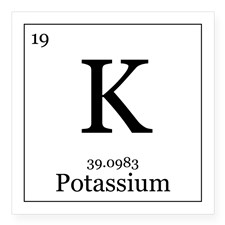
How many neutrons are in the atom "K"? Atomic number: 19. Mass: 39 
a)
7
b)
19
c)
39
d)
20
24.
What particle uniquely identifies an element?
a)
Number of Valence Electrons
b)
Number of Protons
c)
Number of Electrons
d)
Atomic Mass
25.
If an atom has 10 protons, 10 neutrons, and 10 electrons, what is the mass of the atom?
a)
10
b)
20
c)
30
26.
Which statement best explains how periods on the periodic table are organized? 
a)
increasing atomic number from left to right
b)
increasing number of neutrons from left to right
c)
decreasing number of electrons from left to right
d)
decreasing atomic mass number from left to right
27.
Each column in the periodic table is called a _________ .
a)
period
b)
group
c)
cluster
d)
unit
28.

The unit for mass is...

a)

Newton

b)

grams

c)

mililiters

d)

centimeters

29.

What is this tool called....

a)

Ruler

b)

Thermometer

c)

Beaker

d)

Graduated Cylinder

30.

A graduated cylinder is used to measure...

a)

Volume

b)

mass

c)

weight

d)

density

31.

The unit for volume is. (there is more than one right answer)

a)

grams

b)

milliliters (mL)

c)

Newton

d)

Centimeters Cubed

32.


What two types of measurements do you need to calculate DENSITY

a)

Volume and Weight

b)

Temperature and Mass

c)

Mass and Volume

33.

What is the density of water?

a)

0.1 g/mL

b)

1 g/mL

c)

10 g/mL

d)

100 g/mL

34.
Look at this image.  Which object has the LOWEST density in water? How
a)
The Ping Pong Ball because it floats to the top 
b)
The bolt because it has sunk to the bottom
c)
The soda cap because it is not just full of air like the Ping Pong ball
35.

Jack has a rock. The rock has a mass of 144 g and a volume of 3 cm3. What is the density of the rock?

a)

40 mL

b)

48 g/cm3

c)

52 g/cm3

d)

32/7 g/cm3

36.

If an object has a density of 0.78 g/mL and you put it into water it will _________  

a)
sink
b)
float
c)

fly

d)

disappear

37.
Frank has an eraser. It has a mass of 4g, and a volume of 2cm3. What is its density?
a)
8 g/cm3
b)
2 g/cm3
c)
1/2 g/cm3
d)
24 g/cm3
38.
What is the formula for density?
a)
density = mass x volume
b)
density = mass / volume
c)
density = mass + volume
d)
density = mass - volume
39.
Calculate the density of the cube.
a)
2 g/cm3
b)
4 g/cm3
c)
6 g/cm3
d)
8 g/cm3
40.
What is this tool to get mass?
a)
triple beam balance
b)
ruler
c)
thermometer
d)
graduate cylinder
41.
a)

303.4 g

b)

370.4 g

c)

373.0 g

d)

373.4 g

42.

When you put an object in a graduated cylinder of water and measure how much the water level changed what is this process called?

a)

Relative Density

b)

Displacement

c)

Density

43.
What is the volume of Object X?
a)

10.0 ml

b)

15.0 ml

c)

20.0 ml

d)

25.0 ml

44.
What is the volume of the fish?
a)

18.0 ml

b)

6.0 ml

c)

38.0 ml

45.
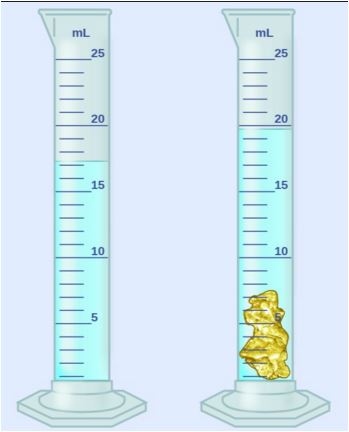
An irregularly shaped piece of gold was lowered into a graduated cylinder holding a volume of water equal to 17 ml. The height of the water rose to 20 ml. If the mass of the gold was 27 g, what was its density?
a)
9 g/mL
b)
10.5 g/mL
c)
6.5 g/mL
d)
8 g/mL
46.
Valence electrons are: 
a)
Electrons farthest away from the nucleus
b)
Electrons closest to the nucleus
c)
Electrons that just come and go - they don't stay with the atom
d)
Electrons in the second shell
47.

How many valence electrons does Phosphorus have?

a)

4

b)

5

c)

6

d)

7

e)

8

48.
How many protons are in this element?
a)
79
b)
196
c)
117
d)
Cannot be determined
49.
How did Mendeleev arrange the elements?
a)

atomic mass  

b)
density
c)
melting point
d)

atomic number

50.

The Modern Periodic Table of Elements is arranged by

a)

atomic mass

b)

atomic number

c)

valence electrons

d)

number of isotopes