wayground logo

Free Printable Worksheets

Font size

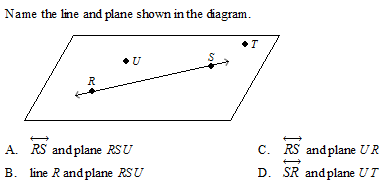
S
M
L
XL
Worksheets

Activities 1-3 Review

Total questions: 50

Worksheet time: 52mins

Name
Class
Date
1.

Name the figure above.

a)

Line AB

b)

Line Segment AB

c)

Ray AB

d)

Points AB

2.
Points that lie on the same plane are ________. 
a)
collinear
b)
coplanar
c)
parallel
d)
perpendicular
3.

Name a plane containing point A.

a)

Plane DEA

b)

Plane DEF

c)

Plane CDF

d)

Plane F

4.
Points that lie on the same line are _________.
a)
coplanar
b)
collinear
c)
parallel
d)
perpendicular
5.
When naming a plane, we should use ________
a)
2 points
b)
a lower case cursive letter
c)
3 points
d)
3 noncollinear points
6.
This angle is written as......
a)
 ∠ABC
b)
 ∠ACB
c)
∠BCA
d)
∠CAB
7.

Choose the wrong name for the angle.

a)
b)
c)
d)
8.
Give another name for line k.
a)
Line BC
b)
Line BCE
c)
Line ED
d)
Line k is the only name, there isn't another name.
9.
Name two points collinear to Point K
a)
H & M
b)
J & L
c)
N & J
d)
M & L
10.
a)
plane FBC
b)
plane BAD
c)
plane FEC
d)
plane FKG
11.
a)
A
b)
B
c)
C
d)
D
12.

What are supplementary angles?

a)

Angles that add up to 180°

b)

Angles that add up to 90°

c)

Angles that are equal to each other

d)

Angles that are opposite of each other when lines intersect

13.

What are complementary angles?

a)

Angles that add up to 180°

b)

Angles that add up to 90°

c)

Angles that are equal to each other

d)

Angles that are opposite of each other when lines intersect.

14.
FInd the pair of Supplementary Angles
a)
Angle AKB and Angle BKG
b)
Angle AKB and Angle KGC
c)
Angle FGE and Angle DGE
d)
Angle FGE and Angle FGI
15.
Find the pair of Complementary angles
a)
Angle FGE and Angle DGE
b)
Angle FGE and Angle KGC
c)
Angle CGD and Angle IGF
d)
Angle IJH and Angle HJG
16.
How many degrees is a straight angle?
a)
90
b)
360
c)
180
d)
145
17.

Find the supplement of the angle

a)

160 degrees

b)

20 degrees

c)

-70 degrees

d)

180 degrees

18.
Are these angles an example of complementary, supplementary, or neither?
a)
Complementary
b)
Supplementary
c)
Neither
19.
The type of reasoning where a person makes  conclusions based on observations and patterns is called...
a)
Inductive reasoning
b)
Deductive reasoning
c)
Conjecture
d)
Experiments
20.
What is a conjecture?
a)
A statement believed to be true based on observations.
b)
An example which disproves an hypothesis.
c)
the performance of tricks that are seemingly magical
21.
Used to prove that a conjecture is false.
a)
Counterexample
b)
Inductive Reasoning
c)
Concluding statement
d)
Conjecture
22.

Sally is taller than Susie and Susie is taller than Nancy, therefore, Sally is taller than Nancy. Is the reasoning Inductive or Deductive?

a)

Inductive

b)

Deductive

23.

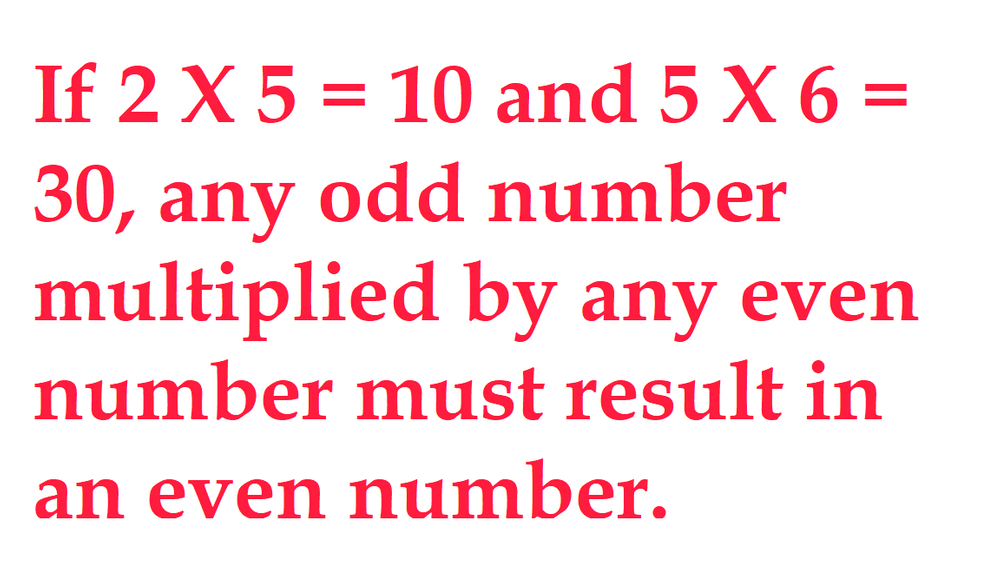
Inductive or Deductive?

a)

Inductive

b)

Deductive

24.

Is this Inductive or Deductive reasoning?

a)

Inductive

b)

Deductive

25.

Is this Inductive or Deductive logic?

a)

Inductive

b)

Deductive

26.

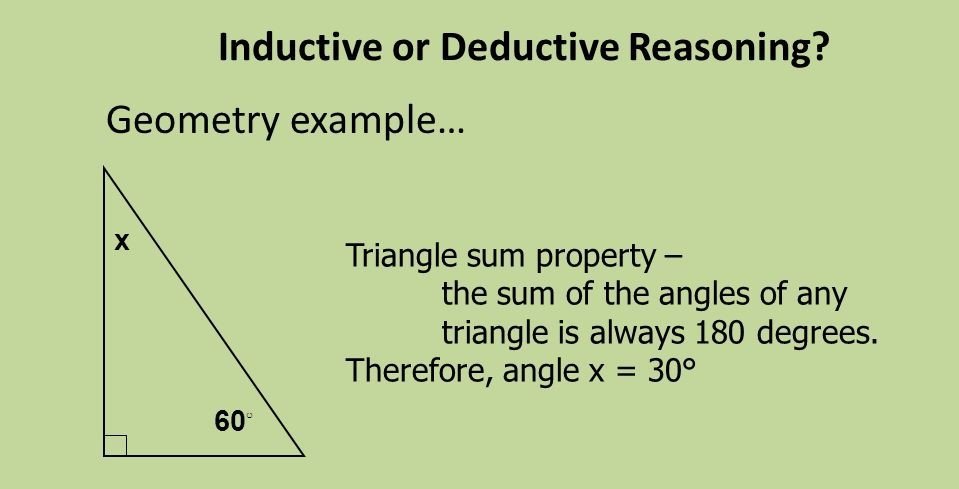
The conclusion that X=30 degrees is Inductive or Deductive reasoning?

a)

Inductive

b)

Deductive

27.

Which of the following provide a counterexample to the claim:

"If two angles are supplementary, then they are not congruent."

a)

 40° and  140°40\degree\ and\ \ 140\degree 

b)

 80° and  80°80\degree\ and\ \ 80\degree 

c)

 30° and  150°30\degree\ and\ \ 150\degree 

d)

 90° and  90°90\degree\ and\ \ 90\degree 

28.

Which is a counterexample to the following statement?

If an angle is obtuse, then it is 125°125\degree .

a)

 90°90\degree  

b)

 57°57\degree  

c)

 160°160\degree  

d)

 180°180\degree  

29.

Which of the following is a counterexample:

No square has an area equal to its perimeter.

a)

3 by 3 square

b)

2 by 2 square

c)

1 by 1 square

d)

4 by 4 square

30.

Conjectures, like theorems, have been proven to be true.

a)

True

b)

False

31.
Identify the property of equality.
If 9=x, then x=9
a)
Reflexive
b)
Symmetric
c)
Transitive
d)
Substitution
32.
Identify the property used here:
39=39
a)
Reflexive
b)
Symmetric
c)
Transitive
d)
Substitution
33.

What is, in most cases, the 1st statement in the reason column of a proof?

a)

Prove

b)

Given

c)

Reason

d)

Statement

34.
Step 2 is what
a)
Substitution property (simplify)
b)
Multiplication property of equality
c)
Division property of equality
d)
Distributive Property
35.
What is step 4
a)
Substitution property (simplify)
b)
Addition property of equality
c)
Subtraction property of equality
36.
What is step 6
a)
Subtraction property of equality
b)
Addition property of equality
c)
Division property of equality
37.
Step 1 is what
a)
addition property of equality
b)
given
c)
subtraction property of equality
d)
prove
38.
What is reason 2?
a)
Addition Property of Equality
b)
Subtraction Property of Equality
c)
Multiplication Property of Equality
d)
Division Property of Equality
39.
Identify the hypothesis of this conditional:
If Sally goes to the park, then she will fall off the swing.
a)
Sally goes to the park.
b)
Sally will fall off the swing.
c)
Parks don't have swings that Sally goes to.
d)
If Sally falls off the swing, she goes to the park.
40.

When writing a biconditional statement, we use the phrase ___ between the hypothesis and conclusion.

a)

if

b)

then

c)

if and only if

d)

always

41.
What is the biconditional that matches the statement: "A right angle is an angle with 90 degrees."
a)
If an angle has 90 degrees, then it is a right angle.
b)
If an angle is a right angle, then it has 90 degrees.
c)
An angle is a right angle if and only if it has 90 degrees.
42.
  Rewrite the following statement as a      biconditional: "Supplementary angles add up to 180"
a)
If two angles add up to 180o then they are supplementary.
b)
You can't it is conditional.
c)
Two angles are supplementary if and only if the sum of the measure of the two angles is 180o.
d)
If two angles sum does not equal 180o then they are not supplementary.
43.

Select the conditional statement(s) of the biconditional statement.


Points are collinear if and only if they all lie in one line.

a)

If collinear points lie in one line, then they are a line.

b)

If points all lie in one line, then they are collinear.

c)

Collinear points lie in one line.

d)

If points are collinear, then they all lie in one line.

44.
Which is a counterexample for the following conditional:
If an electronic device has a screen then it is a television.
a)
television
b)
cell phone
c)
computer mouse
d)
keyboard
45.
If an animal is furry, then it is a hamster. What would be an appropriate counterexample?
a)
goldfish
b)
frog
c)
elephant
d)
cat
46.
Which of the following is the converse of the statement:
"If you are a guitar player, then you are a musician."
a)
If you are not a guitar player, then you are not a musician.
b)
If you are a musician, then you are a guitar player.
c)
If you are a guitar player, then you are not a musician.
d)
If you are not a musician, then you are not a guitar player.
47.
What is the converse to this statement?
a)
If it isn't dark outside, then it is not night.
b)
If it is night, then it is dark outside
c)
If it is not night, then it is not dark outside.
d)
It is night.
48.
What is the inverse to this statement?
a)
If you live in Canada, you live in Montreal
b)
If you don't live in Montreal, then you don't live in Canada.
c)
If you don't live in Canada, you don't live in Montreal.
d)
Montreal is in Brazil.
49.

∠7 and ∠TPU are _______________

a)

Complementary and Adjacent

b)

Supplementary and Adjacent

c)

Adjacent

d)

Vertical

50.

What angle is complementary to angle 4?

a)

∠5

b)

∠3

c)

∠2

d)

∠1