
 Worksheets
animal tissues
Total questions: 50
Worksheet time: 28mins
These cells are small and flat
Cuboidal
Columnar
Squamous
Pseudostratified
Which of the following is NOT a function of epithelial tissues?
covering exposed surfaces
lining internal passageways
producing glandular secretions
contracting to produce movement
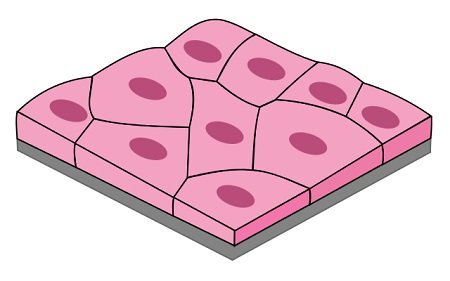
Name the type of epithelium
simple cuboidal
simple squamous
simple columnar
stratified squamous
Stratified epithelium is typically used for
excretion
secretion
protection
absorption
What type of muscle is/are voluntary?
smooth and cardiac
smooth
skeletal and smooth
skeletal
What type of muscle(s) is involuntary?
skeletal and smooth
cardiac and skeletal
smooth and cardiac
skeletal
Moving food through the digestive tract and emptying the bowels and bladder are examples of “housekeeping” activities normally handled by _____ muscles.
skeletal
smooth
cardiac

In what part of your body you can mostly find the stratified squamous tissues?
Intestines
Kidneys
Lungs
Skin
A form of connective tissue in which the cells are specialized for the synthesis and storage of energy-rich reserves of fat, or lipid.
Hyaline cartilage
Adipose tissue
Connective tissue
Areolar tissue
This connects bones at a joint.
Tendon
Ligament
Facia
Cartilage
Moving food through the digestive tract and emptying the bowels and bladder are examples of “housekeeping” activities normally handled by _____ muscles.
skeletal
smooth
cardiac
Cells of bones are called
Chondrocytes
Fibroblasts
Mast cells
Osteocytes
Following are the types of white blood cells
eosinophils, lymphocytes, platelets
basophils, lymphocytes, monocytes
eosinophils, lymphocytes, red blood cells
eosinophils, macrophages, platelets
Areolar tissue is involved in
repair of body
fat storage
movement
absorption
The matrix of cartilage is made of
Calcium and phosphorous
Sugar and protein
Plasma
Basement membrane
tendons join
ligament to bone
bone to muscle
muscle to skin
bone to bone
The cell of Nervous tissue is called
Neuron
Nephron
Neutrophil
Nephridium
Plant tissues are different from animal tissues because
Plants are heterotrophic and have a lot of active tissues
Plants are autotrophic and have a lot of active tissues
Plants are heterotrophic and have a lot of dead tissues
Plants are autotrophic and have a lot of dead tissues
Lines ducts and glands
Simple columnar
Simple cuboidal
Simple squamous
Stratified squamous
Used in places where diffusion needs to occur, such as blood vessels and air sacs in the lungs
Simple cuboidal
Simple columnar
Simple Squamous
Stratified Squamous

Which muscles act involuntarily?
striated muscles
cardiac muscles
skeletal muscles
All the above

While doing work and running, you move your organs such as hands, legs, etc., which among the following is correct?
smooth muscles contract and pull the ligament to move the
bones
smooth muscles contract and pull the tendons to move the
bones
skeletal muscles contract and pull the ligament to move the
bones
skeletal muscles contract and pull the tendon to move the
bones

Voluntary muscles are found in
alimentary canal
limbs
iris of the eye
bronchi of lungs

Bone matrix is rich in
fluoride and calcium
calcium and phosphorus
phosphorus and potassium
calcium and potassium

Which of the following helps in repair of tissue and fills up the space inside the organ?
tendon
adipose tissue
areolar tissue
cartilage

Cartilage is not found in
nose
ear
kidney
larynx


The part of the neuron that insulates the axon and increases the speed of the neural message within the neuron.
Cell Body
Dendrite
Myelin Sheath
Axon Terminal
Tissue present in brain
adipose
cuboidal
nervous
Iris of the eye made up of
involuntary
striated
cardiac
Study of tissues is known as
Cytology
Mycology
Histology
Osteology
Which of the following projects a picture of a cuboidal epithelial tissue?


What type of epithelial tissue is shown on the picture?
Pseudostratified columnar
Simple columnar
Stratified squamous
Simple cuboidal

Cartilage and bone are types of
Muscular tissue
Connective tissue
Meristematic tissue
Epithelial tissue

What kind of muscle is this?
Unstriated Muscle
Striated Muscle
Cardiac Muscle

