wayground logo

Free Printable Worksheets

Font size

S
M
L
XL
Worksheets

WAVES

Total questions: 50

Worksheet time: 2hrs 49mins
Name
Class
Date
1.
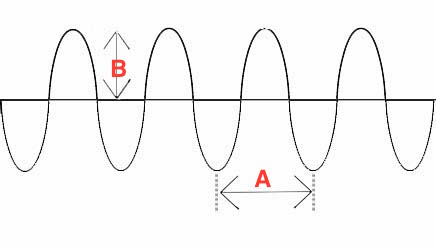
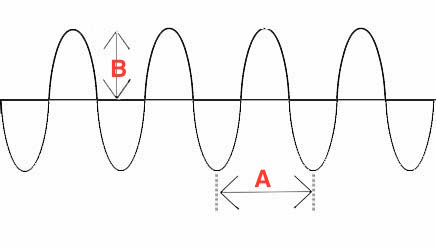
What property of this wave is represented by the letter "A"
a)
amplitude
b)
crest
c)
trough
d)
wavelength
2.
What property of the wave is represented by the letter "B"?
a)
amplitude
b)
crest
c)
trough
d)
wavelength
3.
The lowest point on a wave is the:
a)
Amplitude
b)
Crest
c)
Trough
d)
Wavelength
4.
The type of waves that require medium to pass:
a)
Mechanical Waves
b)
Electromagnetic Waves
5.
What do waves carry from place to place?
a)
Energy, but not matter or particles
b)
Energy and matter or particles
c)
Matter or particles but not energy
d)
Neither energy nor matter or particles
6.
The most dense part of a longitudinal wave.
a)
Density
b)
Compression
c)
Rarefaction
d)
Amplitude
7.
What are the parts of a longitudinal wave?
a)
Compressions and rarefactions
b)
Crests and troughs
c)
Compressions and crests
d)
Rarefactions and troughs
8.
Which wave is pictured?
a)
Transverse
b)
Longitudinal
c)
Both
d)
Neither
9.
Sound is an example of which type of wave?
a)
Transverse
b)
Longitudinal
c)
Both
d)
Neither
10.
Light is an example of which type of wave?
a)
Transverse
b)
Longitudinal
c)
Both
d)
Neither
11.
Which wave travels parallel in relation to a medium?
a)
Transverse
b)
Longitudinal
c)
Both
d)
Neither
12.
Sound needs a medium to travel through.  What is a medium?
a)
solid, liquid, gas
b)
open space
c)
waves
d)
nothing
13.
A wave carries...?
a)
energy only
b)
matter only
c)
the matter carries the energy
d)
neither
14.
Amplitude reflects the amount of ____________________ in a wave.
a)
energy
b)
compression
c)
rarefaction
d)
speed
15.
A _____________________ is the distance between a point on one wave and the identical point of the next wave.
a)
amplitude
b)
wavelength
c)
frequency
d)
compression
16.
Which wave has a greater frequency?
a)
A
b)
B
17.
Sound is caused by? 
a)
force
b)
vibrations
c)
instruments
d)
medium
18.
What is vibration?
a)
how loud a sound is
b)
the back and forth movement of matter
c)
how high or low a sound is
d)
the loudness or softness of a sound
19.

A wave that can only travel through matter is called:

a)

solid waves

b)

longitudinal waves

c)

transverse waves

d)

mechanical waves

20.
When the frequency of a wave increases, what happens to the wavelength?
a)
The wavelength is not directly affected by the frequency of a wave.
b)
The wavelength increases.
c)
The wavelength decreases.
d)
More specific information is needed to form a conclusion about the wavelength.
21.
A mechanical wave cannot travel through...
a)
a vacuum(empty space).
b)
water.
c)
air. 
d)
glass.
22.
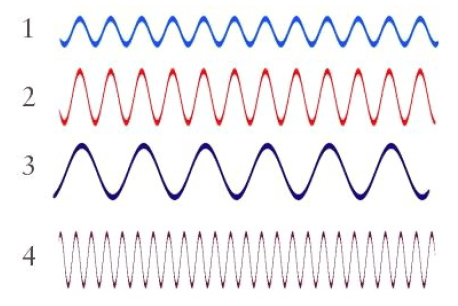
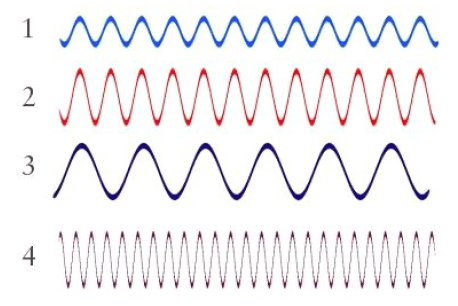
Which wave in the diagram has the greatest frequency?
a)
1
b)
2
c)
3
d)
4
23.
Which wave in the diagram has the greatest wavelength?
a)
1
b)
2
c)
3
d)
4
24.
Which of the following can sound travel through?
a)
solid
b)
liquid
c)
gas
d)
all of the above
25.
The number of wavelengths that pass a point each per second is:
a)
frequency
b)
period
c)
longitudinal 
d)
transverse wave 
26.
Which is the correct equation for calculating the speed of a wave?
a)
T = 1/f
b)
Speed= Wavelength x Period
c)
Speed = Wavelength/Frequency
d)
Speed= Wavelength x Frequency
27.
1.  A wave has frequency of 50 Hz and a wavelength of 10 m. What is the speed of the wave?
a)
500 m/s
b)
50 m/s
c)
5 m/s
d)
0.5 m/s
28.
1.  A wave has frequency of 5 Hz and a speed of 25 m/s. What is the wavelength of the wave?
a)
25 m
b)
125 m
c)
5 m
d)
25 m/s
29.
A wave has wavelength of 10 m and a speed of 340 m/s. What is the frequency of the wave?
a)
34 m/s
b)
3400 Hz
c)
3.4 Hz 
d)
34 Hz
30.
Distance from 'y' to 'y' is a _______
a)
Wavelength
b)
Amplitude
c)
Compression
d)
Rarefaction
31.

What is the amplitude of this wave?

a)

4

b)

8

c)

2

d)

6.3

32.

What is the wavelength of this wave?

a)

4

b)

8

c)

3.3

d)

6.3

33.
The distance between 2 corresponding parts of a wave  (example- crest to crest) is its _____________________
a)
trough
b)
frequency
c)
amplitude
d)
wavelength
34.

Two light sources are said to be coherent if they

a)

are of the same frequency.

b)

are of the same frequency, and maintain a constant phase difference.

c)

are of the same amplitude, and maintain a constant phase difference.

d)

are of the same frequency and amplitude.

35.

What type of interference is represented in the diagram?

a)

Constructive

b)

Destructive

36.

What type of interference do noise cancelling headphones use?

a)

Constructive Interference

b)

Destructive Interference

37.
Resonance occurs when
a)
an object is forced to vibrate at its natural frequency.
b)
sound changes speed in going from one medium to another.
c)
the amplitude of a wave is amplified.
d)
sound makes multiple reflections
38.

A system is oscillated at a frequency equivalent to its natural frequency by an external force.

This phenomenon is called

a)

Damping

b)

Resonance

c)

Rectification

d)

Pitching

39.

Diagram below shows the displacement-time graph of an oscillating spring.

The oscillating spring undergoes …

a)

damping

b)

resonance

c)

interference

d)

forced oscillation

40.

When the amplitude of a wave increases, its

a)

wavelength will increase

b)

frequency will decrease

c)

energy will increase

d)

period will decrease

41.

Diagram below shows an oscillating system.

Which graph shows the correct relationship between displacement and time for the oscillating system?

a)
b)
c)
d)
42.

what is diffraction

a)

is a soild liquid gass

b)

is a beam of light that is spread out and passes through an object

c)

a beam of light

43.
This image is representing what wave interaction?
a)
Refraction
b)
Diffraction
c)
Reflection
d)
Interference
44.

Diagram shows a water wave propagating through a small gap.

What happen to the speed of diffracted wave?

a)

Increase

b)

Decrease

c)

Unchanged

45.

Which of the following shows the phenomenon of wave diffraction?

a)
b)
c)
d)
46.

Name this wave phenomenon

(a)  

47.

when a wave is bent by traveling from one medium to another

a)

reflection

b)

refraction

c)

absorption

d)

propagation

48.

Sonar and echolocation use ----- to detect objects under water.

a)

Refraction

b)

Reflection

49.

The Tacoma Narrows Bridge, musical instruments, and crystal stemware are examples of -----

a)

Frequency

b)

Resonance

c)

Interference

d)

Speed

50.

Sound waves in musical instruments or tubes create standing waves that enhance which type of interference to make louder sounds?

a)

Constructive

b)

Destructive