
 Worksheets
waves
Total questions: 60
Worksheet time: 2hrs 0mins
Definition: Crest
The highest point of a transverse wave
The lowest point of a transverse wave
The center of a transverse wave
The distance between two points on a wave
Definition: Trough
The center of a wave
The resting position of a wave
The lowest point of a transverse wave
The highest point of a transverse wave
What is the frequency of a wave?
# of oscillations produced in a certain amount of time
The distance the wave oscillates from it's resting position
The lowest point of a transverse wave
Resting point of a wave - no wave movement
What is the amplitude of a wave?
Where there is no wave movement
The distance the wave oscillates from it's resting position
A disturbance that transfers energy from one place to another
The distance between two corresponding parts of a wave
What is the resting position?
A disturbance that transfers energy from one place to another
The distance between two corresponding parts of a wave
The distance the wave oscillates from it's resting position
Where there is no wave movement
Definition: Wave
Matter through which a wave travels
A disturbance that transfers energy from one place to another
The distance between two corresponding parts of a wave
The lowest point of a transverse wave
What is a medium?
The lowest point of a transverse wave
The size of a wave
The middle of a wave
Matter through which a wave travels
What type of matter can waves travel through?
Solid
Liquid
Gas
All of the Above
How do you measure wavelength?
transverse and longitudinal
The distance between two corresponding parts of a wave
Crest to Trough
From resting position, up to crest
There are two types of mechanical waves:
EM and Compressional
Compressional and Longitudinal
Transverse and Longitudinal
Transverse and Electromagnetic
What parts of the wave can be used to help measure the wavelength? Hint: There are two correct answers
Crest to crest
Trough to trough
Resting position to wavelength
Amplitude + Frequency
Sound waves are what type of waves? There are two correct answers.
E/M
Longitudinal
Transverse
Compressional
A wave that moves the medium in a direction perpendicular to the direction in which the wave travels.
Longitudinal Wave
Mechanical Wave
Standing Wave
Transverse Wave
The highest part of a transverse wave.
Crest
Node
Trough
Wavelength
The lowest part of a transverse wave.
Crest
Node
Trough
Wavelength
The part of a longitudinal wave where the particles of the medium are close together.
Compression
Crest
Rarefaction
Trough
The part of a longitudinal wave where the particles of the medium are farther apart.
Compression
Crest
Rarefaction
Trough
Unit of measurement for frequency.
Diffraction
Hertz
Node
Wave
The bouncing back of an object or a wave when it hits a surface through which it cannot pass.
Diffraction
Reflection
Refraction
Vibration
The rule that the angle of reflection equals the angle of incidence.
Constructive Interference
Destructive Interference
Law of Reflection
Resonance
The bending of waves as they enter a new medium at an angle.
Reflection
Refraction
Diffraction
Interference
The increase in the amplitude of a vibration that occurs when external vibrations match an object's natural frequency.
Diffraction
Frequency
Interference
Resonance

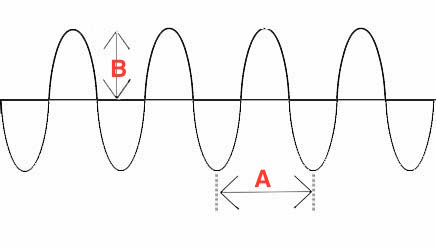
Identify E
Crest
Trough
Rest position
Amplitude

Identify A
Crest
Wavelength
Aplitude
Frequency

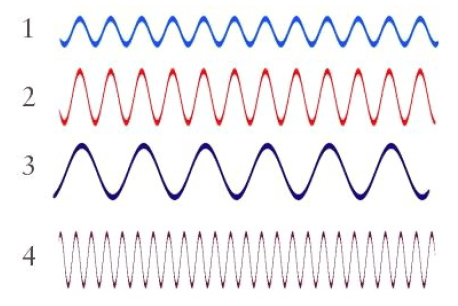
Which wave has the highest frequency?
Figure 1
Figure 2
Figure 3
Figure 4
A wave is traveling in one medium. Then it begins traveling through another medium and changes direction. What happened?
The wave was absorbed
The wave was transmitted
The wave was refracted
The wave was reflected

How does the density of an object impact the speed of a sound wave?
Sound travels the fastest in gas mediums
The less dense the medium, the faster it travels
The density of the medium does not affect the speed of sound
The denser the medium, the faster it travels

Which wave has the most energy?
Wave 1
Wave 2
Wave 3
Wave 4

Sonar and echolocation use ----- to detect objects under water.
Refraction
Reflection
The Tacoma Narrows Bridge, musical instruments, and crystal stemware are examples of -----
Frequency
Resonance
Interference
Speed

A
B
C
D

Frequency T is lower than S, speed T slower than S
Frequency T is lower than S, speed T faster than S
Frequency T is same as S, speed T is slower than S
Frequency T is same as S, speed T is faster than S

A
B
C
D

A
B
C
D

A
B
C
D

This image depicts which of the following wave behaviors?
Reflection
Refraction
Diffraction
Resonance
Definition: The spreading out of waves as they pass through an opening or around objects.
Reflection
Refraction
Diffraction
Resonance
A wave of constant wavelength diffracts as it passes through an opening in a barrier. As the size of the opening is increased, the diffraction effects
decrease
increase
remain the same
Which diagram best represents the shape and direction of a series of wave fronts after they have passed through a small opening in a barrier?
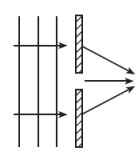
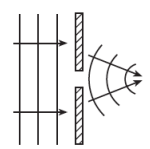
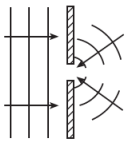
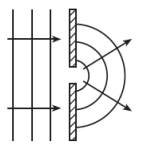
Radio waves diffract around buildings more than light waves do because, compared to light waves, radio waves
move faster
move slower
have a higher frequency
have a longer wavelength
Definition: When one object vibrating at the same natural frequency of a second object forces that second object into vibrational motion.
Reflection
Refraction
Diffraction
Resonance

A beam of light bends when it passes from air into water, and then bends even more when it passes from water into glass. What can you conclude from this fact?
Air is denser than glass.
Water is denser than glass.
Glass is denser than water.
Air is denser than water.
Which of the following shows the phenomenon of wave diffraction?


Which diffraction pattern is correct when waves pass through an obstacle?


Which phenomenon explains the propagation of the waves above?
Reflection
Refraction
Diffraction
Interference
For a better diffraction, wavelength of wave must be.......than the size of slit
Longer
Shorter
Same

