wayground logo

Free Printable Worksheets

NEW

Font size

S
M
L
XL
Worksheets

Biology-Evolution & Classification

Total questions: 25

Worksheet time: 20mins

Name
Class
Date
1.
Darwin theorized that individuals having an advantage due to their traits or abilities will be more likely to survive and reproduce.  This theory is known as
a)
evolution
b)
speciation
c)
adaptation
d)
natural selection
2.
Who was the naturalist that traveled the world to study plants and animals?
a)
Albert Einstein
b)
Charles Darwin
c)
Charles Barkley
d)
Isaac Newton
3.
Remains of ancient organisms are called
a)
Extinctions
b)
Fossils
c)
Mutations
d)
Variations
4.
If an organism has a vestigial structure, that structure likely once had a function in a(n)
a)
close relative
b)
early ancestor
c)
unrelated organism
d)
embryological stage
5.
the hind leg bones in a whale are examples of
a)
homologous structures
b)
analogous structures
c)
fossils
d)
vestigals
6.
What is the study of organisms at the early stages of development?
a)
DNA studies
b)
embryology 
c)
extinction
d)
fossil record
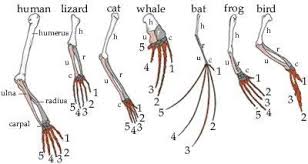
7.
What is this an example of?
a)
vestigial structures
b)
embryology
c)
homologous structures
d)
fossil record
8.
Which layer is the oldest?
a)
1
b)
2
c)
3
d)
4
9.
Structures in organisms that have the same function due to similar environmental pressures.
a)
Analogous Structure
b)
Homologous Structure
c)
Vestigial Structures
10.
Slow in steady change in a species
a)
Gradualism
b)
Punctuated Equilibrium 
11.
Long periods of little change in a species followed by short periods of rapid change
a)
Punctuated Equilibrium
b)
Gradualism
12.

A placental squirrel in North America resembles a marsupial squirrel in Australia. They are genetically and geographically separated. This is best explained by ___.

a)

convergent evolution

b)

divergent evolution

c)

spontaneous generation

d)

vestigial structures

13.

The average individuals in a population are favored in _____ selection.

a)

directional

b)

stabilizing

c)

disruptive

d)

natural

14.

In _____ selection, individuals with both extreme forms of the trait are at a selective advantage.

a)

directional

b)

stabilizing

c)

disruptive

d)

natural

15.

_____ selection favors one extreme form of trait in a population.

a)

directional

b)

stabilizing

c)

disruptive

d)

natural

16.

What is the movement of genes into and out of a gene pool called?

a)

random mating

b)

nonrandom mating

c)

gene flow

d)

direct evolution

17.

A clear fish imprint in a rock indicates the rock is _____.

a)

volcanic

b)

sedimentary

c)

metamorphic

d)

igneous

18.

A species of frog, over time and through mutations, becomes two species as it spreads from swamp to swamp. This is an example of:

a)

Adaptive radiation

b)

Coevolution

c)

Convergent evolution

19.
This experiment was conducted by the scientists:
a)
Stanley Miller and Harold Urey
b)
Harold Urey and Albert Einstine
c)
Harrison Ford and Denzel Washington
d)
James Watson and Francis Crick
20.
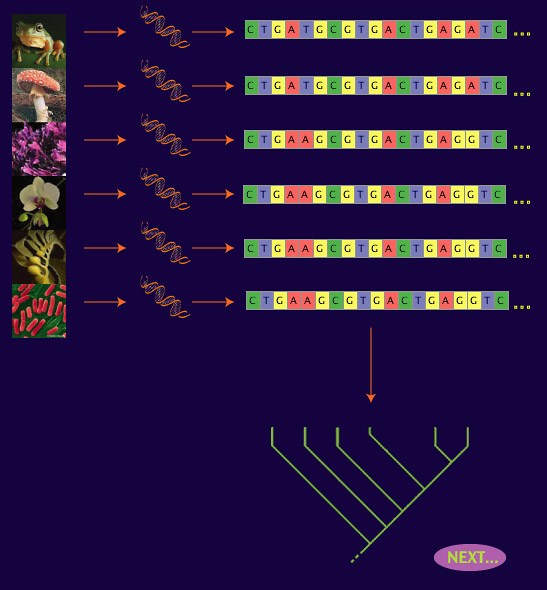
Two organisms that are closely related would have
a)
very similar DNA sequence
b)
exactly the same DNA sequences
c)
no proteins in common
d)
completely different DNA sequence
21.

The science of grouping and naming organisms

a)

Phylogeny

b)

Dichotomy

c)

Taxonomy

d)

Genetics

22.

Which of the following is the CORRECT form of a scientific name?

a)

canis lupus

b)

Canis Lupus

c)

Canis lupus

d)

canis lupus

23.

Which taxonomic level would include the LEAST number of organisms?

a)

species

b)

genus

c)

order

d)

phylum

24.

A ________ can be used to classify organisms based on characteristics.

a)

punnet square

b)

phylogenetic chart

c)

trophic pyramid

d)

dichotomous key

25.

The scientist who came up with the current classification system

a)

Darwin

b)

Newton

c)

Mendel

d)

Linnaeus