wayground logo

Free Printable Worksheets

NEW

Font size

S
M
L
XL
Worksheets

Enzymology

Total questions: 21

Worksheet time: 14mins

Name
Class
Date
1.

These enzymes are responsible for protein digestion, except

a)

Trypsin

b)

Pepsin

c)

Amylase

d)

Peptidase

2.

Enzymes are used up in the reaction

a)

True

b)

False

3.

Enzymes are categorized by the reaction it catalyzes

a)

True

b)

False

4.

Enzyme that join two molecules via covalent bond is categorized as

a)

Ligase

b)

Hydrolase

c)

Lyase

d)

Transferase

5.

Invertase catalyze the hydrolysis of sucrose to

a)

Glucose and Glucose

b)

Glucose and Lactose

c)

Glucose and Fructose

d)

Lactose and Fructose

6.

Hydrolase enzyme generally involves addition or removal of water

a)

True

b)

False

7.

Example of Competetive Inhibitor

a)

succinate

b)

fumerate

c)

malonate/ malonic acid

d)

Citrate

8.

These are the mechanism of enzymes, except

a)

Lowering the activation energy

b)

Providing an alternative pathway

c)

Increasing reaction enthropy

d)

Lowering the energy of transition state
9.
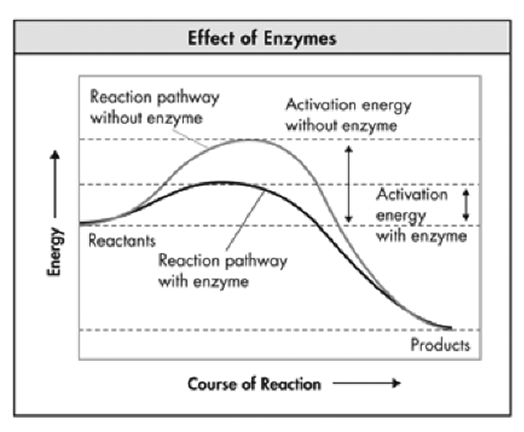
The graph shows how enzymes affect reactions in cells. Which statement best summarizes the information shown in the graph?
a)
Enzymes increase the energy of the reactants.
b)
Enzymes decrease the energy level of the products.
c)
Enzyme decrease the activation energy of the reaction.
d)
Enzymes reverse the direction of the reaction.
10.
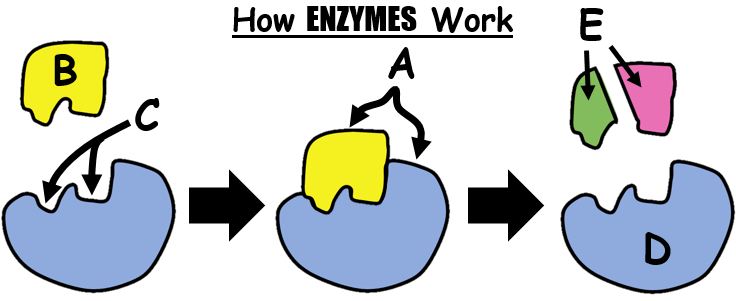
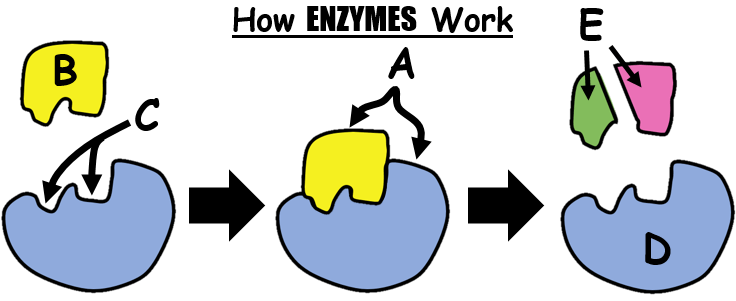
In the diagram, what is letter A? 
a)
product
b)
substrate
c)
enzyme-substrate complex
d)
active site
11.
Letter C...
a)
active site
b)
enzymes
c)
substrate
d)
products
12.

The current model of enzyme action is referred to as the:

a)

Induced Fit Model

b)

Lock & Key Model

c)

Michaelis-Menten Model

d)

Tyra Banks Model

13.
When a molecule can occupy the same active site as the substrate, a situation called __________________ can result
a)
Competitive lnhibition
b)
Allosteric Regulation
c)
Non-Competitive Inhibition
d)
Feedback Inhibition
14.
A receptor site that a molecule can bind to that changes the shape of the active site is called a(n):
a)
Allosteric Site
b)
Active Site
c)
DiSulphide Bridge
d)
MHC Receptor
15.
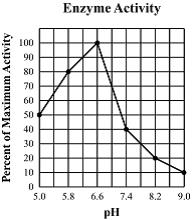
Which of the following conclusions can be drawn from this graph?
a)
The optimum pH of the enzyme is 6.6.
b)
The optimum pH of the enzyme is 5.8
c)
The enzyme’s activity increases as pH increases 5.0 to 9.0
d)
The enzyme’s activity is greater around pH of 8.0 .
16.
What makes an enzyme substrate specific?
a)
Size
b)
Shape
c)
Name
d)
Location it is found in
17.
What happens when enzymes are heated to a high temperature?
a)
The enzymes die.
b)
The shapes of the enzyme are altered denature
c)
The enzymes' amino acid sequence changes.
d)
The enzymes remain the same
18.
Letter E...
a)
active site
b)
enzyme
c)
substrate
d)
products
19.

The human body maintains a temperature of around 37 degrees at all times. Enzymes are involved in almost every chemical reaction in the body. Which of the following describes the connection between these two statements?

a)

Enzymes function best at a specific temperature.

b)

The body needs to be warm to prevent hypothermia.

c)

The body is kept relatively warm to prevent too much enzyme action.

d)

There is no connection between the two statements.

20.

Cofactor is

a)

protein part of enzyme

b)

non-protein part of enzyme

c)

both

d)

none

21.

Apoenzyme is

a)

Inactive enzyme

b)

Enzyme minus cofactor

c)

protein

d)

all of the above