
 Worksheets
Investigating Science - Theories and Laws
Total questions: 60
Worksheet time: 51mins
An observation often leads to a testable question known as a(n)________
evidence
hypothesis
experiment
bar graph
A planned study meant to answer a question is called ________________.
experiment
obervation
conclusion
result
It is very important to test only one _________________, or factors that change, at a time.
investigation
evidence
tools
variable
A claim should be supported by the _________________.
hypothesis
variable
evidence
investigation
To record the growth of a plant what measurement will be recorded?
the soil of a plant
the height of a plant
the mass of a plant
time of a plant

Which is an inference about the car?
There was a car crash.
The car will be toweled .
A flat tire.
Someone opened the door.
What is Newton's 2nd Law?
F=ma
Every action has an equal and opposite reaction
An object at rest stays at rest, an object in motion stays in motion.
Friction

If the man pushes with an equal amount of force, which object will accelerate more?
Car because it has more mass
Lawnmower because it has less mass
Car because it has less mass
Lawnmower because it has more mass
What unit do we measure force in?
Kilometer/hr
Joules
Seconds
Newtons
Which term denotes the combination of genes an organism has?
genotpye
phenotype
heterozygous
homozygous
The passing of physical characteristics from parent to young is called...
Traits
Alleles
Heredity
Hybrid

Which image is inconsistent with Avogadro's law?
A
B
C
D
The Law of Superposition helps scientists to determine what?
The absolute age of rock layers
The age of fossils
The relative age of rock layers
the super powers of squirrels


What is the biggest difference between the Geocentric Model and the Heliocentric Model?
the shape of the planets' orbits
the movement of the moon
the center of the solar system


Which scientific instrument did Galileo use to change the world?
telescope
spyglass
mirror
magnifying glass
Which object is the center of the solar system according to Galileo?
Earth
Moon
Sun
Neptune
Which astronomer first observed the phases of Venus and Jupiter's moons with the help of a telescope?
Gailieo
Aristarchus
Kepler
Aristotle
Copernicus
Theory that states that microscopic organisms named germs can cause disease in the human body.
The big bang Theory
Spontaneous Generation Theory
Germ theory of disease
The Pasteur Theory
What did people believed were the cause of diseases until the acceptance of the germ theory?
That disease was a punishment for sins.
That disease were cause due the flow of life
That disease were caused by books
That disease were caused by movements of the earth
What tool provided the evidence to be able to formulate the germ theory?
Telescope
Microscope
Drill
Hammer
What´s the name of the german physician that was able to isolated several bacteria from sick people?
Francisco Redi
Antoine Vaan Levonhooke
Louis Pasteur
Robert Koch
Robert koch used several steps to isolated bacteria from sick people and to prove this bacteria was the causative agent of the disease, these steps were later be called....
Pasteurization
Koch Law´s
Fermentation Law´s
Koch Postulates
What does the first koch postulates states?
“The organism must be present in half cases of the disease”
“The organism must be absent in every case of the disease”
“The organism must be present in most cases of the disease”
“The organism must be present in every case of the disease”
What does the 2nd koch postulate states?
“The organism must be isolated from a host with the corresponding disease and grown in pure culture”
“The organism must be isolated from a host with a different disease and grown in pure culture”
“The organism must be isolated from a host with the corresponding disease and grown in a culture with other bacteria”
“The organism must be isolated from a host with a different disease and grown in bacteria culture”
What does the third koch postulate states?
“Samples of the organism removed from the pure culture must cause the corresponding disease when inoculated into a healthy, susceptible laboratory animal”
“Samples of the organism removed from the pure culture must cause the corresponding disease when inoculated into a sick, susceptible laboratory animal”
“Samples of the organism removed from the bacteria culture must cause the corresponding disease when inoculated into a healthy, susceptible laboratory animal”
“Samples of the organism removed from the pure culture must cause the corresponding disease when inoculated into a sick, nonsusceptible laboratory animal”
What does the 4th koch postulate states?
“The organism must be isolated from the inoculated animal and identified as being different to the original organisms isolated from the initial, diseased host”
“The organism must be isolated from any animal and identified as being identical to the original organisms isolated from the initial, diseased host”
“The organism must be isolated from the inoculated animal and identified as being identical to the original organisms isolated from the initial, diseased host”
Name some common types of pathogens
Virus, Bacteria, Protist
Virus, Sugar, Bacteria
Bacteria, Amino Acids
Hydrocarburs, Bacteria, Protist
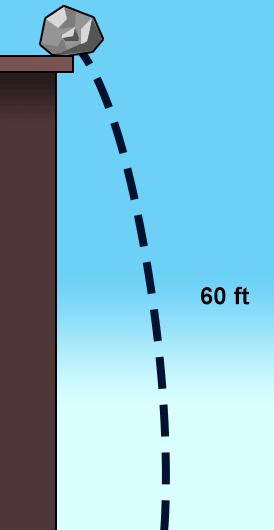
The rock in the picture is pushed over the edge and it begins to fall. Which type of energy conversion is taking place?
mechanical to heat
sound to mechanical
potential to kinetic
kinetic to potential
Who started the modern atomic theory (backed with data) of the atom?
Democritus
Dalton
Thomson
Bohr
Are acquired physical traits passed down from parents to offspring?
yes
no

Which choice best explains why the scientific model of the atom has changed over time?
The discovery of new evidence resulted in changes to the atomic theory.
Advancements in atomic models proved the atomic theory was accurate.
The atomic theory was modified with the discovery of a new element.
Changes in atomic models show that the atomic theory was based on opinion.

