
 Worksheets
Plate Tectonics & Continental drift
Total questions: 43
Worksheet time: 48mins
The theory of continental drift states that all the continents were once part of one big landmass called Pangaea. Who was the scientist that proposed this theory?
Harry Hess
Bill Nye
Alfred Wegener
Albert Einstein
Internal processes continually build up the surface of the earth, while __________________ processes break it down.
Atmospheric
Hydrogeological
External
Volcanic
Earth's internal processes are driven primarily by what?
Heat and convection currents
Ocean currents
Weathering and erosion
Earthquakes and volcanoes
Why was the theory of plate tectonics initially rejected?
It didn't explain how continents move
It did not explain formation of islands
It was based upon false statements
There was no data to support the hypothesis
Which of the following is NOT evidence of continental drift?
Continents fit together like puzzle pieces
Volcanic activity
Fossil evidence
Mineral, rock, and glacial deposit evidence
Present day fossils of similar organisms are found on different continents. This supports the theory of continental drift how?
The environment of these organisms was once connected when continents were joined
The organisms were avian and could live in a wide range
The organisms often migrated
The organisms had a large population that was widespread
Which of the following is evidence that mountain ranges on different continents were once connected?
They have the same climate
They are inhabited by similar wildlife
They are the same age
They have no trees beyond a certain height
At what rate do continents continue to move?
About 7 feet a year
About 2 centimeters per year
They are not moving
About 15 feet per year
Why don't present day continents fit perfectly together?
Weathering and erosion of coastlines
They have been twisted by earthquakes
Fossils
Human actions have changed the shape of coastlines
True/False. Pangaea was the only super-continent known to have formed over Earth's geological history.
True
False


A boundary at which two plates move away from each other
convergent plate boundary
divergent plate boundary
transform plate boundary
subduction

A boundary at which two plate move toward each other __________.
convergent plate boundary
divergent plate boundary
transform plate boundary
subduction

The process wherein one tectonic plate is forced under another at convergent plate boundaries is referred to as _______.
convergent plate boundary
divergent plate boundary
transform plate boundary
subduction

What feature is formed on the continental crust at an oceanic-continental convergent boundary?
volcanoes
mid-ocean ridge
ocean trench
none of these features are formed at a oceanic-continental convergent boundary

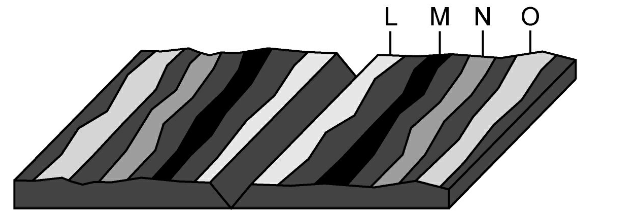
What type of plate boundary is shown in the image?
convergent plate boundary
divergent plate boundary
transform plate boundary
subduction

What type of plate boundary is shown in this image?
convergent plate boundary
divergent plate boundary
transform plate boundary
subduction

What type of plate boundary is shown in the image?
convergent plate boundary
divergent plate boundary
transform plate boundary
subduction


Earth’s crust is divided into two types:
continental and oceanic
ocean and upper
lower and upper
pizza and subway

What is the correct order (starting from the surface) of Earth’s layers?
crust, outer core, inner core, mantle
mantle, outer core, inner core, crust
crust, mantle, outer core, inner core
outer core, inner core, crust, mantle
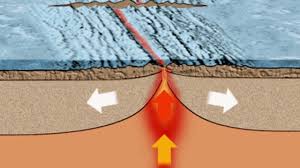
In sea-floor spreading, molten material rises from the mantle and erupts along __________.
the edges of all the continents.
mid-ocean ridges.
in deep-ocean trenches.
at the north and south poles.

The process by which the ocean floor sinks beneath a deep-ocean trench and back into the mantle is known as _______
convection.
continental drift.
subduction.
conduction.

Most geologists think that the movement of Earth’s plates is caused by _______
convection.
continental drift.
subduction.
conduction.
The geological theory of _______ states that pieces of Earth’s lithosphere are in constant, slow motion.
subduction
plate tectonics
deep-ocean trenches
sea-floor spreading
Scientists think that convection currents flow in Earth’s
continents.
mantle.
lithosphere.
inner core.

Below is a picture of sea-floor spreading. How are the ocean crusts moving?
Converging
Diverging
Sliding
No movement
The San Andreas Fault in California is known as an active earthquake area. What type of plate boundary is this region found on?
Convergent
Divergent
Transform
Sea Floor Spreading


