
NEW
Font size
 Worksheets
TEST - Pangea, Continental Drift Theory, Plates and Boundaries
Total questions: 45
Worksheet time: 4hrs 45mins
Mountains on the Earth's surface form in random locations, with no relation to Earth's plates.
True
False
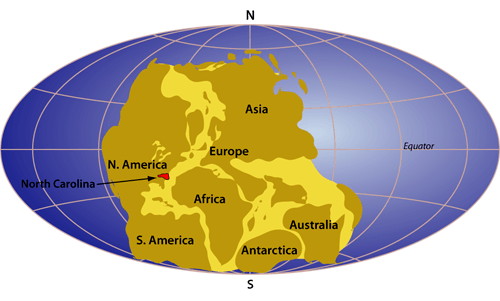
What did scientist Alfred Wegener call the large super continent that once existed?
Pangea
Panamerica
Eurasia
Ring of Fire
Which of these pieces of evidence did Wegener use to support his theory of continental drift?
fossils from different continents
subduction zones
divergent boundaries
seafloor spreading
Which of these is NOT used as evidence that Earth's surface consists of plates that are in continuous motion?
Mountains
Volcanos
earthquakes
blizzards
The rocky outer layer of the Earth is called the ____________.
hydrosphere
lithosphere
atmosphere
mantle
Seafloor spreading explains why ___________.
materials circulate within the Earth's mantle
the oldest part of the ocean floor is found farthest from the mid-ocean ridge
one portion of the Earth's crust dives beneath another portion
the ocean has high and low tides.
The Ring of Fire refers to ____________.
an active erupting volcano
the volcanoes surrounding the Pacific Ocean
the land once known as Pangea
the ocean has high and low tides
Scientist think that tectonic plates can move when __________.
high tide occurs
materials circulate in the Earth's mantle
magma is released from the mid-ocean ridge
the lithosphere begins to melt
A transform boundary exist where one of the Earth's plates _____________.
moves away form another plate?
slides past another plate.
crashes into another plate
dives beneath another plate
What do we call the process in which one tectonic plate moves under another?
weathering
coasting
subduction
none of the above
Where are most divergent boundaries found?
ocean floor
mountains
valleys
hilly regions
What happens to plates at divergent plate boundaries?
They collide
They slide past each other
They move apart
None of the above
What is another name for transform boundaries?
Glaciers
Plateaus
Faults
Hills
What is the name of the transform boundary in California?
The Danali Fault
The Hayward Fault
The Seismic Fault
San Andreas Fault


What is this image of ?
Revolving boundary
San Andreas (Transform fault)
Convergent

The Great Rift Valley in Africa and the Mid-Ocean Ridge were all created by this boundary
Divergent
Convergent
Reform
Transform

Tectonic Plate movement is caused by ______________.
the rotation of the Earth
ocean tides
convection currents in the mantle
the moon's gravity

Which correctly identifies the geologic process that formed the Himalayan mountains (The World's Tallest Mountains, including Mt. Everest)?
Two continental plates converging
An earthquake in a subduction zone
A tectonic plate moving over a hot plate
Movement at a transform fault boundary

Volcanoes and Earthquakes typically occur _______________.
along plate boundaries
only under water
only in hawaii
where it is usually hot

What type of boundary is this?
Divergent
Convergent
Transform

What evidence did Wegener use in his Continental Drift theory?
Continents and fossils fitting together/matching-up like puzzle pieces
Plant and animal fossils
mountain ranges and coal deposits line up across continents
all of the above

What type of Boundary is this? What event will occur at this boundary?
Transform / Earthquakes
Subduction / Volcano Eruption
Tornado / Rain
Mountain Building / Volcanism
Why did people not believe in Wegener's theory about continental drift?
There was a competing theory at the time that was more believable.
There was no data showing the continents ever moved.
The scientists did not know the force responsible for moving the continents.
The scientist presenting the data was unreliable.

The Himalayas are an example of what happens at a?
convergent boundary
divergent boundary
transform boundary
allegiant boundary


The earthquakes experienced in California are related to tectonic plates because these catastrophic events are the result of -
two tectonic plates sliding past each other.
tectonic plates melting as they slide into the mantle.
tectonic plates being weathered over time.
two tectonic plates pulling away from each other.
One piece of evidence that supports the Theory of Plate Tectonics is the discovery of what in both South America and Africa?
The ancient atmosphere in both places was identical.
The rates of weathering of rock are similar.
Fossil remains of the same land-dwelling animal.
Plants on both continents have similar flowers.
Even before modern observations provided evidence that supports the Theory of Plate Tectonics, people developed theories that the continents were once joined together. Using only maps, they observed that -
most of the larger land masses are in the Northern Hemisphere.
continents with the most moderate climates were located near the Equator.
the shapes of continents appeared to allow them to fit together.
the oceans have decreased in size throughout the history of Earth.
Which of the following features is likely to form where two tectonic plates push toward each other?
Ocean shoreline
Mountain range
Mid-ocean ridge
Rift valley
Which of the following crustal features would be the result of two continental tectonic plates moving away from each other?
Mountain range
Volcanoes on land
Rift valley
Mid-ocean ridge

Every 100,000 to 200,000 years, the magnetic poles of Earth reverse. Rocks that contain iron provide a record of both normal and reversed magnetic poles. The pattern of normal and reversed magnetic poles as recorded in the rock on either side of the Mid-Atlantic Ridge provide evidence supporting the Theory of Plate Tectonics because -
the composition of the rock changed every time the plates pushed against each other.
the symmetric pattern shows where plates are moving away from each other.
deposits of iron in the rock were only made when the plates stopped moving.
" the bands of rock showing normal and reversed poles are not all the same width."

