
 Worksheets
Government - Unit 1 Review
Total questions: 70
Worksheet time: 1hrs 21mins
The idea that government rules with the consent of the people comes from which document
Magna Carta
Declaration of Independence
English Bill of Rights
Mayflower Compact
What is the difference between direct and representative democracy.
(a)
Which term refers to dividing the power of the federal government into different branches
Federalism
Separation of Powers
Balance of Powers
Social Contract Theory
What is the purpose of government?
(a)
Which of the following are examples of the government's role to provide public services?
Building a large military
Investing in the education system
Building bridges and roads
Raising or lowering interest rates
Which of the following are examples of the government's role to provide national defense?
Building a large military
Investing in the education system
Securing the boarder
Regulating the stock market
Which of the following are examples of the government's role to maintain social order?
Developing new weapons
Creating and enforcing laws
Investing in the education system
Regulating the stock market
Which of the following are examples of the government's role to regulate the economy?
Raising and lowering interest rates
Creating and enforcing laws
Investing in the education system
Regulating the stock market
The structure of the United States government is a
Federal system
Unitary system
Greek system
Democratic system
Which of the following is an example of an unlimited government?
Finland
Russia
North Korea
South Korea
Which system of government gives all the power to the national or central government?
Unitary System
Federal System
Communist System
Socialist System
Which system of government divides power between the national and local governments?
Unitary System
Federal System
Communist System
Socialist System
What is a Constitution?
(a)
Which of the following are characteristics of a Democracy?
Rule by the people
Liberal view point
Individual liberties
Majority rule
Why did the colonies decide to revolt against Britain?
Over the acquisition of Mexico
Because of the Constitution
Because of the war
Taxation without representation
"we hold these truths to be self-evident, that all men are created equal, that they are endowed by their creator with certain unalienable rights..."
The U.S. Constitution
The Declaration of Independence
The Bill of Rights
The Magna Carta
The first form of government in the United States was under the...
Articles of Confederation
Constitution
Bill of Rights
Declaration of Independence
The Articles of Confederation were very strong and gave a lot of power to the Federal Government.
True
False
Which of the following powers is given to Congress
Make laws
Make judicial decisions
Command the military
Appoint judges
Which of the following is an example of a power given to the Executive branch?
Raise/lower taxes
Appoint cabinet members
Rule on court cases
Coin money
Which of the following are identified in the quote?" We hold these truths to be self-evident, that all men are created equal, that they are endowed by their Creator with ... Life, Liberty and the pursuit of Happiness..."
economic rights
unalienable rights
legal rights
states' rights
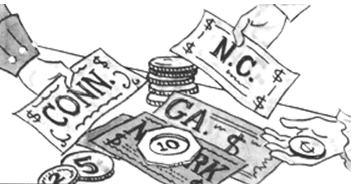
Which of the following weaknesses in the Articles of Confederation does this picture represent?
no common currency (money)
no executive branch
no power to tax
one vote for each state
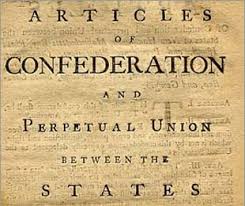
Under the Articles of Confederation, the national government consisted of _______________ branch of government.
3
2
1
4

What does Article I (1) establish?
Legislative Branch
Judicial Branch
Executive Branch
Supremacy of the Constitution
What does Article II (2) establish?
Legislative Branch
Judicial Branch
Executive Branch
Supremacy of the Constitution
What does Article III (3) establish?
Legislative Branch
Judicial Branch
Executive Branch
Supremacy of the Constitution
What does Article IV (4) establish?
The Constitution is Supreme
How to amend the Constitution
How to ratify the Constitution
Relationships between the states
This branch can override a presidential veto.
Legislative
Executive
Judicial
This branch can appoint Supreme Court Justices.
Legislative
Executive
Judicial
This branch confirms all appointments to the Supreme Court.
Legislative
Executive
Judicial
This branch confirms all appointments to the Supreme Court.
Legislative
Executive
Judicial
This branch can declare legislation unconstitutional.
Legislative
Executive
Judicial
This branch approves treaties.
Legislative
Executive
Judicial
This branch approves all Cabinet appointments.
Legislative
Executive
Judicial
This branch can veto legislation.
Legislative
Executive
Judicial
What does impeachment mean?
removal from office
conviction of a crime
formal accusation of wrongdoing


The struggle of competing interest groups for govermental influence is called ____.
pluralism
direct action politics
direct democracy
oligarchy
grassroots mobilization
Which of the following accurately characterizes the main difference between elite theories and pluralist theories of politics in the United States?
Elite theories argue that a single minority dominates in all policy areas; pluralist theories argue that many minorities compete in different policy areas.
Elite theories argue that social status is the major source of political power; pluralist theories argue that wealth is the major source.
Elite theories view government as efficient; pluralist theories view it as slow and wasteful.
Elite theories concentrate on the role of interest groups; pluralist theories emphasize the role of individuals.
The Tenth Amendment to the Constitution has been interpreted by the Supreme Court to
prevent states from taxing agencies of the federal government
reserve powers to the states
restrict the application of judicial review
allow for the burning of the flag as an expression of protest
Of the following, which has been used most to expand the power of the national government?
The First Amendment
The Fifth Amendment
The habeas corpus clause of the Constitution
The commerce clause of the Constitution
Which of the following is an example of checks and balances, as established by the Constitution?
A requirement that states lower their legal drinking age to eighteen so they can receive federal highway grants
Media criticism of public officials during an election campaign period
The requirement that presidential appointments to the Supreme Court be approved by the Senate
The election of the President by the Electoral College rather than by direct election
Both the national and states’ governments can establish court systems. This is an example of
reserved powers
a mandate
concurrent powers
full faith and credit clause

The cartoon expresses which of the following viewpoints?
It's hard to define "life, liberty, and pursuit of happiness."
Politicians tend to be more focused on public opinion than policy.
The members of the Continental Congress were old and feeble.
Sometimes even wealthy and educated individuals don't know the best course of action.
If the president vetoes a bill, how can the veto be overridden?
By a majority vote of the Supreme Court
By a 2/3 vote of the Senate
By a 2/3 vote of both house of Congress
By a majority vote in both houses

