
 Worksheets
ANTENNA
Total questions: 45
Worksheet time: 27mins

The graph shows the relationship between the force of interaction and the magnitude of charge. What type of relationship is this?
Direct
Indirect
Inverse
Reverse
Which two particles are attracted to each other?
Two neutrons
A proton and an electron
Two protons
An electron and a neutron
What is the SI unit for charge?
Joules
Coulombs
Newtons
Meters

Coulomb's law says that the force between any two charges depends
directly on the size of the charges
inversely on the square of the distance between the charges
both are correct
Which is the value of the constant in Coulomb's equation?
k = 9·10-9
k = 9.8
k = 6.67·10-11
k = 9 ·109
The variable "r" in Coulomb's Law would have what units?
Joules
Coulombs
Newtons
Meters


Fig. shown is a distribution of charges. The flux of electric field due to these charges through the surface S is
∈03q
∈0q
zero
∈02q
The S.I. unit of electric flux is
Joule per coulomb
Newton per coulomb
Weber
Volt metre
If i want to find the rotation of a vector A What should i do ?
take divergence
take curl
take gradient
view in microscope
Which law talks about the force between two charges?
Faraday
Gauss
Coulombs
Force law
Force between two charges are is --------------- proportional to -------------- of charges
inversely, sum
directly , sum
inversely , product
directly , product
which are correct
F=Eq
D=eE
f prortional to 1/q
f is proportional to 1/r^2
The magnetic field lines near a long straight wire carrying current are:
Straight lines
Concentric rings
Spiral lines
Radial lines

The magnetic field at the center O' of the following current loop is


Moving charges, or an electric current, produces a magnetic field.
Gauss's Law
Ohm's Law
Ampere's Law
Law of Conservation of Magnetism
What is the unit of magnetic field?
ampere
watt
kilowatt hour
tesla
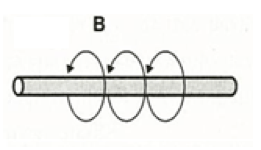
1) A wire carries a current, creating a magnetic field around itself as shown. The current in the wire is:
A. Directed to the right
A. Directed to the left
A. Equal to the magnetic field
In the same direction as the magnetic field

Gauss's law is:
Equation 1
Equation 2
Equation 3
Equation 4

Faraday's Law is
Equation 1
Equation 2
Equation 3
Equation 4

Ampere's Law is
Equation 1
Equation 2
Equation 3
Equation 4

Magnetic Flux formula
Equation 1
Equation 2
Equation 3
Equation 4
The equation that says changing electric field creates magnetic field
Equation 1
Equation 2
Equation 3
Equation 4
The equation that says magnetic field lines form closed loops
Equation 1
Equation 2
Equation 3
Equation 4
The equation that says electric currents create magnetic fields:
Equation 1
Equation 2
Equation 3
Equation 4
The equation that says changing magnetic flux creates electric field
Equation 1
Equation 2
Equation 3
Equation 4
Which of the equations must be modified if
magnetic monopoles are discovered?
Equation 1
Equation 2
Equation 3
Equation 4
Which of the above states that a changing electric
flux through a closed loop or an electric current
through the loop creates a magnetic field around the
loop?
Equation 1
Equation 2
Equation 3
Equation 4
Which of the following cannot be computed using the Biot Savart law?
Magnetic field intensity
Magnetic flux density
Electric field intensity
Permeability
The Ampere law is based on which theorem?
Green’s theorem
Gauss divergence theorem
Stoke’s theorem
Maxwell theorem
Based on Maxwell starting points
Electric field lines:
Originate on positive charges and terminate on negative charges.
Originate on negative charges and terminate on positive charges.
Can be originated on either charges but terminates only on negative charges.
Form closed loops
Based on Maxwell starting points:
•Magnetic field lines :
always form closed loops – they do not begin or end anywhere.
they can form closed or open loops – they begin at specific point but end anywhere.
originate on south poles and terminate on north poles.
magnetis can be found as separate poles
One of Maxwell's starting points was
A varying magnetic field:
induces an emf and hence an electric field
induces only an emf
induces only an electric field
induces ultraviolet catastrophe
Based on Maxwell's starting points
•Magnetic fields are generated :
by moving charges or currents
by still charges
by chemical reactions
by summer and hot weather
Maxwell hypothesized that a changing electric field would produce a magnetic field. and edited which equation:
Gauss's Law
Faraday's Law
Ampere's Law
Magnetic flux through a closed loop formula
When light (or other electromagnetic radiation) travels across a given region, which of the following
is/are oscillating?
I. Electric field
II. Magnetic field
III. Energy
I only
II only
III only
I and II only
I, II and III
In general, which condition of motion MUST be met with regards to a charged particle if it is in the process of emitting electromagnetic waves?
Accelerates
Moves in a circle
Moves at constant velocity
Moves at the speed of light

