wayground logo

Free Printable Worksheets

NEW

Font size

S
M
L
XL
Worksheets

H Chem Unit 1 Review

Total questions: 43

Worksheet time: 51mins
Name
Class
Date
1.

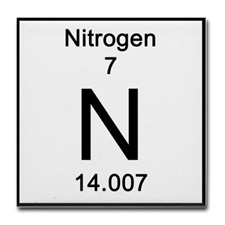
What is the number of electrons that the element in this image contain?

a)

14

b)

7

c)

15

d)

18

2.
The positive particles of an atom are 
a)
Electrons 
b)
Positrons 
c)
Neutrons 
d)
Protons 
3.
The central region of an atom where its neutrons and protons are is its _______.
a)
Nucleus 
b)
Electron cloud
c)
Core 
d)
Center 
4.
An atom with atomic number 6 would have how many protons?
a)
6
b)
12
c)
3
d)
Cannot be determined 
5.
Particles in an atom that are neutral and have no charge are ______. 
a)
Negatrons 
b)
Electrons 
c)
Neutrons 
d)
Protons 
6.
An atoms overall charge is _____.
a)
Positive 
b)
Depends on its mood 
c)
Neutral 
d)
Negative 
7.
Which of the following is a negatively charged subatomic particle?
a)
Electron
b)
Proton
c)
Neutron
d)
Quark
8.
Where are electrons of an atom found?
a)
Nucleus
b)
Electron Cloud
c)
Some are in the nucleus and some in the electron cloud.
d)
They are moving everywhere.
9.
Which statement best describes an electron?
a)
Smaller mass than a proton and a negative charge
b)
Smaller mass than a proton and a positive charge
c)
Greater mass than a proton and a negative charge
d)
Greater mass than a proton and a positive charge
10.

What does the 1.00794 stand for?

a)

Hydrogen

b)

atomic number

c)

atomic mass

d)

mass number

11.

What particle uniquely identifies an element?

a)

Number of Valence Electrons

b)

Number of Protons

c)

Number of Electrons

d)

Atomic Mass

12.

Anything that has mass and takes up space is called

a)

heterogeneous

b)

homogeneous

c)

matter

d)

density

13.
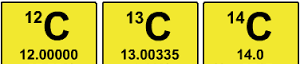
What do these isotopes of carbon all have in common?
a)
neutrons & mass number
b)
atomic number and neutrons
c)
atomic number and electrons
d)
protons, atomic number, and mass number
14.
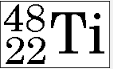
How many protons does this isotope of titanium have?
a)
48
b)
22
c)
26
d)
70
15.
In a correctly written symbol what would be located in the "A" position?
a)
number of neutrons
b)
atomic number
c)
number of electrons 
d)
mass number
16.
What quantities vary between isotopes of an element?
a)
protons, electrons, and atomic mass
b)
protons, electrons, and atomic number
c)
neutrons and electrons
d)
neutrons and atomic mass
17.
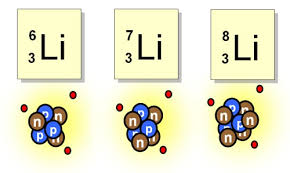
which atom has  4 neutrons?
a)
Li-6
b)
Li-7
c)
Li-8
d)
they have the same # of neutrons
18.
How many neutrons does the isotope below have?     89 36Kr
a)
53
b)
36
c)
89
d)
125
19.
If X is the symbol for an element, which of the following two symbols represent    isotopes of the same element?     I. 7735X  II. 7733X  III. 8137X  IV. 8135 X
a)
I and II
b)
III and IV
c)
I and IV
d)
I and III
20.
Four isotopes of lead include lead-204, lead-206, lead-207, and lead-208.  The average atomic mass of lead is 207.2.  Which isotope of lead is likely to be the most abundant.
a)
204
b)
206
c)
207
d)
208
21.
An atom is electrically neutral when
a)
protons and neutrons are the same
b)
protons and electrons are the same
c)
neutrons and electrons are the same
d)
neutrons balance the protons and electrons
22.
Ions are: 
a)
atoms with a positive or negative charge
b)
atoms with no charge
c)
atoms with ONLY a positive charge
d)
atoms with ONLY a negative charge
23.
How many electrons are in an atom that has an atomic number of 34, an atomic mass of 74 and a charge of -2?
a)
34
b)
36
c)
2
d)
40
24.

Nickel-59 has how many neutrons?

a)

30

b)

31

c)

32

d)

33

25.

76 protons and 114 neutrons

a)

Osmium-114

b)

Osmium-76

c)

Osmium-190

d)

Osmium-190.23

26.

Rubidium has two common isotopes, 85Rb and 87Rb. If the abundance of 85Rb is 72.2% and the abundance of 87Rb is 27.8%, what is the average atomic mass of rubidium?

a)

85.468 amu

b)

37 amu

c)

85.6 amu

d)

86.4 amu

27.

There are two primary isotopes found in any sample of copper: copper-63 and copper-65. The isotope 65Cu composes 69.2% of the sample and 63Cu comprises the other 30.8%. Based on this data, what is the atomic mass of copper?

a)

29 amu

b)

63.546 amu

c)

64.4 amu

d)

63.6 amu

28.
An atom becomes _________ when it gains electrons.
a)
Positive
b)
Negative
c)
Neutral
d)
Invinsible
29.

Why are ions formed?

a)

So the atom can achieve a stable state (usually an octet)

b)

Because atoms are unstable

c)

Because atoms have the same number of protons and electrons

d)

Because atoms gained neutrons

30.

What is the charge of a sodium ion?

a)

+2

b)

+1

c)

-1

d)

-2

31.

Group 7A always has ions with a charge of

a)

+1

b)

+2

c)

-1

d)

-2

32.
If an element has 3 valence electrons, what charge will likely form on its ion ?
a)
+3
b)
+5
c)
-3
d)
-5
33.
Which of the following has a -3 charge?
a)
Boron
b)
Fluorine
c)
Nitrogen
d)
Neon
34.

Elements on the LEFT side of the periodic table will most likely form:

a)

Cations

b)

Anions

c)

Neutral Ions

d)

Ionic bonds

35.

Valence electrons are

a)

outer shell electrons

b)

electrons involved in reactions

c)

electrons that are moved between ions

d)

all of these

36.
A +2 ion will
a)
likely be a nonmetal
b)
add 2 electrons
c)
gain electrons
d)
subtract 2 electrons
37.
What would phosphorous do with its valence electrons?
a)
lose them
b)
gain more
c)
share
d)
nothing
38.
Positive ions will try to achieve the configuration of
a)
the atom in front of itself
b)
the noble gas behind itself
c)
the atom behind itself
d)
the noble gas in front of itself
39.

What happens when two negatively charged ions are pushed together?

a)

they will repel (move apart)

b)

they will be attracted to each other (move together)

40.

What happens when two oppositely charged ions are pushed together?

a)

they will repel (move apart)

b)

they will be attracted to each other (move together)

41.

Manganese (III) combines with Chlorine. What is the product?

a)

MgCl2

b)

MnCl2

c)

MnCl

d)

MnCl3

42.

Calcium combines with Iodine. What is the product?

a)

CaI2

b)

CaI

c)

Ca2I

d)

Ca2I2

43.

Aluminum combines with Oxygen. What is the product?

a)

AlO

b)

Al2O3

c)

Al3O2

d)

AlO3