
 Worksheets
AQA Chemistry Paper 1- Atoms, Elements, Compounds
Total questions: 39
Worksheet time: 47mins
What is the charge of a Proton?
Positive Charge
Negative Charge
Neutral Charge
What is the Charge of an Electron?
Positive Charge
Negative Charge
Neutral Charge
What is the Charge of a Neutron?
Positive Charge
Negative Charge
Neutral Charge
What does the Nucleus of an atom contain?
Protons
Electrons
Neutrons
Which number tells you the amount of protons in an element?
Atomic Number
Mass Number
Which number tells you the amount of protons and neutrons in an element?
Atomic Number
Mass Number
What is an Isotope of a element?
Element with same number of Protons but a different number of Neutrons.
Element with same number of Neutrons but a different number of Protons.
What is a compound?
A substance formed from a two or more elements held by chemical bonds
A mixture of two or more chemicals which provides a useful outcome
What is a Mixture?
A substance formed from a two or more elements held by chemical bonds
A mixture of elements or compounds which can be physically separated
Which one is Filtration?
Used if the product is an insoluble solid and needs to be separated from a liquid. Uses filter paper
Used if the product is a soluble solid. Its placed in an evaporating basin and heated until crystals form
Used if the product is a soluble solid. Its placed in an evaporating basin and heated until start crystals forming then the heat is removed letting the crystals form while cool. Its then Filtered out
Which one is Evaporation?
Used if the product is an insoluble solid and needs to be separated from a liquid. Uses filter paper
Used if the product is a soluble solid. Its placed in an evaporating basin and heated until crystals form
Used if the product is a soluble solid. Its placed in an evaporating basin and heated until start crystals forming then the heat is removed letting the crystals form while cool. Its then Filtered out
Which one is Crystalisation?
Used if the product is an insoluble solid and needs to be separated from a liquid. Uses filter paper
Used if the product is a soluble solid. Its placed in an evaporating basin and heated until crystals form
Used if the product is a soluble solid. Its placed in an evaporating basin and heated until start crystals forming then the heat is removed letting the crystals form while cool. Its then Filtered out
What is Simple Distillation used for?
Separating out Solutions
Separating out a Mixture of Liquids
What is Fractional Distillation used for?
Separating out Solutions
Separating out a Mixture of Liquids
Which one is Simple Distillation?
Solution is Heated. The part with the lowest boiling point evaporates, gets cooled and Condenses and gets collected.
Mixture of liquids is Heated. They rise through a fractionating column the lowest boiling point is collected, temperature is raised and then the next one is collected.
What is the first step in developing the modern day model of an atom?
John Dalton published his ideas about atoms. He thought that all matter was made of tiny particles called atoms, which he imagined as tiny spheres that could not be divided.
J J Thomson carried out experiments and discovered the electron. He made the plum pudding model of the atom. In this model, the atom is a ball of positive charge with negative electrons embedded in it.
Ernest Rutherford did the alpha scattering experiment through which he discovered that the mass of an atom is concentrated at its centre and the nucleus is positively charged. He called it the nuclear model.
Niels Bohr did calculations that led him to suggest that electrons orbit the nucleus in shells. The shells are at certain distances from the nucleus.
James Chadwick found evidence for the existence of particles in the nucleus with mass but no charge. These particles are called neutrons.
What is the second step in developing the modern day model of an atom?
John Dalton published his ideas about atoms. He thought that all matter was made of tiny particles called atoms, which he imagined as tiny spheres that could not be divided.
J J Thomson carried out experiments and discovered the electron. He made the plum pudding model of the atom. In this model, the atom is a ball of positive charge with negative electrons embedded in it.
Ernest Rutherford did the alpha scattering experiment through which he discovered that the mass of an atom is concentrated at its centre and the nucleus is positively charged. He called it the nuclear model.
Niels Bohr did calculations that led him to suggest that electrons orbit the nucleus in shells. The shells are at certain distances from the nucleus.
James Chadwick found evidence for the existence of particles in the nucleus with mass but no charge. These particles are called neutrons.
What is the third step in developing the modern day model of an atom?
John Dalton published his ideas about atoms. He thought that all matter was made of tiny particles called atoms, which he imagined as tiny spheres that could not be divided.
J J Thomson carried out experiments and discovered the electron. He made the plum pudding model of the atom. In this model, the atom is a ball of positive charge with negative electrons embedded in it.
Ernest Rutherford did the alpha scattering experiment through which he discovered that the mass of an atom is concentrated at its centre and the nucleus is positively charged. He called it the nuclear model.
Niels Bohr did calculations that led him to suggest that electrons orbit the nucleus in shells. The shells are at certain distances from the nucleus.
James Chadwick found evidence for the existence of particles in the nucleus with mass but no charge. These particles are called neutrons.
What is the fourth step in developing the modern day model of an atom?
John Dalton published his ideas about atoms. He thought that all matter was made of tiny particles called atoms, which he imagined as tiny spheres that could not be divided.
J J Thomson carried out experiments and discovered the electron. He made the plum pudding model of the atom. In this model, the atom is a ball of positive charge with negative electrons embedded in it.
Ernest Rutherford did the alpha scattering experiment through which he discovered that the mass of an atom is concentrated at its centre and the nucleus is positively charged. He called it the nuclear model.
Niels Bohr did calculations that led him to suggest that electrons orbit the nucleus in shells. The shells are at certain distances from the nucleus.
James Chadwick found evidence for the existence of particles in the nucleus with mass but no charge. These particles are called neutrons.
What is the fifth step in developing the modern day model of an atom?
John Dalton published his ideas about atoms. He thought that all matter was made of tiny particles called atoms, which he imagined as tiny spheres that could not be divided.
J J Thomson carried out experiments and discovered the electron. He made the plum pudding model of the atom. In this model, the atom is a ball of positive charge with negative electrons embedded in it.
Ernest Rutherford did the alpha scattering experiment through which he discovered that the mass of an atom is concentrated at its centre and the nucleus is positively charged. He called it the nuclear model.
Niels Bohr did calculations that led him to suggest that electrons orbit the nucleus in shells. The shells are at certain distances from the nucleus.
James Chadwick found evidence for the existence of particles in the nucleus with mass but no charge. These particles are called neutrons.


What is 5?
cooling tube
condenser
distillate
water pump
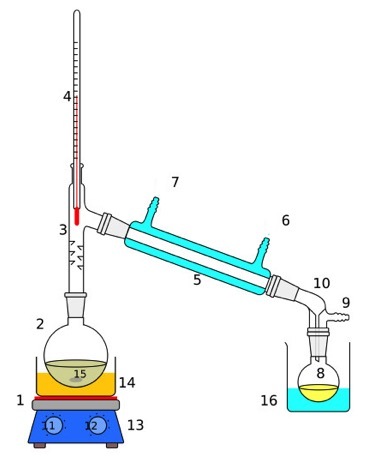
What is 6 and 7?
6: water in / 7: water out
6: water out / 7: water in

What is filtration?
A method used to separate a solid from a liquid that dissolves in the liquid
A separating technique used to separate a mixture of a solid and liquid where the solid does not dissolve in the liquid
Most simple water purification devices used in the home use filtration as their main method of purifying the water
True
False
The part of the mixture that passes through the filter paper is called the
residue
filtrate
suspension

Identify the Reactants in this equation.
A
B
4Ca(OH)2
2KI + ____Cl2 → 2KCl + I2
What number should go in the blank space to balance the chemical equation?
2Al +____ HCl → 2AlCl3 + 3H2
2
4
3
6
Which of the following represent chemical equations? Check all that apply.
2Na + H2O → 2NaOH + H2
2KClO3 → 2KCl + 3O2
2Fe + 3O2 → 2Fe2O3
2H2O
3O3 , H2O

