
 Worksheets
Physical Quantities and Kinematics
Total questions: 36
Worksheet time: 1hrs 15mins
2 types of Physical Quantities are
Base Quantity & Derived Quantity
Base Quantity & Physical Quantity
Physical Quantity & Dimension Quantity
Vector Quantity & Scalar Quantity
Basics quantities is defined as
a quantity which can be derived from any physical quantities.
a quantity which cannot be derived from any vector quantities.
a quantity which cannot be derived from any physical quantities.
a quantity which can be derived from any vector quantities.
Those are from basic quantity except
Time
Velocity
Electric Current
Luminious Intensity
What is the unit for Electric Current?
E
s
I
A
Scalar quantity is defined as a quantity with __________ only.
magnitude and direction
direction
magnitude
basic

The arrow in the picture shows
the length of the object
the size of the object
direction of the object
the color of the object
Below are vector EXCEPT
acceleration
velocity
displacement
distance
Convert 80 km h–1 into its SI unit
22.22 ms-1
22.22 kms-1
22.22 mh-1
22.22 Ms-1
Choose the correct answer for this equation.
A ⋅B = ∣A∣∣B∣cosθVector product
Scalar product

‘The magnitude of A multiplied by the component of B parallel to A’.
This statement is referring to
dot product
cross product

Cross product is also known as Vector product. Choose the right answer that best described the diagram above.
The magnitude of B multiplied by the component of A perpendicular to B
The magnitude of A multiplied by the to component of B parallel A

2A+2B


Resolve the vector to its horizontal component
x=14 sin 55
x=14 cos 55
x=55 cos 14
x=55 sin 14
The dimensional formula for kinetic energy is:
M2 L2 T2
M L2 T-2
M2 L T-2
M L2 T
Hooke’s law states that the force, F, in a spring extended by a length x is given by F = −kx. From Newton’s second law F = ma, where m is the mass and a is the acceleration, calculate the dimension of the spring constant k.
M L2 T2
M T2
M L-2 T-2
M T-2
dimensionless

If an object starts from rest, what is its initial velocity?
Depends on the problem
0
-9.8m/s2
Always positive
All of the following may cause an object to accelerate EXCEPT
change in direction of velocity
change in magnitude of velocity
change in time taken
change in both magnitude and direction of velocity
The area under a velocity–time graph illustrating the motion of a particle represents the distance moved by the particle.
True
False

Calculate the acceleration for segment A.
2 m/s2
2 m/s
-2 m/s2
0 m/s2
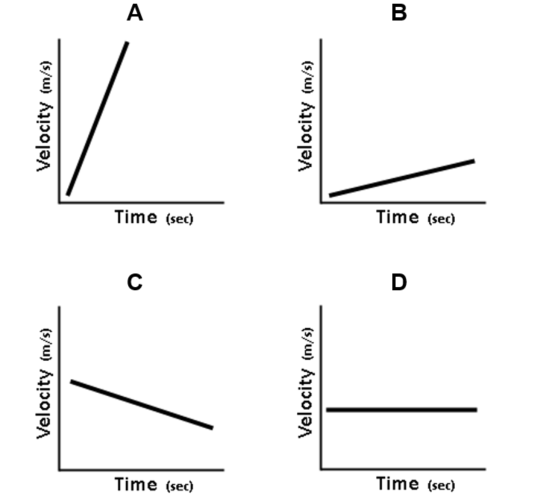


You toss a ball straight upward, in the positive direction. The ball falls freely under the influence of gravity.
At the highest point in the ball’s motion,
its velocity is zero and its acceleration is zero.
its velocity is zero and its acceleration is positive (upward).
its velocity is zero and its acceleration is negative (downward).
its velocity is positive (upward) and its acceleration is zero.
its velocity is positive (upward) and its acceleration is zero.

This is a motion diagram of an object moving along the x-direction with constant acceleration. The dots 1, 2, 3, … show the position of the object at equal time intervals ∆t. Which of the following vx-tgraphs best matches the motion shown in the motion diagram?


Which of the following ax–t graphs (graphs of acceleration vs. time)best matches the motion of the glider as it goes down?


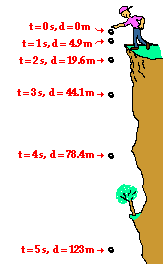
A boy throws a stone at a velocity of 20 m s-1, 50° above horizontal.



