Wayground logo

Free Printable Worksheets

Font size

S
M
L
XL
Worksheets

Newton's 1st and 2nd laws of Motion

Total questions: 36

Worksheet time: 33mins

Name
Class
Date
1.
What Unit do we measure Force in? 
a)
Newtons
b)
Joules
c)
Force
d)
Don't know
2.
Which of Newton's laws is illustrated when a magician pulls a tablecloth out from under the dishes without disturbing them?
a)
first
b)
second
c)
third 
d)
fourth
3.
You push on a tree with 20 N of force. If the tree doesn't move, the tree is pushing back on you with _____of force.
a)
20N 
b)
40N 
c)
10N 
d)
70N
4.
If a ball of cheese is fired into frictionless space, the amount of force needed to keep it going equals
a)
twice the force with which it was fired
b)
the same amount of force with which it was fired
c)
1/2 the force with which it was fired
d)
zero, since no force is requires to keep it moving. 
5.
Which has more Inertia? 
a)
Truck
b)
Ant
c)
A cat
d)
A skateboard
6.
A 20 kg bike accelerates at 10 m/s2.  what was the force
a)
25 N
b)
200 N
c)
20 N
d)
10 N
7.
a push or pull
a)
inertia
b)
force
c)
movment
d)
friction
8.
Suppose that a sled is accelerating at a rate of 2 m/s2. If the net force is tripled then what is the new acceleration of the sled?
a)
12 m/s/s
b)
6 m/s/s
c)
12 in/s/s
d)
120 m/s/s
9.
Which of Newtons laws  best explains why football teams have big, large, fast athletes.
a)
Gravity
b)
second law
c)
first law
d)
Third law
10.
A net force of 15 N is exerted on an encyclopedia to cause it to accelerate at a rate of 5 m/s2. Determine the mass of the encyclopedia?
a)
 m = 3.0 kg
b)
m = 4.0 kg 
c)
m = 3.0 ml 
d)
m = 30.0 g
11.
According to Newton’s first law of motion, a moving object that is not acted on by an unbalanced force will
a)
remain in motion.
b)
eventually come to a stop.
c)
change its momentum.
d)
accelerate.
12.
Pushing  a child on a swing is easier than pushing an adult on the same swing. 
a)
1st Law 
b)
2nd Law
13.
A 20 kg bike accelerates at 10 m/s2.  what was the force
a)
25
b)
200 N
c)
20 N
d)
10 N
14.
Which type of force(s) will cause a change in an object's motion?
a)
gravity
b)
zero net force
c)
balanced forces
d)
unbalanced forces
15.
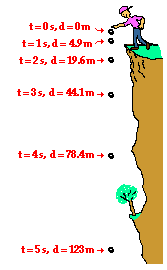
What happens to the velocity of a ball as it is dropped off a cliff? 
a)
It decreases at a uniform rate 
b)
It increases at a uniform rate 
c)
It is constant 
d)
It increases at a non-uniform rate
16.
What is the velocity of a ball that has been dropped off a cliff after 1 , 2, 3, 4, and 5 seconds? (concept development page 4). 
a)
10, 20, 30, 40, 50 m/s
b)
5, 10, 15, 20, 25 m/s
c)
5, 20, 45, 80,125 m
d)
10,10,10,10,10 m/s
17.

As a rock in FREE FALL falls through the air, Velocity

a)

stays constant

b)

decreases until it hits terminal velocity

c)

increases until it hits terminal velocity

d)

increases ~10 m/s each second

18.
In practice A of the figure, What is  the magnitude of the  resultant displacement?
a)
5 km 
b)
8 km
c)
11 km
d)
15 km
19.
Which statement describes a vector?
a)
It has magnitude but no direction
b)
It has direction but no magnitude
c)
It has both direction and magnitude
d)
It has constant magnitude but no
 direction
20.
Which of the following quantities are vectors?
a)
speed, velocity, acceleration
b)
velocity, acceleration, force
c)
force, acceleration, mass
d)
length, mass, time
21.

Calculate the net force on the box.

a)

Σ\Sigma F = 0 N

b)

\Sigma Fx = 0 N, \Sigma Fy = 0 N

c)

\Sigma F = -3 N

d)

\Sigma Fx = 0 N, \Sigma Fy = -3 N

e)

\Sigma Fx= 0 N, \Sigma Fy = 3 N

22.

The force acting upward on an object

suspended from a spring scale is called:

a)

gravity

b)

weight

c)

tension

d)

equlibrium

23.

“the sum of force = 0.”  This is the mathematical representation of:

a)

Net Force

b)

Equlibrium

c)

Vector

d)

Scalar quantity

24.

mass, volume, speed represents examples of:

a)

Vector quantity

b)

Scalar quantity

25.

_______ has only magnitude.

a)

Vector quantity

b)

Scalar quantity

26.

_______ has magnitude and direction

a)

Vector quantity

b)

Scalar quantity

27.

A cart is pulled to the right with a force of 15 N while being pulled to the left with a force of 20 N. The net force on the cart is:

a)

5 N to the left

b)

A.5 N to the right

c)

25 N to the left

d)

25 N to the right

28.

The Net force applied on an object 6 N to the right and 4 N to the right is:

a)

2 N to the left

b)

2 N to the right

c)

10 N to the right

d)

0 N (no change in motion)

29.
Newtons 1st law of motion states:
a)
An object in motion will stay in motion and an object in rest will stay in rest unless acted upon by and unbalance force.
b)
For every action there is an equal and opposite reaction. 
c)
Acceleration is produced when a force. acts on a mass. 
d)
The greater the mass  the greater the amount of force needed to change its motion. 
30.

What is the force on a 1000 kg elevator that is falling freely at 9.8 m/sec2

a)

102.04 n

b)

9,800 n

c)

980 n

d)

103 n

31.
A force of 250 N is applied to an object that accelerates at a rate of 5 m/sec2.  What is the mass of the object?
a)
100kg 
b)
1,250kg
c)
50kg
d)
5kg
32.
What is inertia?
a)
How heavy an object is. 
b)
How fast an object is moving. 
c)
The movement of an object. 
d)
The resistance of an object to change in motion. 
33.
The formula we get from the second law is...?
a)
F = m*a
b)
v = d/t
c)
a = v/t
d)
f = 1/T
34.
The Free Fall acceleration for Earth is or g equals what...?
a)
9.8 m/s/s
b)
10 m/s/s
c)
98 m/s/s
d)
2 m/s/s
35.
Variable that the SCIENTIST CHANGES or TESTS.
a)
Control Variable
b)
Variable
c)
Dependent Variable
d)
Independent Variable
36.
Variable that is MEASURED or OBSERVED; it DEPENDS on the independent variable.
a)
Control Variable
b)
Variable
c)
Dependent Variable
d)
Independent Variable