
 Worksheets
Unit 1 Test Review Precalc
Total questions: 115
Worksheet time: 5hrs 54mins
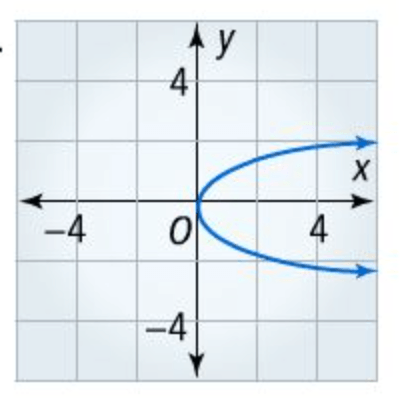
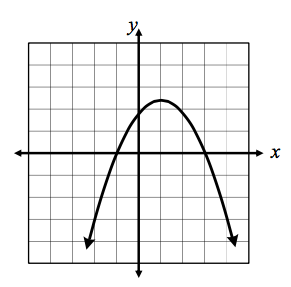
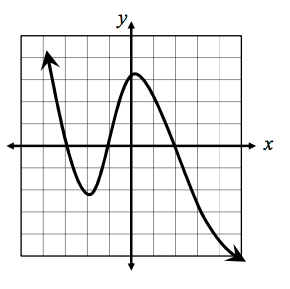

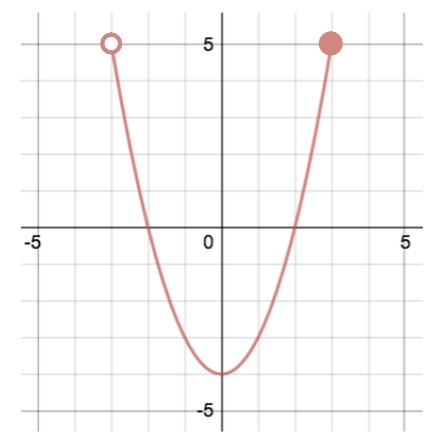


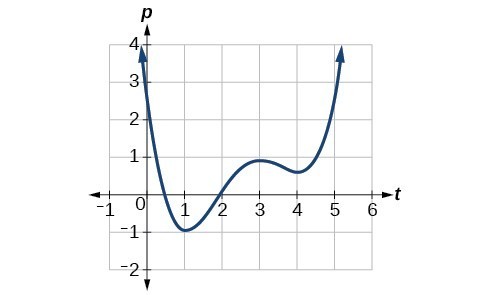
What is the range of the graph?
[-15, 9]
(-∞, ∞)
(-15, ∞)
[-15, ∞)
In interval notation, positive and negative ∞ are always closed in by ______.
( ) Parentheses
[ ] Square Brackets
{ } Curly Brackets

Which of the following best describes the continuity at x = 1?
Continuous at x = 1
Removable Discontinuity at x = 1
Infinite Discontinuity at x = 1
Jump Discontinuity at x = 1

Which of the following best describes the continuity at x = 5?
Continuous
Removable Discontinuity at x = 5
Infinite Discontinuity at x = 5
Jump Discontinuity at x = 5

Which of the following best describes the continuity at x = 5?
Continuous at x = 5
Removable Discontinuity at x = 5
Infinite Discontinuity at x = 5
Jump Discontinuity at x = 5

Where are the discontinuities?
Continuous
Infinite Discontinuity at x = -1
Jump Discontinuity at x = -1
Removable Discontinuity at x = -1

Where are the discontinuities?
Removable Discontinuity at x = 5
Infinite Discontinuity at x = 3
Removable Discontinuity at x = 3
Infinite Discontinuity at x = 5
Removable Discontinuity at x = -5
Infinite Discontinuity at x = -3
Removable Discontinuity at x = -3
Infinite Discontinuity at x = -5

Name the discontinuity at x=2.
Infinite Discontinuity
Removable Discontinuity
Jump Discontinuity
Continuous at x=2

Identify the type of location of the discontinuity/discontinuities.
Infinite Discontinuity at x = 4
Continuous
Removable Discontinuity at x = 4
Jump Discontinuity at x = 4

Name the discontinuity at x=2.
Infinite Discontinuity
Removable Discontinuity
Jump Discontinuity
Continuous
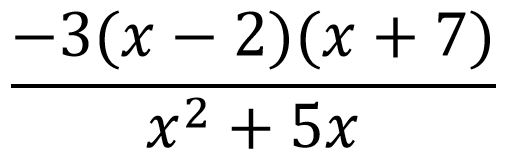

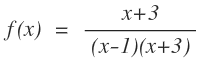
Find the vertical asymptotes and holes of the function.
Holes: None;
VA: x = 1, -3
Holes: x = -3;
VA: x = 1
Holes: x = -3, 1
VA: None
Holes: x = 1
VA: x = -3
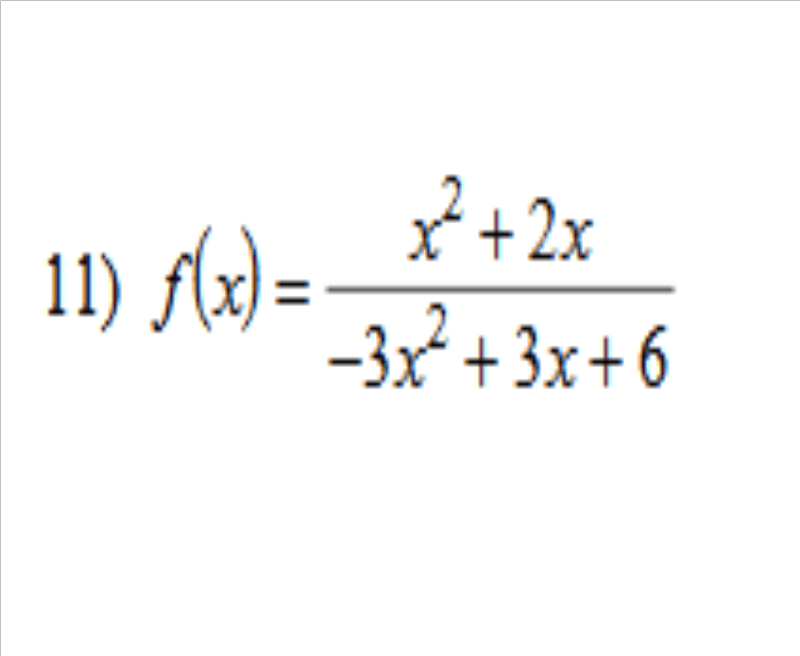
Find the horizontal asymptote.
None
y=0
y=3−1
y=−3

What's the horizontal asymptote of the function?
y = 0
No horizontal asymptote
y = 1
y = 9

Find the horizontal asymptote.
y=−2
none
y=0
y=21

The horizontal asymptote equals zero when:
the degree of the numerator and denominator are equal
the degree of the numerator is less than the degree of the denominator
the degree of the numerator is greater than the degree of the denominator
the numerator equals zero

What is the increasing interval for the function below?
(−∞,∞)
(−∞,2]
(−∞,6]
(−6,6)

Which are the intervals of decreasing for the graph?
(2, ∞)
(-∞, -1)
(2, ∞)
(.5, 2)
The logarithmic function is increasing on
(0, 1)
(0, ∞)
(1, ∞)
(−∞, ∞)


What are the extrema of the graph?
Max = (0,-4)
Min = (-1.5,0) and (1.5, 0)
Max = (0,1.5) and (0, -1.5)
Min = (-4,0)
Max = (-1.5,0) and (1.5, 0)
Min = (0,-4)
Max = (-4,0)
Min =(0,1.5) and (0, -1.5)

What are the extrema of the graph?
Max = (2, -3), (1, 2)
Min = (-3, -1), (-1, 4)
Max = (-3, -1), (-1, 4)
Min = (2, -3), (1, 2)
Max = (-1, -3), (4, -1)
Min = (-3, 2), (2, 1)
Max = (-3, 2), (2, 1)
Min = (-1, -3), (4, -1)

Which of the following is the equation of the graph?


Which of the following is the equation of the graph?


Which of the following is the equation of the graph?


Which of the following is the equation of the graph?


Which of the following is the equation of the graph?


Which of the following is the equation of the graph?


Which of the following is the equation of the graph?


Which of the following is the equation of the graph?


Which of the following is the equation of the graph?


Which of the following is the equation of the graph?


Which of the following is the equation of the graph?


Which of the following is the equation of the graph?


What is the domain of the function?
( - ∞ , - 5 ) U ( - 5 , ∞ )
( - ∞ , 5 ) U ( 5 , ∞ )
( - ∞ , - 5 ] U [ - 5 , 5 ] U [ 5 , ∞ )
( - ∞ , - 5 ) U ( - 5 , 5 ) U ( 5 , ∞ )

What is the domain of the function?
[ 0 , ∞ )
( - ∞ , - 8 ) U ( - 8 , 8 ) U ( 8 , ∞ )
( - ∞ , - 8 ] U [ - 8 , 8 ] U [ 8 , ∞ )
[ 0 , 8 ) U ( 8 , ∞ )

Is the graph an even, odd, or neither function?
Even
Odd
Neither
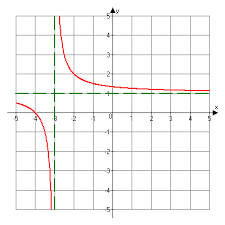
Is the graph even, odd, or neither?
Even Function
Odd Function
Neither
Not a Function

Is this graph even, odd, or neither?
Even Function
Odd Function
Neither
Not a Function


If f(x) = x−1 and g(x)=5x−2 , then (f+g)(x)=
5x2+1
5x2−3
6x+1
6x−3
If f(x) = x−1 and g(x)=5x−2 , then (f−g)(x)=
-4x - 3
-4x +1
6x + 1
6x - 3
If f(x) = x−1 and g(x)=5x−2 , then (f⋅g)(x)=
5x−3
5x2+2
5x2−7x+2
5x−7
If f(x) = x−1 and g(x)=5x−2 , then (gf)(x)
5x−2x−1
x−15x−2
3−1
−3
If f(x) = 3x2−4 and g(x)=x2−8x+4 , then (f+g)(x)=
4x4−8x−8
4x4−8x
4x2−8x−8
4x2−8x
If f(x) = x+5 and g(x)=3x−7 , then (f∘g)(x)=
3x−2
3x+8
3x2+8x−35
3x−12
If f(x) = x+5 and g(x)=3x−7 , then (g∘f)(x)=
3x−2
3x+8
3x2+8x−35
3x−12
If f(x)=5x , g(x)=−2x+1 , and h(x)=x2+6x+8 , find f(g(−2)) . (Your answer should be a number.)
(a)
If f(x)=5x , g(x)=−2x+1 , and h(x)=x2+6x+8 , find h(f(−5)) . (Your answer should be a number.)
(a)
find (f/g)(-3).

Are the following inverses of each other? Use composition of functions. fog(x) and gof(x)
True
False

Inverse Functions
Not Inverse Functions
What operation allows us to verify if functions are inverses?
Multiplying
Dividing
Adding
Composing
What does an inverse function do?
Nothing
Makes it bigger
Does the opposite of the original function

If f(g(x)) = x, then f and g must be inverses of one another.
f(2) = -1 g(1) = -2 f(1) = -2,
then which of the following MUST be true?
If f is an invertible function and f(a) = b, then f-1(b) = a.

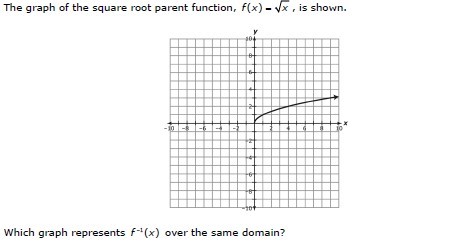
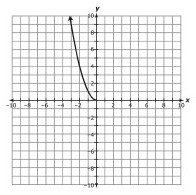
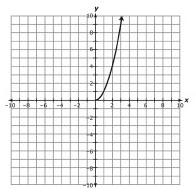
Which graph represents f-1(x) over the same domain?
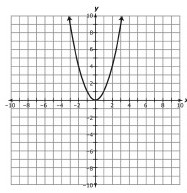
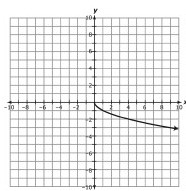


Write the equation that results if the parent absolute value function is shifted right 15 units, down 3 units, and reflected vertically.
y=−∣x−15∣−3
y=−∣x+15∣−3
y=21∣x+3∣−15
y=21∣x−3∣−15
y=∣−x−15∣−3
Which transformations are involved in the equation y=21x+1−1 ?
Horizontal translation left
Vertical shrink
Vertical translation down
Horizontal translation right
Vertical stretch
What does the transformation f(x) → f(x+1)−9 do to the graph of f(x) ?
translates it left one unit and down 9 units
translates it right one unit and down 9 units
translates it up one unit and right 9 units
translates it down one unit and left 9 units
What does the transformation f(x) → 31f(x)+4 do to the graph of f(x) ?
Shrinks the graph vertically by a factor of 1/3 and translates up 4 units.
Stretches the graph by a factor of 3 and translates up 4 units.
Translates the graph left 1/3 of a unit and up 4 units.
Translates the graph right 3 unites and down 4 units.
Which of the following parent function(s) is (are) even?
f(x) = x
f(x) = |x|
f(x) = x2
f(x) = 2x
f(x) = 1⁄x2
Which of the following parent function(s) has (have) a vertical asymptote?
f(x) = 2x
f(x) 1∕x2
f(x) = x3
f(x) = lnx
f(x) = √x
Which statement is always true of an even non trig graph?
A horizontal shift will change the symmetry.
A reflection will change the symmetry.
A vertical shift will change the symmetry.
Both statements a and c are true.
Describe the transformation to f(x) that results in g(x).
Describe the transformation to f(x) that results in g(x).
y=(x-2)3+4


Using the pictured graph, what is f(-3)?
A
-3
B
-1
C
1
D
3

How many hearts does an octopus have?
1
4
3
20

How long do elephants sleep each day?
12 hours
7-8 hours
Almost 20 hours
2-3 hours

How many oceans are there?
4
5
6
7

Which planet is closest to the sun?
Venus
Earth
Saturn
Mercury


“We must be swift as the _______ ________. With all the force of a great Typhoon."
Forcing River
Coursing River
Pouring River
Coring River

Choose the best answer to describe boundedness of the graph.
above
below
bounded
not bounded

Choose the best answer to describe boundedness of the graph.
above
below
bounded
not bounded

Choose the best answer to describe boundedness of the graph.
above
below
bounded
not bounded

Choose the best answer to describe boundedness of the graph.
above
below
bounded
not bounded

Determine the boundedness of the function graphed.
Bounded Above
Bounded Below
Bounded
Unbounded

