
 Worksheets
Biology Unit 2 Revision Quiz 3
Total questions: 15
Worksheet time: 30mins
Upregulation can best be describes as:
the cell is stimulated to produce more of a specific component.
the cell is stimulated to produce less of a specific component.
the process that cells use to make protein.
positive feedback.
What type of cell produces antibodies?
macrophage
cytotoxic T cell
Helper T cell
B cell

Sunken stomata can be found in the leaves of some Australian plants. A section of such a leaf is shown. How do sunken stomata assist the plant to conserve water in a dry environment?
They trap moist air, reducing humidity.
They prevent entry of gases into the leave.
They accumulate moist air, reducing transpiration.
They increase the surface area available for transpiration.
After an initial infection, B-cells recognise the measles virus. How is this helpful in human immune response?
The B-cells use this recognition to defend the body against other pathogens, such as bacteria.
The B-cells more quickly recognise and respond to any other virus that invades the body.
The B-cells produce antibodies more quickly if the measles virus is encountered again.
The B-cells transfer this recognition to T-cells, which will then devour the viruses.
White blood cells are an important part of the human immune response. Two types of white blood cells, neutrophils and macrophages, act as phagocytes. Phagocytes perform which of the following functions in the human body?
They produce antibodies.
They bind to antigens and develop into plasma cells.
They engulf and destroy bacteria.
They form a barrier against pathogens.
One of the chemical that causes vasodilation so that more blood (containing neutrophils and macrophages) can flow to the area of infection
Mucous
Prostaglandin
Lysozyme
Neurotransmitter
When a neuron is depolarised, what are the first channels to open?
sodium
calcium
potassium
receptors
A signal molecule that transmits nerve impulses across synapses
neuron
neurotransmitter
electrical impulse
action potential


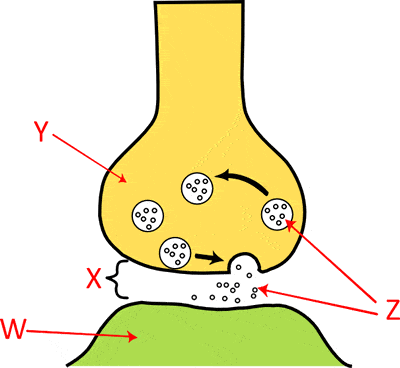
Identify the structure labelled W
Post-synaptic neuron
Neurotransmitters
Pre-synaptic neuron
Synapse

Identify structure labelled Y
Pre-synaptic neuron
Neurotransmitters
Post-synaptic neuron
Synapse

