wayground logo

Free Printable Worksheets

NEW

Font size

S
M
L
XL
Worksheets

Physical Science Ch. 1 The Nature of Science Review

Total questions: 50

Worksheet time: 2hrs 21mins

Name
Class
Date
1.
The scientific method is used in everyday life to acquire/get information.
a)
True
b)
False
2.
A fair and valid experiment contains:
a)
independent variable
b)
dependent variable
c)
controlled variables (controls)
d)
All of the above
3.
How can an one help insure that an experiment is unbiased and valid?
a)
peer review
b)
multiple graphs
c)
multiple trials, peer review, independent and dependent variables
d)
send a link to a news outlet
4.
Scientists must remain open-minded, meaning that they are willing to accept different ideas that may not agree with their hypothesis.
a)
True
b)
False
5.
Scientist and other people start with questions and observations that may come from:
a)
Curiosity, skepticism, open-mindedness, and creativity
b)
Practical problems (flooding issue in a coastal area)
c)
New technology (3-D printers)
d)
All of the above
6.
Which is an example of qualitative data?
a)
The girl has brown hair.
b)
The girl's hair is 50 centimeters long.
c)
The girl is 95 centimeters tall.
d)
The girl weighs 140 lbs
7.
Which is an example of quantitative data?
a)
The boy did a lot of push-ups
b)
The boy has blonde hair.
c)
The boy weighs 140 pounds.
d)
The boy has green eyes.
8.

Scientists who disagree with hypotheses design experiments to test them.

a)

True

b)

False

9.
Why is peer review important?
a)
Scientists need to stay busy to do their best work.
b)
Publishing peer-reviewed articles in scientific journals allows researchers to share ideas and to test and evaluate each other’s work.
c)
Scientists do not do peer review.
d)
They want to make sure that only they are right.
10.
What are the goals of science?
a)
Tell society what to feel and think
b)
Provide natural explanations for events in the natural world
c)
Explain religion and philosophy
11.
The factor in an experiment that will be changed. 
a)
dependent variable
b)
independent variable
c)
controlled variable
d)
inferences 
12.
You use your five senses to describe something
a)
observation
b)
prediction
c)
experiment
d)
conclusion
13.
The summary at the end of an experiment that explains the results, and referrers to the hypothesis using data. 
a)
conclusion
b)
procedures
c)
materials
d)
responding variable
14.
This part of the experiment serves as a basis of comparison; the one variable being tested has been omitted. (not changed)
a)
experimental group
b)
control group
c)
data
d)
variables
15.
A series of steps used by scientists to solve a problem or answer a question. 
a)
scientific method
b)
recipe
c)
data collection
d)
metric system
16.
The test of a hypothesis is called a
a)
control
b)
dependent variable
c)
conclusion
d)
experiment
17.
Things that stay the same throughout the whole experiment are called
a)
controls
b)
conclusions
c)
independent variables
d)
constants
18.
The name of the information that you get from your experiment (you organize it into charts and graphs).
a)
observations
conclusion
b)
data
c)
variables
d)
hypothesis
19.
A hypothesis is simply a prediction that has not yet been _.
a)
proven or disproven
b)
made into a theory
c)
results calculated
d)
written about
20.
The factors in an experiment that can be changed. 
a)
variables
b)
quantitative data
c)
hypothesis
d)
steps
21.
This variable is the actual data collected during the experiment. 
a)
independent variable
b)
dependent variable
c)
control group
d)
data group
22.
At one point in time, many people thought disease was caused by fate or by incorrect behavior. Following the invention of the microscope, bacteria were discovered. After this, a new theory of what causes disease arose that was known as the germ theory.  Why was the original theory modified? 
a)
It quickly became obvious that germs cause disease.
b)
The person who invented the microscope became ill.
c)
New evidence prompted revision to the original ideas.
d)
The proponents of the germ theory had political power.
23.
Why do we want to test one variable at a time?
a)
Because it is hard to setup a data table with more
b)
To know what is causing the changes. This helps us understand cause and effect.
c)
It is what has always been done
24.

What step does every scientific experiment begin with?

a)

hypothesis

b)

question/problem

c)

procedures

d)

conclusion

25.
What is the SI base unit for volume?
a)
gram
b)
meter
c)
liter
d)
foot
26.
What is the SI unit for temperature?
a)
Celsius
b)
Fahrenheit
c)
liter
d)
thermometer
27.
_______________ is the amount of space an object takes up.
a)
mass
b)
volume
c)
weight
d)
density
28.
________________ is the amount of material (matter) in an object
a)
mass
b)
volume
c)
weight
d)
density
29.
Mass is measured in
a)
grams
b)
liters
c)
meters
d)
g/cm3
30.
The dip that you use to measure liquid volume is called the
a)
dip
b)
meniscus
c)
patella
d)
hibiscus
31.
What is the volume of the liquid in this graduated cylinder?
a)
19 mL 
b)
35 mL 
c)
24 mL 
d)
1.9 mL
32.
1 meter = _______ cm
a)
1
b)
1,000
c)
100
d)
400
33.
240 cm = ___________ m
a)
2400
b)
24
c)
2.4
d)
0.24
34.
15.6 L = ___________ mL
a)
15,600
b)
156,000
c)
1,560,000
d)
15,600,000
35.

Lilly was trying to explain to her friend the difference between a theory and a law in science. She used the theory of plate tectonics and the law of superposition as examples. Lilli explained the difference by using non-scientific language. Which statement could Lilly use to correctly describe the difference between a theory and a law in science?

a)

A theory describes a natural event, while a law explains it.

b)

A theory explains a natural event, while a law predicts it.

c)

A theory explains a natural event, while a law describes it.

d)

A theory predicts a natural event, while a law explains it.

36.
Scientific theories are based on
a)
general assumptions of how systems work.
b)
mathematical principles that can be proven true.
c)
large amounts of data collected over time.
d)
observations from within only one scientific discipline.
37.
What is a law?
a)
Describes what happens
b)
Explains a process
38.
What is a theory?
a)
Describes what happens
b)
Explains a process
39.

What is it called when we collect information using our senses?

a)

observation

b)

inference

40.
How would you write 4.3756 x 10in standard form?
a)
437,560,000
b)
0.00043756
c)
43,756
d)
4,3756
41.

How would you write 0.0005 in scientific notation?

a)

50 x 10-5

b)

5 x 10⁻⁴

c)

5 x 10³

d)

.5 x 103

42.

What percentage does the entire circle graph represent?

a)

100%

b)

50%

c)

25%

d)

15%

43.
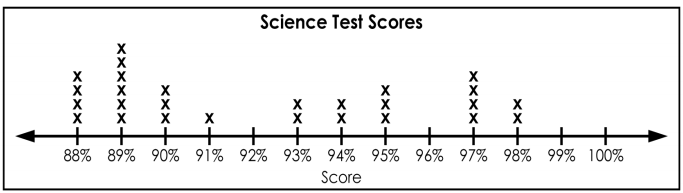
How many students received a score of 94%? 
a)
94
b)
4
c)
1
d)
2
44.

Which superhero is the most popular among fans?

a)

Hulk

b)

Batgirl

c)

Storm

d)

Thor

45.
In which year did exactly 60 students have scholarships?
a)
2010
b)
2011
c)
2012
d)
2013
46.
What type of graph/chart is this?
a)
Bar Graph
b)
Line Graph
c)
Pie Chart
d)
Infographic 
47.
To __________ something means to draw a conclusion based on what you observe.  
a)
infer
b)
theorize
c)
hypothesize
d)
guess
48.
A hypothesis must be:
 
a)
proven correct
b)
 testable
c)
 observed
d)
 experimental
49.
Which of the following is not an example of scientific honesty?
a)
Reporting when data was collected as the result of an equipment malfunction
b)
Discussing all sources of error
c)
Citing work of previous experiments that informed the current experiment
d)
Manipulating graphs or statistical analyses to fit a hypothesis
50.

A representation created to understand something that is too big, too small, or too complicated to understand.

a)

Mass

b)

Matter

c)

Model

d)

Abundant