
 Worksheets
PHYSICAL FEATURES OF INDIA
Total questions: 57
Worksheet time: 31mins


This body of water is surrounded by land, can be large in size and can be deep
Ocean
Lake
River
Beach


True or false. Is an Ocean a land form?
True
False

Another name for a mountain top is ________.
peak
top
high
snowy mountain
What is a valley?
A long stream of water
Lower land between hills or mountains
A large, flat land area
Piece of land surrounded by water
The deeper you go into the earth, the greater the pressure.
Which layer of Earth flows slowly and causes the crust to move?
Crust
Mantle
Inner Core
Outer core
This layer is the most dense in comparison to the other layers.
Crust
Mantle
Inner Core
Outer Core
What is a physical classification of the outer core (hint: state of matter)?
gas
solid
liquid
plasma
Which reason below best describes why the inner core is a solid?
Gravitational pull
Iron and Nickel becomes a solid when heated
Its under great pressure
Its just the way it was made
Geologists and Seismologist study _______________ and __________________ to determine what's happening inside of Earth?
oceans and land
people and plants
rocks and seismic waves
The thinnest and outermost layer of Earth is called...
crust
mantle
outer core
inner core
A combination of Earth's rotation and the outer core rotating around the inner core, a force field is created. This called the ________________ effect.
dynamo
pangaea
continental drift
winter solstice
Convection currents occurs in which of Earth's layers?
crust
mantle
outer core
inner core
Which of the following is responsible for Earth's crust moving?
Convection Currents
Dynamo Effect
Great Pressure
Gravitational pull from the Sun
Select the landforms that form at a convergent boundary.
mountains
volcanoes
deep ocean trenches
mid ocean ridges

What boundary does this picture show?
Divergent
Transform
Convergent
What occurs at a transform boundary?
Faults
deep ocean trenches
earthquakes
mountains

What boundary does the picture show?
Transfrom
Divergent
Convergent
What landforms will occur at a divergent boundary?
mid ocean ridge
mountain
deep ocean trenches
rift valley

What landform does this picture show? Where does it occur?
Rift valley
convergent boundary on land
divergent boundary on land
volcano

What boundary does this picture show?
Convergent
Divergent
Transform

What will happen to the Mediterranean sea as the Eurasian plate and the African plate continue to move towards each other over time?
It will get smaller
It will get larger
It will eventually disappear
Nothing will happen
How will the land in this area change as the Eurasian plate and the African plate continue to move towards each other over time?
Mountains will form
Land will be destroyed
Nothing will happen
What drives the movements of Earth's plates?
Convection currents in the mantle
Earth's rotation
sea floor spreading
subduction
What processes helped prove the hypothesis of continental drift?
the water cycle
Subduction
Sea Floor Spreading
none of the above
What is denser oceanic or continental crust?
Oceanic
Continental
What forms when two pieces of continental crust collide?
land is destroyed
earthquakes occur
high mountain ranges form
What happens when oceanic and continental crust collide?
mid ocean ridges form
volcanoes form
deep ocean trench occurs
Subduction occurs at a
Mid ocean ridge
converging boundaries of oceanic and continental crust
Deep ocean trench
Where do volcanoes form?
convergent boundaries
subduction zones
when continental and continental crust collide
What is the first step that forms a volcano?
When two plates collide and one is subducted under the other.
water enters the mantle
the water lowers the melting point of them mantle and the mantle partially melts
Magma will then rise
What is the second step that forms a volcano?
When two plates collide and one is subducted under the other.
water enters the mantle
the water lowers the melting point of them mantle and the mantle partially melts
Magma will then rise
What is the third step that forms a volcano?
the water lowers the melting point of them mantle and the mantle partially melts
Magma will then rise
When two plates collide and one is subducted under the other.
water enters the mantle
What is the last step that forms a volcano?
the water lowers the melting point of them mantle and the mantle partially melts
Magma will then rise
When two plates collide and one is subducted under the other.
water enters the mantle
The Peninsular Plateau of India is part of which of the following landmass?
Angaraland
Tethys
Gondwanaland
None of the above
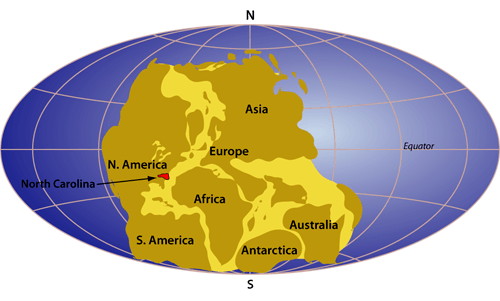
What is this a picture of?
Gondwanaland
Laurasia
Pangaea
Panthalassa
What does the theory of continental drift state?
The continents were once joined in a super-continent and have moved over time
Continents are stationary and do not move
The Earth is broken into lithospheric plates that move due to convection currents
None of the above

