wayground logo

Free Printable Worksheets

NEW

Font size

S
M
L
XL
Worksheets

APHG Unit 3 Review Test

Total questions: 60

Worksheet time: 3600secs

Name
Class
Date
1.

Which of the following religions is the fastest spreading religion today?

a)

Christianity

b)

Buddhism

c)

Hinduism

d)

Islam

2.

All of the following are characteristics of a universalizing religion except

a)

connected to a specific founder

b)

generally widespread

c)

seeks to convert

d)

followers are highly clustered

3.

Which of the following religions are considered to be universalizing religions?

a)

Buddhism, Christianity, & Islam

b)

Islam, Hinduism, & Buddhism

c)

Hinduism, Judaism, & Christianity

d)

Judaism, Islam, Buddhism

4.

Which religion has the most followers?

a)

Islam

b)

Judaism

c)

Christianity

d)

Buddhism

5.

Who is considered the "Patriarch" or father of the Semitic (monotheistic) religions?

a)

Isaac

b)

Noah

c)

Jesus

d)

Abraham

6.

Which of the following believes that all things possess a "kami" or divine spirit?

a)

Islam

b)

Shintoism

c)

Bahai

d)

Zoroastranism

7.
Which of the following is not generally a characteristic of an ethnic religion?
a)
found within a particular culture
b)
always polytheistic 
c)
spatially concentrated
d)
does not seek outside converts
8.

One of the unique characteristics of Hinduism is that it:

a)

is so young

b)

is a very simple religion

c)

emerged without a prophet or book of scriptures

d)

has so few followers

9.
The Shinto faith is found mostly in which country?  
a)
Israel 
b)
China 
c)
India 
d)
Japan 
10.
Which world religion is the oldest that practices the belief of monotheism? 
a)
Christianity 
b)
Hinduism 
c)
Judaism  
d)
Islam
11.
How many adherents in Christianity worldwide?
a)
2 billion
b)
500 million
c)
300 million
d)
1 billion
12.

The map shows the distribution of what major world religion?

a)

Hinduism

b)

Judaism

c)

Christianity

d)

Islam

13.

What religion is most associated with keeping Kosher?

a)

Judaism

b)

Hinduism

c)

Buddhism

d)

Christianity

14.
All of the following are traits common to Muslim regions of the world except:
a)
fasting
b)
pilgrimage
c)
polytheism
d)
daily ritual prayers
15.
In Islam the religious practice of "sacred struggle" is known as:
a)
hajj
b)
Ramadan
c)
jihad
d)
Shabbat
16.
The concept of nirvana is most closely associated with which of the following religions?
a)
Judaism
b)
Animism
c)
Confucianism
d)
Buddhism
17.
In some societies, an organized form religion has:
a)
become more traditional 
b)
become more diverse
c)
experienced strong revival
d)
become less important
18.
Ethnicity is associated with _____ ancestry, while race is associated with _____ ancestry. 
a)
cultural: biological 
b)
biological: cultural 
c)
cultural: religious 
d)
religious: cultural 
19.
Folk cultures are typically associated with _____ groups of people in __________.
a)
homogeneous : isolated areas 
b)
heterogeneous : isolated areas 
c)
homogeneous : large societies 
d)
heterogeneous: large societies 
20.
What is the difference between a habit and a custom?
a)
A habit is practiced by an individual, a custom by a group.
b)
A habit is practiced by a group, a custom by an individual.
c)
Customs performed by a group are made up of habits.
d)
There is no difference.
21.
Which of the following is an element of material culture?
a)
clothing 
b)
behavioral norms 
c)
religious beliefs 
d)
family beliefs 
22.
The popularity of American bands in Europe is an example of:
a)
globalization of culture 
b)
assimilation 
c)
ethnocentrism 
d)
transculturation 
23.
In the face of globalization, folk cultures face _____ challenges
a)
sustainability 
b)
ethnocentrism 
c)
geographic 
d)
relativism 
24.

A country with a low percentage of women in its adult labor force might be

a)

Sweden

b)

Lesotho

c)

Qatar

d)

Russia

25.

Hanification is a term

a)

that is distinctly Chinese.

b)

that represents the dilution of regional cultures by a main culture.

c)

has happened in more countries than just China.

d)

all of the above.

26.
_____ diffusion occurred when Muslim missionaries spread Islam to sub-Saharan Africa.
a)
relocation 
b)
contagious 
c)
hierarchical 
d)
stimulus 
27.

A simplified lingua franca created to facilitate communication is known as a:

a)

pidgin language

b)

dialect

c)

creole language

d)

isolated language

28.
People in Chicago call it pop. People in Charlotte call it coke. This is an example of:
a)
creole dialects 
b)
differences due to dialects 
c)
lingua franca influencing vocabulary 
d)
isolated languages 
29.
In terms of speakers, the two largest language families are:
a)
Indo-European & Sino-Tibetan
b)
Indo-European & Niger-Congo
c)
Austric & Niger-Congo
d)
Niger-Congo & Sino-Tibetan
30.
The most powerful influence in the diffusion and consequent survival of a language is:
a)
political and military power 
b)
social and economic power 
c)
 whether a language is declared official in a country 
d)
whether the physical landscape allows for easy movement 
31.
In terms of diffusion, what is a hearth?
a)
The point of origin
b)
The final destination
c)
The mid-way point
d)
All points along the diffusion route
32.
The clearest example of a folk culture today in the US is
a)
Hispanics in southwest Florida
b)
Catholics in the northeast U.S.
c)
Harlem in New York City
d)
Amish of southeast Pennsylvania
33.
practice of judging another culture by the standards of one’s own culture and generates misunderstanding, ignorance and conflict 
a)
Ethnosuperiorism
b)
Egotism
c)
Ethnocentrism
d)
Human nature
34.
NOT an example of a cultural landscape
a)
The street patterns of Bogota
b)
the buildings of Ciudad Perdida
c)
a rain forest
d)
A golf course
35.

Which of the following would be an example of “Popular Culture”?

a)

a small homogenous cultural group

b)

a heterogeneous group in an urban area

c)

a group living in a rural area

d)

groups that have little interaction

36.
The presence of similar restaurants, gas stations, and stores throughout the United States 
a)
is an example of possibilism
b)
illustrates how popular culture can create a uniform landscape
c)
increases cultural awareness
d)
is a prime example of regionalization
37.
Which of the following best accounts for the universal appeal of blue jeans?
a)
Adoption of unique folk culture
b)
Need for durable clothing
c)
Impact of high income on clothing habits
d)
Diffusion of popular culture
38.

Which of the following countries has the largest percentage of Roman Catholics?

a)

United States

b)

Great Britain

c)

Indonesia

d)

Brazil

39.

Which of the following is an example of a cultural landscape?

a)

A coral reef

b)

A stand of pine trees

c)

Terraced fields of crops up a mountainside

d)

Glaciers

40.

Which of the following is NOT an ethnic religion?

a)

Hinduism

b)

Judaism

c)

Shintoism

d)

Buddhism

41.

Isoglosses are used to mark

a)

Creation of pidgins

b)

Extent to which a lingua franca is used in a certain area

c)

Limits for an area in which certain words or other language features are used

d)

Area in which an extinct language is used

42.

Acculturation is a process whereby

a)

A more dominant culture adopts most of the traits of the less dominant culture

b)

The dominant culture completely absorbs the less dominant one

c)

Cultural traits are equally exchanged between cultures

d)

The less dominant culture adopts some of the traits of the more influential one

43.

Which language has become the world's primary lingua franca?

a)

Mandarin

b)

Hindi

c)

German

d)

English

44.

Which of the following is the best example of a folk food?

a)

Hamburgers in the US

b)

Pizza in the US

c)

KFC in China

d)

Blowfish in Japan

45.

A sociofact is a(n)

a)

material item that is part of one's culture like a pen or a computer mouse.

b)

element of social interaction like a handshake or slang language.

c)

type of economic measure for income.

d)

all of the above are sociofacts.

46.
Which are the first and second most-spoken languages in the world?
a)
Spanish and English
b)
Cantonese and French
c)
German and Mandarin
d)
Mandarin and English
47.
A nation in which many languages are spoken. In Switzerland 4 Official Languages are used.
a)
Monolingual
b)
Bi-lingual
c)
Multilingual
d)
Indo-European
48.
Canada is an example of a Bi-Lingual Nation made up of English and most French speakers located in...
a)
the western provinces
b)
Quebec
c)
Northern Territories
d)
near the Hudson Bay
49.
Spanglish...would most likely be found in areas with higher Hispanic populations located in the ______ region of the United States.
a)
Northeast
b)
Midwest
c)
Southwest
d)
Gulf Coast
50.
This Romance Language would dominate the highlighted regions.
a)
English
b)
Spanish
c)
French
d)
Italian
51.
What is culture?
a)
Set of beliefs/values/practices a group has in common
b)
People who share similar culture traits
c)
Activity/behavior in which people take part
d)
Area in which people share culture traits
52.

A frequent repetition of an act, that can become a characteristic of a group of people is known as:

a)

Custom

b)

Popular Culture

c)

Folk Culture

d)

physical trait

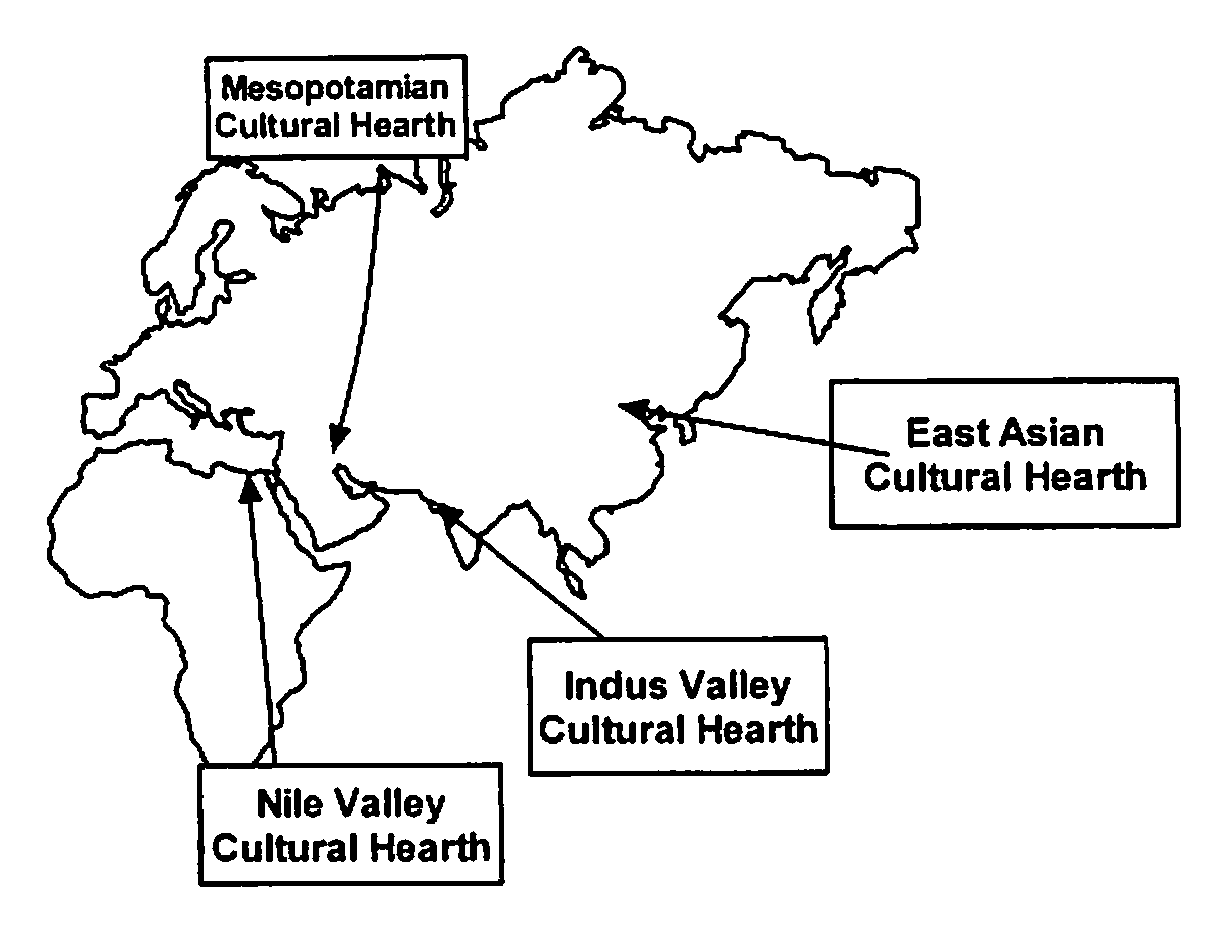
53.

The geographical locations of all four cultural hearths illustrate on the map (right) were in

a)

Areas with abundant rainfall

b)

Coastal areas

c)

Cold climates

d)

River valleys

54.
Folk culture is most likely to spread by _____.  
a)
contagious diffusion 
b)
relocation diffusion 
c)
hierarchical diffusion 
d)
stimulus diffusion 
55.
Buddhism originated in 
a)
Greece
b)
Nepal
c)
China
d)
Korea
56.
Animism is the belief that objects
a)
are to be used
b)
have a spirit
c)
have nothing to do with religion
d)
have power
57.
There are fundamentalists in all religions
a)
True
b)
False
58.
If I want to know if it is going to be a cold winter, and I throw rocks to find out, that is
a)
Fundamentalism
b)
Animism
c)
Geomancy
d)
Fate
59.
Cultural diffusion describes
a)
how culture is used
b)
how culture affects peoples
c)
how culture spreads
d)
how culture develops
60.
Relocation diffusion often occurs when a people
a)
a relative moves
b)
shop at the same name brand store in different cities
c)
bring their cultural traditions with them 
d)
change the dialect of their language