wayground logo

Free Printable Worksheets

Font size

S
M
L
XL
Worksheets

Benchmark Q1

Total questions: 27

Worksheet time: 29mins

Name
Class
Date
1.

Which of the following is true for both bacteria and viruses?

a)

both contain genetic material

b)

can be killed using antibiotics

c)

have a cell membrane

d)

have a protein coat

2.

Which statement is true about viruses?

a)

Viruses can eat and metabolize food.

b)

Viruses can reproduce only using a host cell.

c)

Viruses can reproduce on their own at any time.

d)

Viruses contain DNA, so they are alive.

3.

One important way to control the spread of viruses in through

a)

the use of vaccines

b)

drinking a lot of tea

c)

the use of other types of bacteria

d)

the use of antibiotics

4.

A bacterium reproduces asexually by dividing to form two new bacterial cells. What is the name of the process by which bacteria reproduce?

a)

meiosis

b)

mitosis

c)

budding

d)

binary fission

5.

Which of the following is a risk of overusing antibiotics to treat infections>

a)

Bacteria may become resistant to antibiotics.

b)

Antibiotics increase the rate of infection.

c)

Antibiotics cause other diseases to develop.

d)

Antibiotics only work once.

6.

Which of the following is a viral infection?

a)

cholera

b)

influenza

c)

strep throat

d)

tuberculosis

7.

Can a virus be cured with antibiotics?

a)

yes

b)

no

8.
Bacteria are
a)
single-celled organisms
b)
small plants
c)
a type of virus
d)
small animals
9.
Bacteria reproduce when each cell divides into
a)
2 identical cells
b)
2 different cells
c)
5 identical cells
d)
5 different cells
10.
Which is smaller?
a)
bacteria
b)
virus
11.

If we started with one bacteria, how long would it take us to have 8 bacteria?

a)

6 hours

b)

1 hour

c)

20 minutes

d)

8 hours

12.
When penicillin was first introduced, it was very effective in destroying most of the bacteria that cause gonorrhea. Today, certain varieties of this bacterium are resistant to penicillin. Which statement best explains the appearance of these resistant varieties?
a)
Penicillin stimulated the bacteria to become resistant, and this resistance was passed to the offspring.
b)
Penicillin killed the susceptible bacteria, while naturally resistant varieties survived and reproduced.
c)
Penicillin used today is not as strong as the penicillin used when it was first introduced.
d)
Penicillin stimulated the production of antigens in the resistant bacteria.
13.
Mutations are important because they bring about
a)
death of the organism in which they develop
b)
genetic variation needed for a population to evolve
c)
benefits for the individual, not for the population
d)
Hardey-Weinberg equilibrium within a population
14.

What is the term for a feature that allows an organism to survive better in its environemtn?

a)

variation

b)

adaptation

c)

homologous structure

d)

vestigial structure

15.
Natural selection results in change over time by acting on traits that are
a)
heritable
b)
new
c)
mutated 
d)
better than the best
16.
The gradual change in species over time is...
a)
Evolution
b)
Nucleotide 
c)
Adaptation
d)
Natural Selection
17.
What is another name for natural selection?
a)
survival of the smartest
b)
survival of the fastest
c)
survival of the biggest
d)
survival of the fittest
18.

Adaptations are:

a)

physical or behavioral tendencies.

b)

physical or behavioral characteristics that help an organisms survive and reproduce.

c)

physical or behavioral characteristics that do not help the organism in any way.

d)

genetic mutations that have gone wrong.

19.

If Easter eggs were living species of organisms, their different colors would be considered:

a)

Adaptations

b)

Variations

c)

Different species

d)

Extinct species

20.

Where are hereditary traits stored in all organisms?

a)

In the blood

b)

In the brain

c)

In the DNA

d)

In the heart

21.
Only populations can evolve.
Individuals can not evolve.
a)
True
b)
False
22.
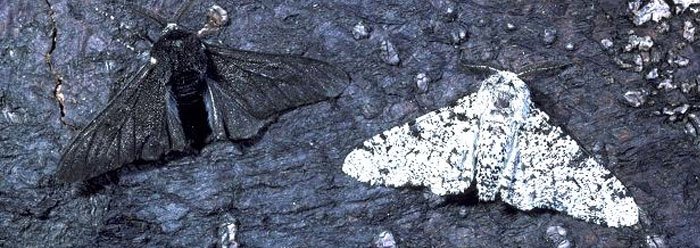
The trees these moths used to live on were white, but have been covered in soot from coal factories. Which moth will be more successful in this environment?
a)
Dark moth
b)
Light moth
c)
Both will be equally successful
d)
Neither will be successful
23.

How do you "win" at natural selection?

a)

survive

b)

go extinct

c)

survive & reproduce

24.
If an organism can't adapt fast enough, this might happen.
a)
hibernate
b)
stay the same
c)
live longer
d)
become extinct
25.
What can happen to a species over time if some of the organisms have an advantage?
a)
The population will decrease
b)
The population will become extinct
c)
The population will slowly increase
26.
Which of these is an example of natural selection?
a)
The largest animal in a population will have more opportunities for reproduction.
b)
Several species of organisms work together so that they all succeed.
c)
One species takes all the resources in an environment leaving none for others.
d)
Organism that are best suited to an environment tend to survive and reproduce more often.
27.
The theory of evolution by natural selection means that what is changing over time?
a)
The inherited traits of a population.
b)
The acquired traits of a population.
c)
Hair color and eye color
d)
Attractive features.