
 Worksheets
Cells quiz!
Total questions: 22
Worksheet time: 18mins
What is the MAIN function of a cell membrane?
Storage of water
Storage of energy
Make proteins
Breakdown of materials
Regulates what enters or exits a cell
Which of the following is NOT a reason cells have to be a certain size?
communication between cell parts breaks down if a cell is too large
the cost to move materials becomes to costly if a cell is too large
the cell may burst if a cell is too large
a cell cannot reproduce if a cell is too large
Which of the following kingdoms are prokaryotic?
animals
plants
protists
bacteria
fungi
Prokaryotic organisms have a nucleus and specialized organelles
True
False
Which of the following is true of Facilitated diffusion?
Uses energy
is used to move large molecules through a protein channel
moves from low to high concentration
used to move very small molecules from high to low concentration
A student using a microscope observes a cell and notices it has a nucleus, mitochondria, chloroplast, and a cell wall made of cellulose. This cell would most likely be:
A plant cell
An animal cell
A bacteria
A fungus cell
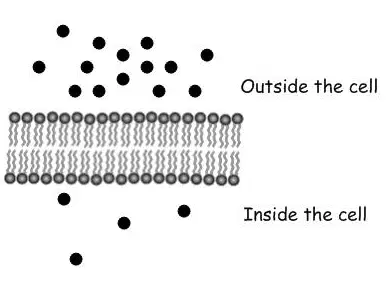
In the diagram the dots represent small, uncharged carbon dioxide particles. Predict the motion of the molecules
will move into the cell via active transport
will move into the cell via osmosis
will move into the cell via simple diffusion
will move out of the cell via facilitated diffusion

What process is being used to move materials across the membrane into the cell?
osmosis
None of the above
exocytosis
facilitated diffusion
active transport
Site of protein production in the cell. Found in all types of cells
Chloroplast
peroxisome
lysosome
Mitochondria
Ribosome
Works with the ribosomes to modify proteins. Acts like a "highway system" to transport materials
Endoplasmic reticulum
Lysosome
Nucleus
Cytoskeleton
This organelle site of cellular respiration(makes energy) for a cell.
nucleolus
ribosome
centrioles
chloroplast
mitochondria
This organelle acts like “support beams” to maintain shape and structure in animal cells.
ribosome
nucleus
cytoskeleton
choroplast
nucleolus
Which of the following explains why drinking high sugar drinks can be dangerous before being active in high temperatures?
creates a hypotonic environment in the blood which dehydrates cells
creates a hypertonic environment in the blood which dehydrates cells
creates a hypotonic environment in the blood which causes cells to burst
creates a hypertonic environment in the blood which causes cells to burst
Which of the following is a way that active transport and diffusion are different?
active transport moves small molecules, diffusion moves large molecules
active transport moves water high to low, diffusion moves everything else
active transport uses energy, diffusion does not
active transport only moves things out of the cell, diffusion moves things both ways
The vacuole of a plant cell stores water and maintains turgor pressure in a cell
True
False
Since all cells need a source of energy, all cells must have mitochondria
True
False
The Golgi contains digestive enzymes to break down old cell parts and pathogens.
True
False
Bacteria, Fungi, and Protists are the only kingdoms with unicellular organisms
True
False
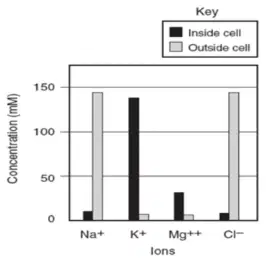
What process would be used to move Na+ INTO the cell?
Osmosis
Active Transport
Simple diffusion
Plasmolysis
Plants make their own sugar in _________ and then break down the glucose sugar into ATP energy via cellular respiration in the __________
chloroplast; vacuole
chloroplast; mitochondria
mitochondria; chloroplast
mitochondria; ribosome
Which of the following organelles is found in ALL kingdoms of life?
nucleus
chloroplast
ribosomes
Endoplasmic reticulum (ER)
When measuring the amount of a solute, the following terms are used: Identify the correct word parts to their meanings, Isotonic = _________, Hypotonic = _________,
and Hypertonic = _________
same; more; less
more; less; same
less; more; same
same; less; more

